


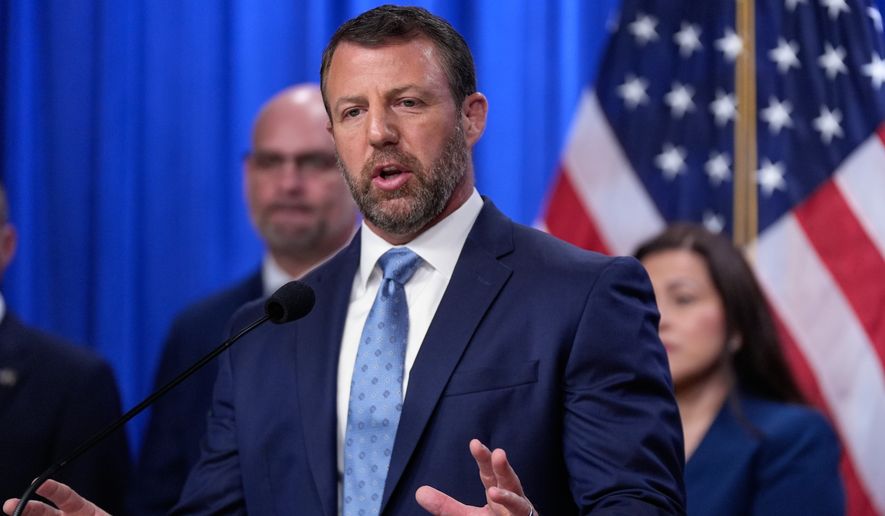

Homeland Security Secretary Markwayne Mullin said Sunday the lapse of a key surveillance tool that enables the government to collect foreign intelligence has made it more difficult to keep Americans safe ahead of several high-profile events, including the World Cup and America’s 250th celebrations.
The spy authority, known as Section 702 of the Foreign Intelligence Surveillance Act, lapsed at 12 a.m. Sunday after Democrats refused to extend it in opposition to President Trump’s pick to oversee the nation’s intelligence agency.
Mr. Mullin said Section 702 has expired at a time when America’s threat level is “the highest it’s ever been,” putting the nation at risk.
“There’s ways we can get to what we need to do, but it makes it significantly more difficult,” Mr. Mullin told “Fox News Sunday.” “We can cut through a lot of the bureaucracy with 702 and go after the terrorists that are trying to attack us every single day. It’s not impossible; it’s just, instead of something that we can get done in maybe hours, this may take days.”
Mr. Mulin added that Homeland Security is still getting back up to speed after Democrats defunded it in protest of the Trump administration’s aggressive immigration crackdown. President Trump later restored the funding in April, ending the longest agency shutdown in U.S. history.
“You have Freedom 250 with all the activity that’s going on, tremendous amount of local partnership that has to take place and not all have the resources,” Mr. Mullin said. “So what the Democrats did by defunding us was to make the burden on local law enforcement to start carrying that load.”
“Now we’re able to refund them and we’re trying to get the money out as fast as possible, but it did make it significantly more difficult,” he continued.
Democrats have opposed extending Section 702 since Mr. Trump announced that he selected Bill Pulte, the head of the Federal Housing and Finance Agency, to temporarily serve as director of national intelligence. In addition to his lack of national security experience, Democrats contend that the nominee targeted some of Mr. Trump’s political foes on allegations of mortgage fraud.
Mr. Trump on Friday announced that he would nominate Jay Clayton, the U.S. attorney for Manhattan, for the position, backing away from Mr. Pulte. However, Mr. Pulte is still slated to serve as acting director on June 19 until Mr. Clayton can be confirmed. However, Democrats said they don’t want to give Mr. Pulte any access to 702.
Sen. Jack Reed of Rhode Island, the highest-ranking Democrat of the Senate Armed Services Committee, said Mr. Clayton may face some difficulty winning approval.
“We have to look very clearly at Jay Clayton. He’s a very accomplished lawyer but the statute requires someone taking this job to have significant national security experience,” Mr. Reed told “Fox News Sunday.” “I don’t think he does.”
“He is a very sophisticated securities lawyer, business lawyer; he’s in the Southern District of New York, which is a very challenging post, but it’s not all about national security,” Mr. Reed continued. “In fact, I think it’s a lot more about securities laws, mergers, acquisitions, criminal laws etc. We’re looking for someone who can step in as they have done in the past and have an immediate sense of the situation overseas, understanding the different cultures of these intelligence agencies and that’s not the case here.”
Section 702, which was authorized in 2008, allows the government to monitor the electronic communications of foreigners abroad without a warrant. Lawmakers have said about 60% of the president’s daily intelligence briefing is derived from information collected under the law and it is considered a tool critically important to national security.
However, civil liberties groups have warned for years that Americans’ data have been incidentally swept up in that collection. Some Republicans have demanded reforms to the statute.
Mr. Trump said Thursday he is considering drafting an executive order restoring Section 702’s powers, but a White House official told The Washington Times such an order would leave gaps because it wouldn’t have the power to compel telecommunications companies to turn over data.
An executive order can’t compel private companies to cooperate with law enforcement like a federal statute such as Section 702 and could result in telecom companies suing to avoid any liability for sharing information.
“An executive order cannot address the intelligence gaps that a lapse would potentially create and cannot grant the government authority to issue new certifications,” the official said.

Please read our comment policy before commenting.