



OPINION:
President Trump has done what he can using the power of the presidency to deliver admirably on his promise to stop America’s scourge of illegal immigration.
Executive power gave Mr. Trump the legitimate constitutional authority to secure the border, to focus governmental resources on enforcing existing laws and to reduce illegal immigration in both his first and current terms. Americans are safer than they have been in years.
Yet the longevity of presidential actions, unlike permanent congressional legislation, can be fleeting, particularly in the highly partisan realm of immigration.
After all, upon taking office, President Biden used his executive authority, in addition to ultra vires edicts, to dismantle immediately what Mr. Trump had put into place. President Obama relied on his “pen and phone” — most would say abusing the authority of both — to make sweeping changes.
Future Democratic presidents may do likewise, especially given that executive power has expanded for decades. Thus, it has become common for each subsequent administration to try to reverse the actions of its predecessors.
Such whipsawing of the immigration issue by successive administrations is likely to worsen as our nation’s political divide widens. Party differences are dangerously pronounced, antithetical and seemingly irreconcilable, and it is clear the leadership of the left has all but declared that policy debate is over.
Mass immigration is now the deeply entrenched core component of the progressives’ ideological identity, and they will not compromise on it.
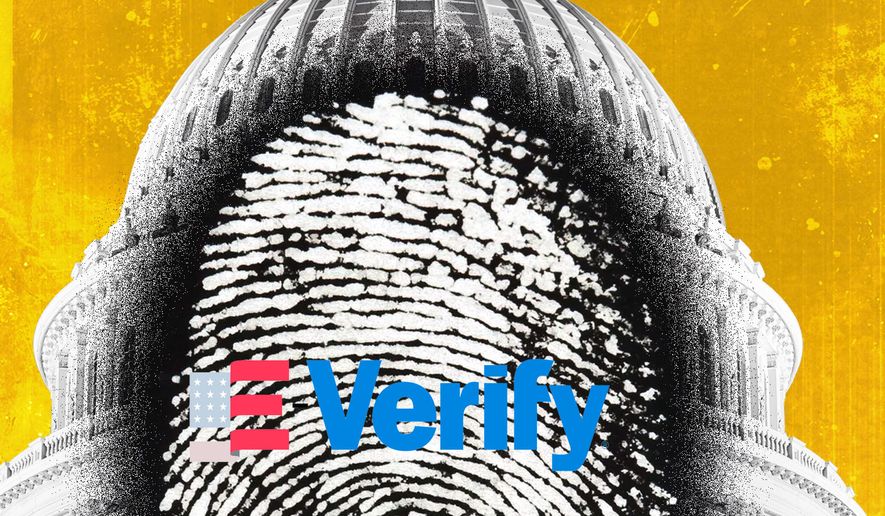
This radicalization does not bode well for the durability of Mr. Trump’s actions over time, which is why Congress must now enact nationwide, mandatory E-Verify.
A sweeping E-Verify bill would put into place a permanent and effective mechanism designed to stop illegal aliens from getting jobs. It would dry up the magnet that incentivizes most illegal crossings. Doing so would assure Americans that some of Mr. Trump’s legacy efforts to solve the nation’s most pressing problem might carry forward, transcending the whims of future chief executives dead-set on scrapping the rule of law and fueling mass immigration.
E-Verify is the meat and potatoes of worksite verification and the best tool to ensure that the 1986 law prohibiting employers from hiring illegal aliens is enforced, thus saving jobs for Americans.
Authorized by the Illegal Immigration Reform and Immigrant Responsibility Act of 1996, E-Verify is a web-based system through which employers electronically confirm the employment eligibility of their employees. The Social Security numbers or alien identification numbers of new hires are checked against government records to weed out fraudulent numbers and ensure they are legally authorized to work.
Businesses like E-Verify (nearly 1.4 million U.S. employers already use it) because it is fast, simple and free, and it means employers no longer need to be document experts. When a business uses E-Verify, the liability for determining an employee’s legal status is on the government, not the employer.
If a mistake is made, the employer is off the hook — provided the employer was using E-Verify.
In the absence of national legislation, E-Verify exists now as a patchwork. Some states have made it mandatory, but exceptions are commonly extended to small employers, representing an egregious loophole because “mom and pop” contracting firms are where most illegal aliens gravitate first for work.
Past congressional efforts to pass mandatory E-Verify for all employers nationwide have sputtered because Democrats have used it as a bargaining chip. “We’ll consider approving E-Verify if you give us mass amnesty.”
Efforts continue, however. Most recently, Sen. Katie Britt, Alabama Republican, introduced the Mandatory E-Verify Act of 2026, which would permanently reauthorize the government’s E-Verify program and mandate its use by all employers in the U.S.
As Mr. Biden demonstrated when he gutted most of Mr. Trump’s first-term policies, securing America’s border and enforcing our nation’s immigration laws is subject to a perennial one-step-forward, one-step-back phenomenon with each new administration.
Congressional legislation, such as Ms. Britt’s bill, can buffer that consequence. Although legislation can, in theory, be reversed in the future, it often is not. Codification and the enactment of laws have a lasting effect that outlives executive actions.
It is time for Congress to act. Regardless of how future rogue presidents may choose to use or abuse their executive authority to advance mass immigration agendas, sweeping E-Verify legislation, with no capitulating quid pro quo for amnesty, would ensure that illegal aliens would not be rewarded with jobs if they get here.
• Matt O’Brien is the deputy executive director at the Federation for American Immigration Reform. He has 30 years of experience in immigration law and policy. Immediately before joining FAIR, he was the assistant chief immigration judge overseeing the U.S. Immigration Court at Annandale, Virginia.

Please read our comment policy before commenting.