


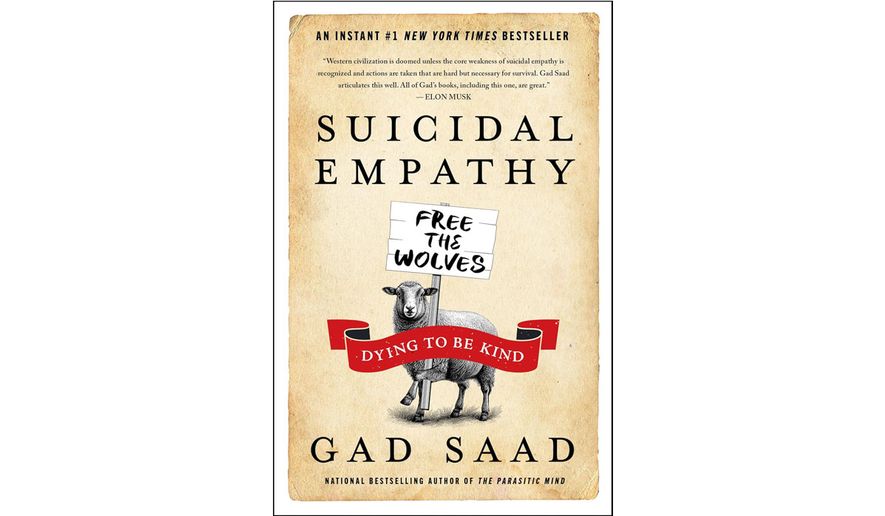

OPINION:
“It is never a good idea to ignore the warning signs of reality.”
So ends “A Good Virtue Gone Bad,” Chapter 1 of “Suicidal Empathy: Dying To Be Kind,” by Gad Saad, an evolutionary behavioral scientist, who also observes that suicidal empathy is “the proactive will to be victimized for a supposed higher noble goal.”
Dozens of examples are coupled with brutally objective analysis throughout the gripping chapters of “Suicidal Empathy.”
With respect to “Forbidden Knowledge” in Chapter 2, he writes: “Reality does not abide by your feelings. Knowledge is either true or false, irrespective of your level of offense.”
If facts or opinions are offensive, then perhaps serious debate, not censorship or mislabeling statements as “misinformation” or “disinformation,” is in order.
Chapter 3 addresses the “Cultural Theory of Mind.” Mr. Saad rightly asserts that all cultures are not equal.
“Should the West tolerate child brides, honor killings, and female genital mutilations?” he writes. “Should we be empathetic to the barbarism of other cultures? The West has apparently responded with a resounding yes! Suicidal empathy requires orgiastic tolerance.”
In Chapter 4, “Blank Slate Felons,” Mr. Saad further identifies suicidal empathy as seeking to “reflexively mitigate the actions of violent criminals by proposing external ‘root’ causes. It is society’s fault. It is systemic racism. It is an impoverished childhood. It is an abusive parent. From this perspective, criminals are ‘blank slate felons.’ Suicidal empathy requires the removal of a criminal’s personal agency.”
Not surprisingly, many criminals “utilize our broken moral compass to commit crimes unencumbered by the concern that there might be severe consequences for their acts,” Mr. Saad writes.
Chapter 5 covers “Settled Science, Taboo Trade-Offs,” where the “settled science” surrounding onerous and largely unchallengeable COVID-19 policies, climate change hype and transgender hysteria versus biological reality is adeptly addressed.
I have enjoyed decades of work in atmospheric science, a field with a strong quantitative foundation. Such science has mostly survived the influence of feelings and politics — except for frightening climate prognostications that, predictably, seem to fail.
Perhaps more concerning is the encroachment of diversity, equity and inclusion nonsense. In Chapter 6 regarding “Selling Indulgences,” Mr. Saad takes a deep dive into DEI (which the author reorders and refers to as DIE). He notes: “A mathematical proof is either correct, or it is not. A computer program either has a bug in it, or it does not.”
Regardless, “we used to aspire to put physicians and surgeons through a rigorous objective training, given that they hold our lives in their hands. But as we all now know, meritocracy and scientific knowledge are tantamount to white supremacy.”
Furthermore, “aviation is another industry that one would hope is strictly rooted in an ethos of meritocracy. But this is precisely what an ableist bigot would say.”
Thus, even medicine and aviation have moved toward elevating and implementing DEI requirements. (To which I scribbled, “Yikes!” in my marginal remarks while reading the book.)
“Govern Me Harder, Daddy!” (Chapter 7) observes, “To the extent that communism purports to create utopian equality for all, it makes sense that the more empathetic you are, the more you are likely to support this failed ideology. Interpersonal empathy is positively correlated with one’s score on a governmental intervention scale.”
In this chapter and elsewhere, Mr. Saad employs “Unicornia” to identify “the land of mythical egalitarianism”: “While it is often argued that the welfare state is a generous entity, there is nothing generous about exhibiting largesse with other people’s hard-earned money. … Despite its failure in every society in which it has been tried, the socialism phoenix rises from the ashes of devastation fueled by the allure of empathetic fairness.”
Thankfully, the final chapter prescribes “Inoculation Against Suicidal Empathy.” “The West’s capacity to reason has indeed taken a long-unwelcomed nap, but [Mr. Saad hopes] that [his] book, along with [his previous book,] ’The Parasitic Mind,’ will awaken people from their stupor.”
Among other welcome pieces of advice, Mr. Saad recommends choosing targets of empathy wisely.
Numerous instances of dangerously misplaced compassion are documented in “Suicidal Empathy.” As the saying goes, “No good deed goes unpunished.”
That axiom is more appropriate for an ill-advised good deed. Eventually, savage reality catches up with the naive do-gooder, and the consequences for them and others they wish to help or control can be quite catastrophic.
• Anthony J. Sadar is an adjunct associate professor of science at Geneva College in Beaver Falls, Pennsylvania, and co-author of “Environmental Risk Communication: Principles and Practices for Industry “(CRC Press).
• • •
Suicidal Empathy: Dying To Be Kind
Gad Saad
Broadside Books, $32.99, 255 pages

Please read our comment policy before commenting.