


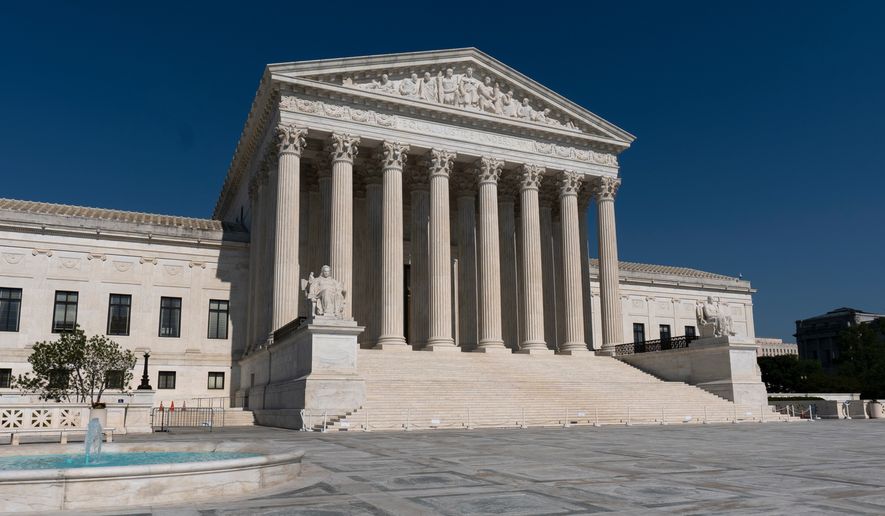

The Supreme Court ruled Thursday in favor of an occasional marijuana user, saying the government went too far in prosecuting him as a habitual drug addict who faces a lifetime ban on possessing a gun.
The unanimous ruling said as much about relaxing attitudes toward marijuana as it did about gun rights, with the justices comparing modern pot use to the use of alcohol at the nation’s founding.
Justices across the ideological spectrum said it was a stretch for prosecutors to argue that someone who used marijuana a few times a week and kept a firearm at home ostensibly for personal defense was enough of a danger to the community to justify a potential 15-year prison sentence.
That doesn’t mean, said Justice Neil M. Gorsuch, who wrote the key opinion, that the government can’t ever prosecute a marijuana user or someone who uses other illegal drugs for possessing a gun.
But it does require more than simply connecting a gun to an occasional drug user, he said.
“We appreciate that drugs and guns can sometimes make for a dangerous mix,” Justice Gorsuch wrote. “But, even taking all that into account, the government cannot carry the burden it has set for itself.”
The ruling could upend some past cases of others convicted of gun possession by illegal drug users.
Indeed, the same section of law was used against Hunter Biden, son of the former president. His father pardoned him.
The case is the latest to test the limits of Second Amendment rights in the wake of the 2022 Bruen decision, which established gun rights as fundamental and said any laws restricting those rights must have been the sort that would have been countenanced by the nation’s founders.
Federal prosecutors tried to draw an analogy between marijuana use today and habitual drunkards of the founding era, pointing to some state laws that did target them as public dangers.
Justice Gorsuch, though, said those founding-era laws had a much higher standard, requiring someone to be so drunk as to be mentally incompetent or unable to function. And the bar was set high.
Indeed, he pointed to founders such as George Washington, who took three glasses of Madeira wine with his dinner, and John Adams, who drank a tankard of cider with his breakfast. None of that was considered dangerous.
Occasional users of marijuana also don’t fit that category, the court ruled.
“The problem in this case is simply that the historical evidence the government presents does not support the categorical restriction it urges,” Justice Gorsuch wrote.
The case involved Ali Hemani, an American-born dual citizen of the U.S. and Pakistan who lives in Texas.
Federal authorities searched his home as part of an investigation into what the court termed “terrorism-related activities.” Agents found Mr. Hemani’s marijuana and a gun, as well as some cocaine.
Mr. Hemani said his mother had hidden the cocaine and he wasn’t a current user of it, though he did admit to using marijuana “about every other day.”
Prosecutors felt that was enough to charge him under Section 922(g)(3) of the Gun Control Act, which bars anyone who is “addicted to” or an “unlawful user of” a “controlled substance.”
Justice Samuel A. Alito Jr. wrote his own opinion to stress the changing attitudes toward marijuana.
“In these circumstances, marijuana use today is like alcohol use at the founding. It is widespread and increasingly considered socially acceptable in many quarters. And from a practical standpoint, law enforcement widely tolerates the use of marijuana,” the George W. Bush appointee wrote.
The case forged common ground from conservatives and liberals, plus from groups on all sides of the gun debate.
The American Civil Liberties Union, for example, which vehemently objected to the Bruen decision, saw Thursday’s ruling as a victory for leveling the playing field.
“With nearly half of Americans reporting marijuana use at some point in their lives, this ruling protects the rights of millions and curbs the government’s ability to impose arbitrary and discriminatory penalties,” said Cecillia Wang, the ACLU’s legal director.
The Second Amendment Foundation also hailed the ruling.
“The court rightly held today that the proper understanding of the Second Amendment only provides for disarming those who are actually dangerous,” said Alan M. Gottlieb, executive vice president of the foundation.
The Bruen decision struck down state laws limiting the issuance of concealed-carry permits to lawful gun owners. The court created its historical analogy test for gun laws to survive constitutional scrutiny.
That decision has spurred a renewed look at laws governing what sorts of guns can be restricted, what sorts of locations can be placed off limits and who can be denied Second Amendment rights.
In the Rahimi decision in 2024, the high court ruled that someone facing a domestic violence restraining order was dangerous enough to lose the right to possess a gun.
Cases testing bans on drug users, nonviolent felons and unauthorized immigrants are also winding their way through the courts.
Justice Ketanji Brown Jackson, who agreed with Thursday’s decision, wrote her own opinion saying the Bruen framework is “unworkable.”
“It imposes on judges the unfamiliar and difficult tasks of sifting through centuries-old evidence to answer ’Contested historical questions’ and ’applying the answers to resolve contemporary problems,’” she wrote in an opinion joined by Justice Sonia Sotomayor.
Roughly 6,500 people were sentenced in 2021 for being prohibited from possessing guns, according to U.S. Sentencing Commission data.
The vast majority — 79% — had felony records, but the second-highest category was for drug users, with about 350 cases that year. Unauthorized immigrants were third-most prevalent, with about 190 cases.
Contact the author



Please read our comment policy before commenting.