


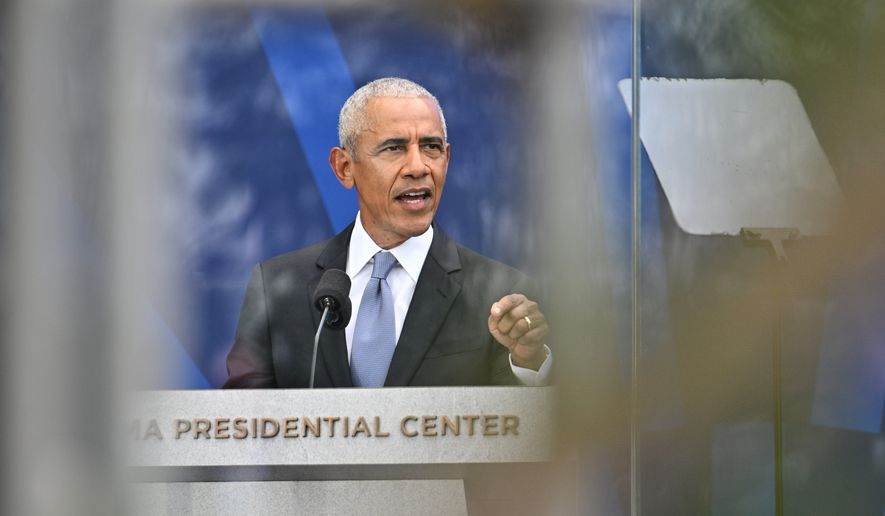

The Obama Presidential Center opened its doors to the public in Chicago’s Jackson Park on Thursday, drawing thousands of visitors to the 19-acre South Side campus, even as critics renewed complaints about its photo-ID requirement for free admission and mounting taxpayer-funded infrastructure costs tied to the $850 million project.
The dedication ceremony, held Wednesday on the eve of opening day, drew former Presidents Bill Clinton, George W. Bush and Joe Biden, along with performances by Bruce Springsteen, Stevie Wonder, Bono and the Edge of U2, and John Legend. Former President Barack Obama grew visibly emotional during former first lady Michelle Obama’s remarks, wiping away tears as she praised his character and presidential record. Later in his own remarks, Mr. Obama quipped, “She did me wrong — she wouldn’t let me see her speech.” President Trump was not invited to participate in the ceremony.
The 19.3-acre campus at 6001 S. Stony Island Ave. houses a four-level museum with digital exhibits on key moments of the Obama presidency, a replica Oval Office, a Sky Room, an NBA regulation-size basketball court, a branch of the Chicago Public Library, gardens and plazas, and other community spaces. Most of the outdoor campus is free and open to the public; museum entry requires a timed ticket.
Museum tickets are priced at $30 for adults and $23 for children ages 3 to 11, with discounted rates of $26 and $15, respectively, for Illinois residents. Illinois residents are also eligible for free admission every Tuesday — but must present a valid photo ID, Illinois driver’s license, state ID, or city-issued ID to verify residency. Children 2 and under enter free.
That ID requirement has drawn pointed criticism from conservative commentators who argue it contradicts years of Democratic opposition to voter identification laws.
“The Obama Presidential Library is making people show an ID for proof of Illinois residency to get in for free,” one social media user wrote. “So residents have to prove who they are for this, but not to vote?”
Republicans, including Kayleigh McEnany and Rep. Brandon Gill, publicly highlighted the issue online, arguing the policy exposed a contradiction between Democratic opposition to voter identification requirements at polling places and support for ID verification at cultural institutions. Critics also noted that the Foundation’s grand opening sweepstakes rules explicitly limited entry to U.S. citizens and lawful permanent residents.
Beyond the ID controversy, the center has faced sustained scrutiny over its public funding footprint. While Mr. Obama described the project as a “gift” to Chicago and the Obama Foundation says the campus was built with $850 million in private donations, surrounding infrastructure costs have been borne substantially by taxpayers.
The Chicago Department of Transportation has spent $123.3 million since 2022 on capital projects to remake roadways and green space in and around Jackson Park, with final city infrastructure costs expected to approach $200 million. The Illinois Department of Transportation has separately acknowledged approximately $229 million in state-managed infrastructure spending tied to the project, up from an earlier estimate of roughly $174 million — meaning combined public expenditures have crossed $350 million, with no single agency producing a consolidated total.
Illinois Republican Party Chair Kathy Salvi called the situation a product of mismanagement, saying taxpayers are being left “on the hook for hundreds of millions of dollars” while accusing state leaders of corruption and pay-to-play dealings.
The Obama Foundation has defended the project, saying the center will serve as an economic catalyst for Chicago’s South Side, generating jobs, community programs and public amenities for a neighborhood that has long been underinvested.
Museum tickets for the opening weekend sold out in advance.
This article was constructed with the assistance of artificial intelligence and published by a member of The Washington Times' AI News Desk team. The contents of this report are based solely on The Washington Times' original reporting, wire services, and/or other sources cited within the report. For more information, please read our AI policy or contact Steve Fink, Director of Artificial Intelligence, at sfink@washingtontimes.com
The Washington Times AI Ethics Newsroom Committee can be reached at aispotlight@washingtontimes.com.

Please read our comment policy before commenting.