


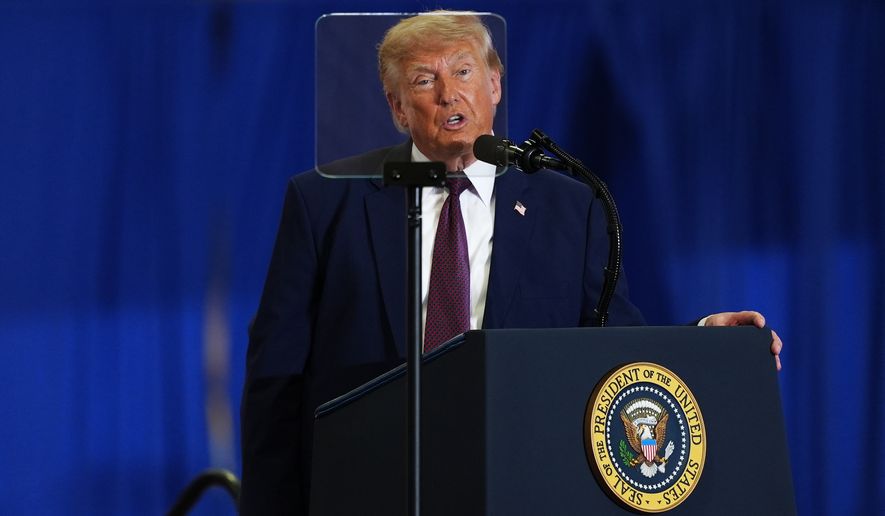

Senate Republicans hope their Wednesday meeting with President Trump will resolve intraparty fissures over the SAVE America Act and other issues several say are distracting from more important preelection priorities.
It will also serve as an opportunity for GOP senators to ask the president questions about ongoing peace negotiations with Iran, his decision to delay confirmation of a permanent director of national intelligence and other issues on which they’ve disagreed in recent months.
“I think the big issues right now [are], the Democrats want to shut down the government October 1; what’s our plan? The voters still want the SAVE America Act; what’s our plan? And I think Iran,” said Sen. Rick Scott, Florida Republican.
Mr. Scott chairs the Senate Republican Steering Committee, which hosts weekly Wednesday lunches for the GOP conference and invites guest speakers to address a range of issues. He was speaking with Mr. Trump on Friday and decided the president would be a “good invite” for this week’s lunch.

The confab comes as Mr. Trump and Senate Republicans have clashed on a number of issues in recent months.
GOP senators blocked taxpayer funding for securing the new White House ballroom and forced the Justice Department to abandon the president’s $1.8 billion anti-weaponization fund.
Mr. Trump, in turn, directed Jay Clayton, his nominee to lead the intelligence community, not to testify at his scheduled confirmation hearing last week so the president could give his unpopular, appointed acting director, William J. Pulte, time to clean house at the Office of the Director of National Intelligence.
In delaying Mr. Clayton’s confirmation, Mr. Trump is holding up the action Democrats say they need to agree to renew a key spy tool that expired earlier this month.
The president is refusing to sign a reauthorization of Section 702 of the Foreign Intelligence Surveillance Act, which allows spying on foreign targets’ communications without a warrant, unless the Senate passes his long-stalled election integrity bill, the SAVE America Act.
Mr. Trump said he intends to make that a focus of Wednesday’s meeting.
“We have to be able to get proof of citizenship when you vote, otherwise we don’t have elections. We have to be able to get voter ID,” he said.
Senate GOP leaders and many in the rank-and-file would rather prioritize economic and safety issues that are top of mind for voters heading into the November midterms.
“There are things that I believe will create a record of accomplishment that our candidates can run on, and that will enable us to take an argument to the American people that will persuade them that they want to keep [GOP] majorities here in Congress,” said Senate Majority Leader John Thune, South Dakota Republican.
He said Mr. Trump and the GOP should focus their energy in the remaining four-and-a-half months before the election on issues that unite the party and can appeal to independent and Democratic crossover voters: keeping the country safe, putting more money into Americans’ pockets and giving them better opportunities for economic mobility.
“The key here is we’ve just got to be tight on execution between now and November. We don’t have a lot of room. We’re dealing with historical headwinds,” said Sen. Thom Tillis, North Carolina Republican.
Mr. Tillis is retiring, but the Republican running for his seat, former national party chair Michael Whatley, is trailing the Democratic candidate, former Gov. Roy Cooper, by 14 points in a new poll released Tuesday.
Ohio GOP Sen. Jon Husted, who is running for reelection in a state Democrats are targeting and also trailing in recent polls, said he wants to discuss with the president how Republicans can message measures they’ve passed to help the American people with economic struggles.
That includes last year’s working families tax-cut law and legislation the Senate passed Monday to lower the cost of housing.
As for the SAVE America Act, Mr. Husted noted that he has voted to advance it all six times it has come up in various iterations in the Senate this year, but that the voting and other protections it would implement already exist in his state.
“We have photo ID, proof of citizenship, a ban on boys playing girl sports in Ohio,” he said. “Those are issues that are, you know, more for other states than my state.”
Mr. Thune has had several “direct” conversations with Mr. Trump about the Senate not having a realistic path to passing the SAVE America Act and is hoping other GOP senators will help reinforce that message during Wednesday’s meeting.
“There are not the votes to nuke the filibuster, and there aren’t going to be 10 Democrat votes to all of a sudden support the SAVE America Act,” he said. “Those are just hard realities, and I think people at some point have to come to grips with that.”
The president is not prepared to accept that as an answer, saying it is the Senate leader’s job to convince holdouts to accept the majority party’s position.
“John is a leader and hopefully he can get the votes,” Mr. Trump said.
Mr. Trump will have backing for his position in the meeting from Sen. Mike Lee, the Utah Republican who authored the SAVE American Act.
“Those of us advocating for the SAVE America Act can’t be brushed aside as ‘ignoring the hard realities,’” Mr. Lee wrote on X. “This is about doing whatever it takes to try to pass a necessary reform, even when the outcome is uncertain and the path is difficult.”
He has argued that the Senate should use its talking filibuster rule to wear out Democrats during floor debate and force a simple-majority vote.
Mr. Thune said the talking filibuster has “never worked before” to pass legislation at a simple majority, as getting to that point requires majority party discipline to defeat any number of politically toxic votes the minority can wedge into the open process.
Mr. Tillis was even more blunt, dismissing Mr. Lee’s talking filibuster push as “goofy stuff” motivated by “naivete or a desire to get more likes on a social media post, maybe both.”
Contact the author


Please read our comment policy before commenting.