



A version of this story appeared in the daily Threat Status newsletter from The Washington Times. Click here to receive Threat Status delivered directly to your inbox each weekday.
OPINION:
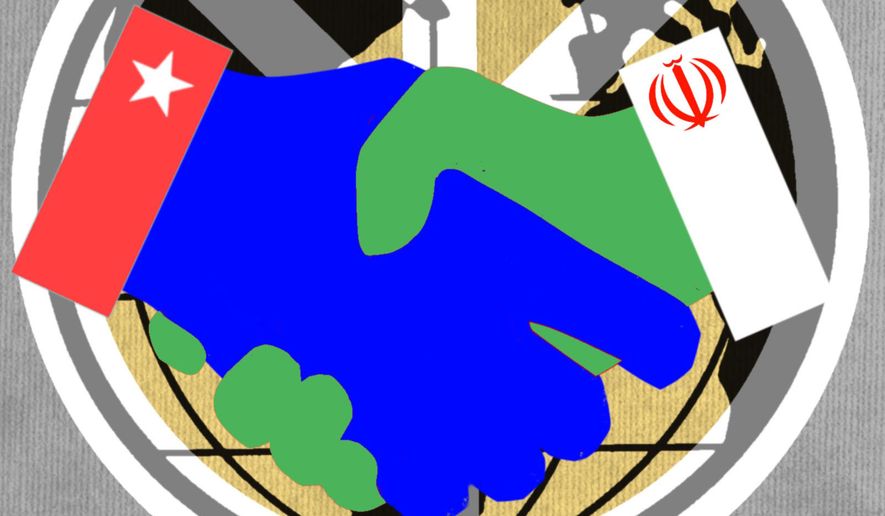
The Trump administration’s deal with Iran accomplishes the objectives set by the president at the outset of Operation Epic Fury, and it represents the culmination of his continuous strategic policy focus to prevent Tehran from acquiring nuclear weapons.
Most important, though, it begins the process of reorienting American grand strategy away from the Middle Eastern conflicts that have characterized the first quarter of the 21st century and toward the great power rivalries that will likely define the next.
Essentially, President Trump was obliged to use decisive military force against Iran to disengage from a region of peripheral concern to long-term U.S. interests.
Since announcing his first campaign for president in 2015, Mr. Trump has been unequivocal that Iran cannot acquire a nuclear weapon.
In 2018, he withdrew from the fatally flawed Joint Comprehensive Plan of Action negotiated by President Obama — a deal that paid Iran large sums of cash in exchange for flimsy promises not to acquire nuclear weapons.
Instead, the first Trump administration imposed substantial economic pain on Tehran and maintained that pressure until Mr. Trump’s last day in office.
The Biden administration almost immediately proposed further negotiations with Iran. Mr. Trump, returning to office in 2025, addressed the threat posed by the mullahs’ unrepentant march toward nuclear weapons. He launched Operation Midnight Hammer in June 2025. Iran’s weapons program was largely destroyed.
Operation Epic Fury achieved the limited goals set by Mr. Trump. Tehran’s leadership was destroyed, its missile program was degraded, and its economy and supply chains were profoundly disrupted by the U.S. Navy’s successful blockade. The Iranian regime is at its weakest since the 1979 Islamic Revolution.
Although Mr. Trump has expressed hope that the Iranian people will ultimately choose a different future, regime change was never a goal of Epic Fury.
Rather, Mr. Trump has clearly understood the core American interest at stake with Iran: preventing a fanatical regime from gaining a nuclear weapon and preventing the disruption of a region that still supplies substantial global energy resources.
In the process, Iran’s myopic decision to militarily target U.S. Gulf Arab allies will solidify those states’ efforts to increase their own defense while demonstrating the fallacy of the entreaties by China that proliferated during the Biden years.
The United States will emerge from the Iran deal having met (and in some cases exceeded) its modest strategic goals for the region.
Epic Fury’s success will ultimately rest on America’s ability to execute Mr. Trump’s 2025 National Security Strategy, which prioritizes the defense of the U.S. homeland and the Western Hemisphere, as well as the projection of American power into the Indo-Pacific to deter China’s attempt at hegemony.
Although every administration since Mr. Obama’s has promised some form of “pivot” or “rebalance” to the Indo-Pacific, only the Trump administration has done the difficult statecraft needed to position the U.S. for that strategic shift.
Unlike every previous post-Cold War president, Mr. Trump has been honest about the trade-offs required to meet a challenge as formidable as that posed by the Chinese Communist Party.
Mr. Trump’s National Security Strategy identifies and prioritizes regions of greatest U.S. interest and directs resources accordingly. His conduct of Epic Fury and the accompanying peace deal reflect the realization of this strategy.
By recognizing that, without bold American leadership, Iran will continue to divert U.S. attention and resources away from our most significant priorities, and acting accordingly, Mr. Trump displayed uncommon vision.
His willingness to wage war for limited ends and to conclude a peace that serves core U.S. national interests will satisfy neither hawks nor doves, but it will place the U.S. in a better strategic position.
The Trump-Vance administration approaches its second half with enviable strategic flexibility.
The proposed $1.5 trillion defense budget would begin to reverse the steady erosion of the military balance between the United States and China that has threatened deterrence in the Indo-Pacific.
Continued investments in American energy dominance at home make deprioritizing the Middle East a realistic possibility.
The president’s agenda for American reindustrialization is bearing fruit, reviving the U.S. defense industrial base and encouraging the U.S. private sector to dominate the frontier technologies of the future, including artificial intelligence, quantum computing and fusion energy.
America is on track to emerge from Operation Epic Fury in a far stronger position to win the competition that will define the remainder of the 21st century.
• Alexander B. Gray, a nonresident senior fellow at The Atlantic Council, served as deputy assistant to the president and chief of staff of the White House National Security Council from 2019 to 2021.

Please read our comment policy before commenting.