


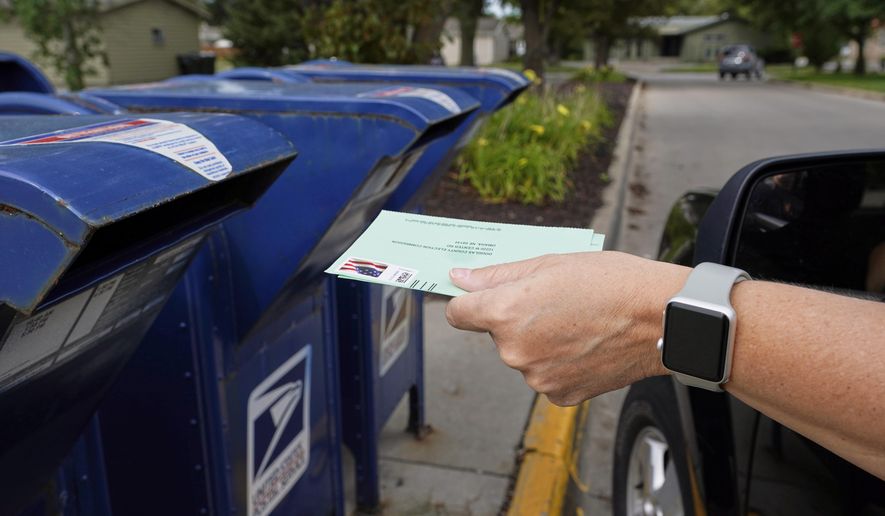

The Supreme Court ruled Monday that states are free to count ballots cast on time but received after Election Day, saying it is Congress’ job, not the court’s, to address concerns about lengthy vote counts and growing distrust of election results.
The justices, in a 5-4 decision, said it is a matter of federal law, and as of now, Congress has not forbidden the states from counting late-arriving ballots, so they are free to do so.
At issue was whether the federal law, when it says Election Day, envisions a single day of voting or whether it countenances what has become election season, with votes cast months in advance and counted weeks afterward.
People were interested in these podcasts
Justice Amy Coney Barrett, writing for the majority, said the election season is legal under the law as it exists.

She said federal law treats elections as the process of choosing, and although it defines when ballots must be cast, states get to define when they can be received.
“The election-day statutes say nothing about ballot receipt, and we cannot add to the words Congress chose,” the Trump appointee wrote, joined by Chief Justice John G. Roberts Jr. and the court’s three Democratic appointees: Justices Sonia Sotomayor, Elena Kagan and Ketanji Brown Jackson.
President Trump declared the ruling a “tremendous loss” and urged Congress to revive his Safeguard American Voter Eligibility Act, or SAVE Act. That legislation would require voters to provide documentary proof of citizenship when registering and show photo ID when voting, including a copy of their ID for mail-in ballots.
The requirement to prove citizenship at registration would severely limit mail-in voter registration, and the photo ID requirement would affect mail-in voters as well.
“There is no excuse for a politician, or otherwise, to be against the above three requirements. There is only one reason to oppose — CHEATING!” Mr. Trump posted on social media.
The case before the justices came from Mississippi, where state law allowed ballots to be cast and postmarked by Election Day and then be counted as long as they were received no later than five business days “after the election.”
Justice Samuel A. Alito Jr. led the dissent, writing that the court was removing a safeguard against fraud, including against “bad actors seeking to stuff ballot boxes when early election results suggest a tight race” — and upending the idea of a single Election Day.
“Today’s decision is inconsistent with the terms of the election-day statutes, contemporary election-law principles, two centuries of historical practice, and the case law on the question presented,” wrote Justice Alito, a George W. Bush appointee. “And it creates a serious risk of further undermining public confidence in our elections and our system of self-government.”
Justices Clarence Thomas and Neil M. Gorsuch joined Justice Alito’s dissent in full. Justice Brett M. Kavanaugh joined in part.
At the country’s founding, voting was in person, in public, and on whatever day each state determined.
Federal law would eventually set a single day for elections to national office, and by the late 19th century, voting would retreat into the booth, behind the curtain.
Exceptions for military voters casting ballots early and from afar have existed since the Civil War, but in recent decades have expanded to offer average Americans more opportunities to vote.
The COVID-19 pandemic emergency then led to an explosion in absentee and mail voting, and Mississippi was among them.
Roughly 30 states now allow at least some mailed ballots to be counted even if they are received after Election Day.
Washington allows ballots to be processed and counted up to 21 days after Election Day as part of its certification process, and eight states allow ballots to arrive without postmarks.
Justice Alito ticked off the issues with that: it is tougher to verify the identities of mailed ballots, there is a greater risk of voter manipulation, and the chain of custody of ballots becomes muddied.
Justice Barrett countered that if Congress is worried about election fraud, it can change the law.
The two major parties squared off over the case. The Republican National Committee led the challenge to Mississippi’s law, and the Democratic National Committee defended it.
“Trump and Republicans are attacking our elections and trying to rig the system in their favor because they know the American people are ready to reject their chaos and corruption this November,” DNC Chair Ken Martin said in response to the decision.
Jason Snead, executive director of Honest Elections Project, said the ruling missed the mark.
“Federal law is clear: all ballots must be received by Election Day to be counted. The court missed a major opportunity to reinforce election integrity and instead sides with California-style chaos,” Mr. Snead said.
That was a reference to California’s reliance on mailed ballots and its tendency for Election Day results — often favorable to Republicans — to shift toward Democrats as counting stretches into days after the election.
Even as it cleared the mail-in voting issue, the Supreme Court signaled interest in another election battle, asking the Trump administration to weigh in on a case challenging Arizona’s law requiring proof of citizenship to register to vote.
Opponents said that although Arizona can require proof of citizenship for state elections, federal law does not allow such checks for voters in national elections.
The 9th U.S. Circuit Court of Appeals agreed and has blocked the state’s law.
The Republican National Committee appealed to the justices, who have agreed to take the case.
Oral arguments will be held sometime next term, which begins in October.
Contact the author



Please read our comment policy before commenting.