



OPINION:
The CIA first identified North Korea as a serious nuclear nonproliferation concern in 1984, at the peak of the Cold War. Forty-two years and multiple crises later, North Korea has become a nuclear weapons state with an arsenal estimated at 30 to more than 60 nuclear weapons, as well as intercontinental ballistic missiles capable of delivering them to the American heartland.
How did we get to this point, and where do we go from here?
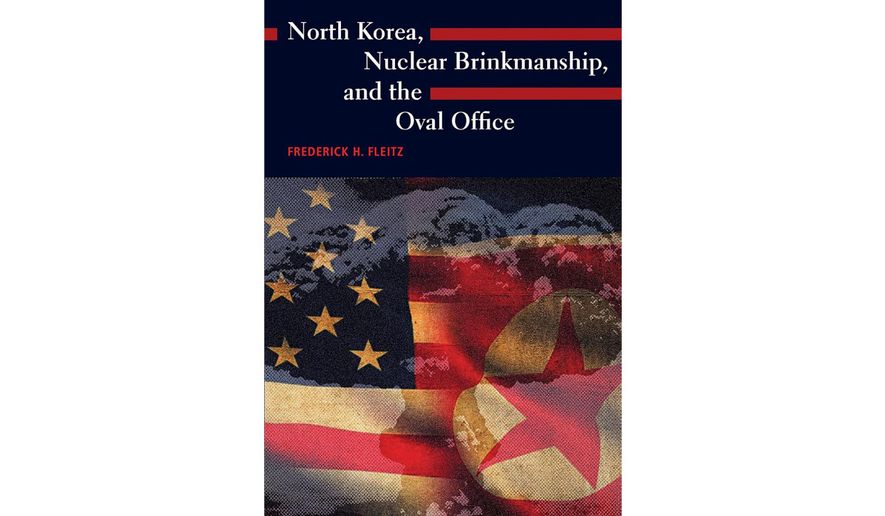
To answer that, read the just-released “North Korea, Nuclear Brinkmanship, and the Oval Office” by Frederick H. Fleitz.
People were interested in these podcasts
Mr. Fleitz has been an intelligence and policy insider for much of that time, first as a CIA weapons proliferation analyst and then at the State Department, the House Permanent Select Committee on Intelligence, and finally as deputy assistant to President Trump and National Security Council chief of staff. Today, he is vice chairman of the Center for American Security at the America First Policy Institute, where I am a senior fellow.
Full disclosure: I have known Mr. Fleitz since he served as chief of staff to Undersecretary of State John R. Bolton during the early years of the George W. Bush presidency. Mr. Fleitz was always watching the proliferators — whether Iran, North Korea, Libya or others — and was sometimes willing to discuss issues with a serious investigative reporter to test his conclusions.
It was, in part, thanks to a tip-off from Mr. Fleitz that I traveled to Tripoli, Libya, in March 2004, to accompany a congressional delegation led by Rep. Curt Weldon, Pennsylvania Republican, and Sen. Joseph R. Biden, Delaware Democrat, to witness the handover of Col. Moammar Gaddhafi’s uranium enrichment gear and ballistic missiles to the United States. It was a hugely significant and largely ignored victory against the “Nukes ’R Us” network of Pakistani nuclear proliferator A.Q. Khan, which Mr. Fleitz details at some length in this book.
Khan’s story is well known by now, thanks to his written confession and a handful of interviews he granted to Western reporters. A 1981 book, “The Islamic Bomb,” by Steve Weissman and Herb Krosney, first gained him international notoriety for stealing uranium enrichment technology from Europe on behalf of Pakistan.
I first learned of Khan’s relationship with Iran in 1986 while monitoring the CIA’s open source blue books for Iran, then known as the Foreign Broadcast Information Service.
An obscure broadcast from a local radio station in Busheir, Iran, announced Khan’s visit to a nuclear power plant begun by the Germans under the shah and then abandoned. Subsequent entries detailed visits to a nuclear research facility in Isfahan and, the following year, a consulting agreement with the Iranian Atomic Energy Organization.
What expertise would the inimitable Khan have that might interest the Iranians? It could be only uranium enrichment, I concluded. From there, I began tracking contracts with China to build a uranium hexafluoride plant in Isfahan for the enrichment feedstock and a massive dual-use import program of centrifuge components.
North Korea’s relationship to the inimitable A.Q. Khan was shrouded in mystery for years. A similar pattern began to emerge in North Korea in 1994. For more than a decade, the U.S. intelligence community tried to downplay the evidence of a uranium enrichment program, only to have the facts thrust in their faces by former Los Alamos bomb designer Siegfried Hecker, who led a series of nongovernmental scientific delegations to the “hermit kingdom.”
What is even more astonishing is the revelation that Khan served as a conduit between China and Pakistan as early as 1982, when he arranged to send China uranium enrichment equipment he had stolen in Europe in exchange for 15 tons of uranium hexafluoride and, later, enough highly enriched uranium for Pakistan to make two bombs.
North Korea’s Kim dynasty became masterful negotiating provocateurs. Its formula: Test weapons, make threats, elicit blackmail and then negotiate. This cycle ultimately led to the 1994 “Agreed Framework” between the United States and North Korea, the 2003-2008 six-party talks and the Trump-Kim summits of 2018-2019.
Each time, the North Koreans came out on top, winning U.S. economic and/or political concessions and reneging on their pledges to slow down or stop their nuclear and missile programs.
“These mistakes were often caused by government national security careerists (and sometimes political appointees),” Mr. Fleitz writes, “who instinctively tried to avoid confrontation and decisive action and instead promoted bureaucratic inaction and endless dialogue to address national security problems.”
For many of these careerists, “the process of diplomacy was always the main goal, rather than a tool to secure American interests,” Mr. Fleitz adds.
The chronology of North Korea’s long march to becoming a nuclear weapons state may appear tedious to some, but it is necessary because it demonstrates that events do not just happen: They are caused. Good policies can reduce tensions, but bad policies can breed disasters.
One of the more egregious villains of this story is a State Department careerist named Christopher Hill, whom Vice President Dick Cheney characterized as “deceitful, perfectly prepared to lie to the president.”
Mr. Hill’s apparent goals were to defang and reduce U.S. pressure by the George W. Bush administration on North Korea, prolong negotiations way beyond their useful life and mock those who dared to suggest the North Koreans might be cheating by having a second, secret, pathway to the bomb.
“Some people imagine there is a building somewhere with a secret door they can open and find a group of scantily clad women enriching uranium,” he told Rep. Ed Royce in April 2008.
Just two years later, Mr. Hecker traveled to North Korea, where officials not only acknowledged the uranium enrichment program but also took him on a tour of an active uranium enrichment plant that the “experts” said did not exist.
Mr. Fleitz notes repeatedly that North Korea and Iran are joined at the hip, and his publisher notes that he is working on a companion volume that chronicles Iran’s long march to nuclear weapons.
The United Nations passed 14 Security Council resolutions condemning North Korea after its first nuclear test in 2006. Many of them imposed sanctions on the Kim regime. It was not until Mr. Trump began to enforce those sanctions that “Little Rocket Man” finally came to the table.
Mr. Trump’s personal diplomacy with Kim Jong-un ultimately failed to achieve lasting results, as it was interrupted by COVID-19 and his 2020 election defeat. Yet during the 18-month span of those negotiations, the North Koreans refrained from nuclear tests and dramatically scaled back ballistic missile tests. Once Mr. Biden entered the White House, they ended that moratorium, increasing missile tests from 40 during the entire Trump presidency to 90 in 2022 alone.
Mr. Fleitz concludes: “At the end of the Biden administration, one thing was clear about the threat from North Korea’s nuclear and missile programs: They were much more dangerous than when Biden was sworn in as president on January 20, 2021.”
Mr. Biden’s lack of a clear North Korea policy, his eagerness to secure a new Iran deal, and his provocative stances on Russia and China led to the emergence of a new Russia-China-Iran-North Korea axis that persists to this day.
Call it the revenge of the rogue regimes.
Mr. Fleitz warns that “career national security employees tend to relentlessly promote status quo policies and oppose or water down efforts by new presidents to change them.” He also faults “a cadre of Democratic officials and their careerist allies” who have “negotiated bad agreements on the Iranian and North Korean nuclear programs for almost four decades.”
This politicization of intelligence and government statecraft plays into the hands of our adversaries, Mr. Fleitz argues.
“Iran and North Korea love endless nuclear negotiations because this gives them time to continue nuclear weapons work while pretending to be interested in diplomatic settlements.”
I am sure the Trump White House is listening.
• Kenneth Timmerman is an author and former senior fellow at the America First Policy Institute. His 14th book of nonfiction, “The Iran House: Tales of Revolution, Persecution, War, and Intrigue,” can be ordered at Amazon or through his website, kentimmerman.com.
• • •
North Korea, Nuclear Brinkmanship, and the Oval Office
Frederick H. Fleitz
Texas A&M University Press, $75, 448 pages

Please read our comment policy before commenting.