



OPINION:
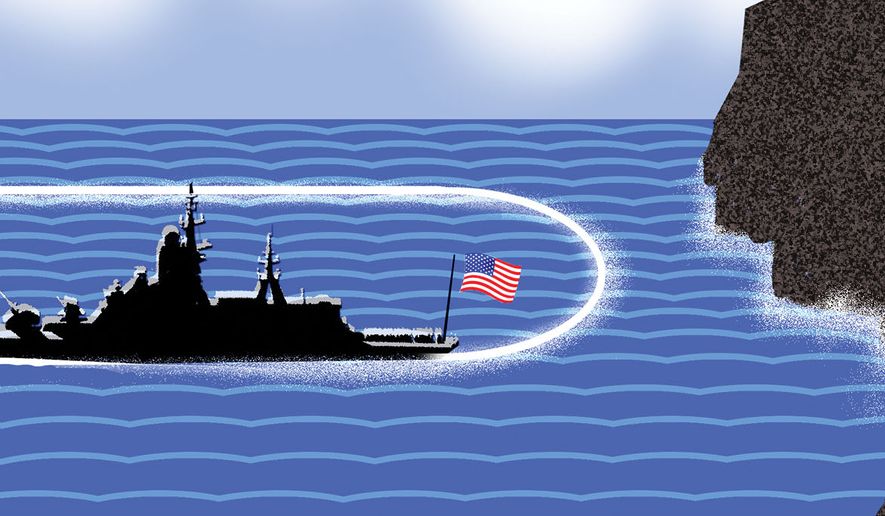
For the first time since the Reagan era, the U.S. Navy is in a favorable position, with capable leadership poised to address the critical challenges facing America’s maritime forces.
It is widely acknowledged that more than 80% of global trade transits by sea. The closure of the Strait of Hormuz reminds us of the vulnerability of the U.S. economy to threat actors who control sea lines of communication. Securing U.S. interests at sea requires a robust naval presence, a factor the nation has neglected since the end of the Cold War.
Just one month ago, there was widespread concern at the Pentagon and on Capitol Hill that the Department of the Navy was drifting deeper into dysfunction at precisely the moment it needed decisive leadership. Secretary of the Navy John Phelan’s anticipated appearance before Congress for critical May budget hearings was a source of anxiety among lawmakers, military officials and defense industry leaders alike, fearing poor performance would derail momentum behind urgently needed fleet modernization efforts and broader initiatives to rebuild America’s struggling shipbuilding industrial base.
People were interested in these podcasts
Those fears were well-founded. Mr. Phelan, a businessman with no military background, struggled to earn credibility on Capitol Hill and appeared detached from the operational and strategic priorities facing the naval service. Critics privately complained that he devoted more energy to ceremonial and cultural matters than to mastering the Navy’s budget, acquisition and readiness challenges.
His front-office staff was consumed by internal politics, bureaucratic maneuvering and ill-informed attempts to gain greater control over operational prerogatives. Programmatic changes were imposed by directive, cutting out key stakeholders, creating friction, alienation and growing mistrust among senior civilian and uniformed leaders. Instead of focusing on shipbuilding, his staff invested vast amounts of energy in absorbing service-level prerogatives and oversight. SECNAV became synonymous with administrative paralysis and incessant power struggles that distracted from its core mission.
Into this environment stepped retired Navy Capt. Hung Cao. Initially confirmed as undersecretary of the Navy, Mr. Cao had a reputation for operational competence, political instinct and a firsthand understanding of military service. A plainspoken combat veteran and unlikely politician, he was tasked by Mr. Phelan with addressing some of the department’s most persistent problems: force readiness, personnel management and infrastructure modernization. Unlike many other political appointees, Mr. Cao approached the role with a clear sense of purpose rooted in concern for sailors and Marines.
Members of Mr. Phelan’s inner circle made little effort to hide their intention to marginalize him. According to people familiar with internal deliberations, most within the secretary’s front office viewed Mr. Cao as a threat rather than an asset and openly discussed plans to “put this Cao out to pasture.” Ironically, the White House elevated Mr. Cao to maximize Mr. Phelan’s success, given his operational credibility, familiarity with acquisition programs, and ability to navigate Congress and the Pentagon.
With only weeks remaining before the critical budget drill, several high-priority initiatives were quietly removed from Mr. Phelan’s oversight in an extraordinary rebuke that underscored the severity of the situation. Mr. Phelan’s dismissal soon followed.
Immediately, Mr. Cao, as acting secretary of the Navy, addressed an administrative backlog of more than 2,500 unresolved actions and focused on restoring order and communication within the department. He rescinded problematic issuances and brought on a leadership team with the programmatic and acquisition experience necessary for success. Most importantly, Mr. Cao reinstated conventional chains of communication and command between the secretary’s office and service leadership. After a year marked by conflicting guidance and uncertainty, Navy and Marine Corps leaders again had predictable processes, clear authority and stable direction.
In one of his first acts, Mr. Cao flew out to meet personally with sailors aboard the USS Gerald R. Ford Carrier Strike Group after one of the longest deployments since the Vietnam War. Rather than treating the visit as a photo opportunity, Mr. Cao framed it as an expression of gratitude to service members and their families who had endured extraordinary operational demands. In typical Cao style, he reportedly irritated his handlers by permitting never-ending requests from enlisted sailors, one of whom said: “He is one of us, wow.”
“I recently returned from a visit to the Gerald R. Ford Carrier Strike Group for one reason,” Mr. Cao said afterward, “to personally thank America’s sons and daughters for completing a long, demanding deployment.”
Mr. Cao’s leadership style emphasized sailors and Marines. His first major test was defending the Navy’s fiscal year 2027 budget request before the House Appropriations defense subcommittee.
Throughout the nearly 3½-hour hearing, Mr. Cao, the chief of naval operations and the commandant worked seamlessly together, presenting a detailed and coherent strategy focused on fleet readiness, shipbuilding expansion, industrial base revitalization and Marine Corps modernization. Lawmakers noted Mr. Cao’s command of details, his fluency on acquisition and operational issues, and his willingness to engage constructively on contentious topics.
Unlike Mr. Phelan, who was regarded as aloof and unavailable, Mr. Cao feels a kinship with the enlisted forces.
He made this clear not only by his actions on the Ford but also during an all-hands message after becoming acting SECNAV and summarized his leadership philosophy. His first priority is ensuring sailors and Marines have the resources they need to accomplish their missions. His second is rebuilding American shipbuilding capacity, and his third is defending the nation. He ended with a phrase that quickly circulated throughout the fleet: “I’m never above you, I’m never below you, I’m always beside you.”
In just a month, leadership was restored, morale was boosted, and honest bipartisan discussions were held on how the naval forces can become more lethal and accomplish their global mission. Not a bad first month.
• Josh Segal is a retired naval officer who spent five years on the Secretary of the Navy staff. He travels frequently to Ukraine and serves as a consultant to the Defense Department. He is also a member of the Iron Gate Capital Technical Advisory Board.

Please read our comment policy before commenting.