



SEOUL, South Korea — The yelling conservatives wanted to get the attention of liberal President Lee Jae-myung — and maybe they did.
On Saturday afternoon, hundreds of right-wing demonstrators, protesting a procedural shambles in last week’s local elections, cheered and banged drums as members of the opposition People Power Party, speaking on a makeshift stage, loudly expressed indignation.
They were gathered alongside the scenic wall of Gyeongbok Palace, the 14th century location around which Seoul was constructed. Just north of the palace – and well within earshot — stands the Blue House, the presidential complex. The area’s proximity to the president’s ears make it a popular location for demonstrations.
Even larger protests were taking place in southern Seoul.
The target of the protesters’ ire is a long-standing conservative complaint: The National Election Commission, or NEC.
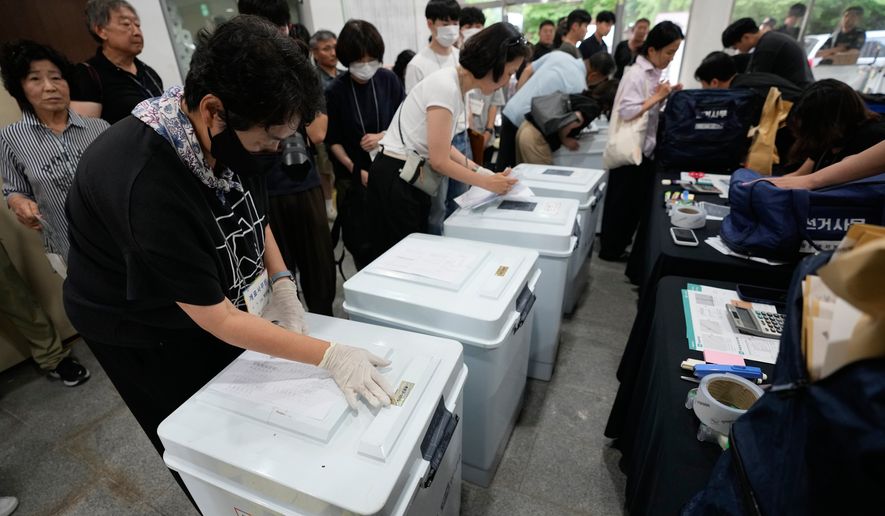
During nationwide local elections that took place Wednesday, voting stations in five cities, including Busan and capital Seoul, were found to be short of ballot papers, leaving some voters waiting for hours for ballots to be delivered.
That led to furious scenes on Wednesday at some voting stations, and a late-night intervention by PPP politicians, including Jang Dong-hyeok, the party’s leader.
They arrived at the NEC in the early hours of Thursday and forced their way into the office of the body’s chairman, demanding an explanation.
By Saturday, the number of stations suffering shortages jumped to 67.
“We don’t even know if it is 67 — it could be a few hundred,” PPP spokesperson Choo Hyun-chul said. “The 67 locations were all in districts where our party candidate had won in the last presidential election … we’ve heard this is how [Maduro-era] Venezuela defrauded voters.”
The situation moved fast.
On Sunday, PPP Leader Jang Dong-hyeon demanded new elections in the affected wards.
On Monday, the number of polling stations found to have insufficient ballots had risen — by the NEC’s own internal count — to 91.
South Korea’s chief justice on Monday accepted the resignation of NEC Chairman Rho Tae-ak.
The National Assembly has also acted with unusual bipartisanship. Late Monday, the ruling liberal Democratic Party of Korea agreed with the PPP establish a special prosecution investigation.
Also Monday, Mr. Lee weighed in.
“It is necessary to get to the bottom of the incident,” the president told a meeting of high-level judicial officials Monday, per local reports, calling it “a very serious problem that cannot be excused.”
Given that 14,000 voting stations had enabled the local elections nationwide, it looks unlikely that the overall outcome will change.
The DPK won 12 of the 16 key mayoral and gubernatorial contests, though the PPP retained the mayorship of Seoul.
Similarly, the national political landscape is not set for a seismic shift.
The PPP lost both the 2024 National Assembly election and the 2025 presidential election.
That leaves it with zero levers of political power bar street politics — but the street is a fecund avenue whenever Koreans get fired up.
The PPP think they may now have a spark to ignite the flame of public emotion: The proven incompetence — or worse — of the NEC.
It is a target they have aimed at before.
Electoral Commission draws renewed fire
Impeached conservative President Yoon Suk Yeol lost his presidency and his freedom — he is in jail serving multiple sentences, with some trial outcomes still pending — after deploying commandos to the National Assembly and the NEC immediately after declaring martial law on the night of Dec. 4, 2024.
The declaration — a high-risk gamble by Mr. Yoon — stunned a nation that retains living memories of the struggle for democratization in the 1980s.
Indecisive special forces heli-dropped at the National Assembly were bypassed by fast-acting lawmakers, who forced their way into the building, formed a quorum, and voted down martial law within three hours of its declaration.
That spelled political doom for Mr. Yoon.
The drama at the Assembly — widely covered by media — has since passed into national legend, showcasing Koreans’ determined attachment to democracy.
Commandos deployed to the NEC — which, located in a government complex 12 miles outside Seoul, lacked media coverage — were tasked with securing data. They, too, stood down after martial law was lifted.
It is a belief among many conservatives that there has been election interference, conducted, some allege, by shadowy Chinese actors.
The NEC, run by judges, maintains a very closed shop. But serious holes have been found in its defenses.
In 2023, the National Intelligence Service ran an audit on multiple government agencies, including the NEC, against the commission’s wishes.
Mr. Yoon subsequently stated that spooks easily breached NEC systems — some of which, he said, were protected by passwords like 12345. He also said that North Koreans had hacked into the NEC.
The NEC survived that embarrassment and subsequently pushed back against allegations by a conservative former lawmaker regarding Chinese interference.
However last week’s election fiasco cannot be finessed. Not only is it another blow to NEC credibility, it has drawn cross-party condemnation.
The announcement that a special prosecutor will probe the NEC is a kind of victory for the PPP.
The government earlier sought to conduct a National Assembly audit of the NEC — a process lasting just three days, and without authorization to gather evidence.
A special prosecutor, though, has real teeth: The probe can run for six months, it has a dedicated staff, and has the power to seize evidence.
In the days ahead, the PPP and DPK will have to agree on a prosecutor to appoint. Even so, Mr. Choo is upbeat.
“We want change in the NEC, though we don’t know what we want to change,” he said. “Who knows what’s in there? Who knows what will be revealed?”
More widely, the PPP is hoping that anger surrounding the NEC will give the nation’s conservatives new momentum — albeit, on the street, rather than in the halls of power.
The PPP occupies 110 seats in the unicameral Assembly; the ruling DPK holds 161.
“We just don’t have sufficient votes,” Mr. Choo admitted. “So we need the power of public protest — we need the people’s support.”
Contact the author


Please read our comment policy before commenting.