



President Trump said Tuesday he will retaliate against Iran for shooting down a U.S. military helicopter near the Strait of Hormuz, while Israel renewed its assault on Hezbollah targets in Lebanon, leaving peace talks hanging by a thread.
Mr. Trump said the U.S. military reviewed the cause of the crash and determined that Iran took down the Army AH-64 Apache helicopter.
“There were two pilots involved, both are safe and uninjured. Nevertheless, the United States must, of necessity, respond to this attack,” Mr. Trump said in a social media post.
People were interested in these podcasts
The incident comes against the backdrop of a so-called ceasefire between the U.S. and Iran, which is meant to facilitate diplomacy between the two sides in the hopes of reaching a deal to end the war that began in late February.
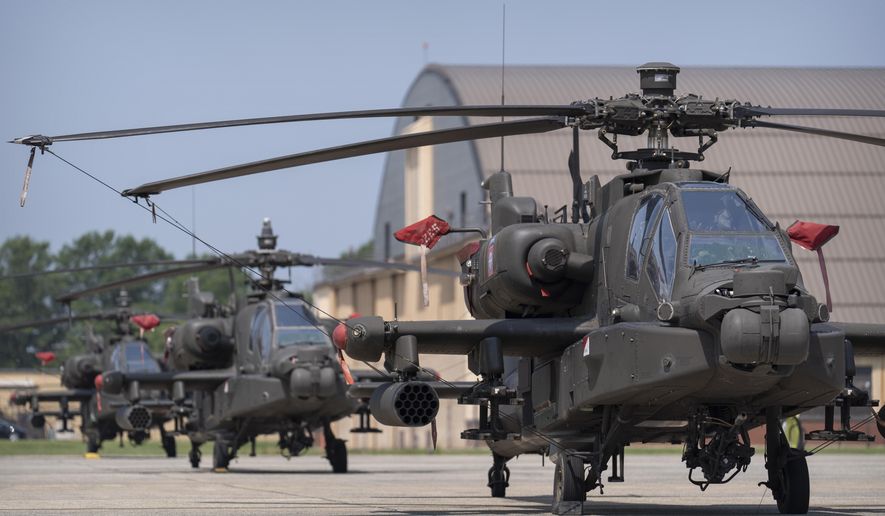
But Iran has been exchanging fire with Israel and is now blamed for the downing of the American helicopter, a spate of violence that is the worst since all parties agreed to a pause in fighting in early April.
Iranian Parliament Speaker Mohammad Bagher Ghalibaf issued an ominous warning to the U.S. side on social media, moments after Mr. Trump vowed retaliation.
SEE ALSO: Israel continues assault in Lebanon despite threats of retaliation from Iran
“We prefer the language of diplomacy, but we speak other languages far more fluently. Break your commitments, and we’ll switch to what we speak best,” he wrote. “You ride the horse you saddled!”
U.S. Central Command said the helicopter went down near the coast of Oman while patrolling regional waters. The two crew members are in stable condition, officials said, and were both rescued within two hours of the incident.
The president did not describe the method that Iran used to take down the chopper.
The U.S. has lost a significant number of aircraft during the Iran war, including drones and fighter jets — at least 42 total aircraft lost, according to a recent Congressional Research Service report.
The most notable incident came in early April when Iran shot down an F-15E fighter jet over its territory. U.S. forces mounted a daring rescue operation and found the two crew members before Iranian forces could capture them.
Also on Tuesday, Israel pummeled southern Lebanon with airstrikes despite Iran’s warning that further attacks would lead to a devastating response.
SEE ALSO: Drone boat helps rescue U.S. Army helicopter crew shot down near Strait of Hormuz
The Israeli military issued evacuation orders for the city of Tyre, on Lebanon’s southwestern coast, before launching a wave of airstrikes in the surrounding area.
State-affiliated media in Lebanon reported that at least nine people were killed in a strike near the city early Tuesday.
Tyre is one of southern Lebanon’s largest cities, with nearly 175,000 people in the city and its metropolitan area.
Israel’s latest evacuation order for the city included Tyre’s Christian sector, which had previously been excluded from airstrikes. Israel asserts that Iran-backed Hezbollah militants are hiding within the city but has not provided direct evidence.
Israeli authorities said troops also killed a gunman on Tuesday who entered Israel from Lebanon and opened fire at soldiers stationed near the border. The IDF did not immediately identify the gunman as a member of Hezbollah or any other organization.
Violence in Lebanon had been the main sticking point in efforts to negotiate a peace between the U.S. and Iran that would reopen the Strait of Hormuz, lift a U.S. blockade of Iranian ports set the table for talks on Tehran’s nuclear ambitions.
The helicopter crash raised additional questions about the likelihood of a deal.
Vice President J.D. Vance, in an interview excerpt released Tuesday by CBS’s “Sunday Morning,” said the U.S. is “very close” to a deal that would address Iran’s nuclear program but offered a wide timeline for an outcome.
“I think we’re going to know a lot before the midterm elections,” Mr. Vance said. “Look, I think that the deal could happen in the next week, but the deal could also happen months from now.”
Mr. Trump late Monday told reporters that a deal with Iran was imminent, but that was before the military determined the cause of the downed chopper.
Sen. Ted Cruz, Texas Republican, urged Mr. Trump to respond forcefully to the latest incident, saying “enough is enough.”
“President Trump and our Armed Forces decimated Iran militarily, but the Iranian regime has been trying to rebuild and now they’ve taken down an American Apache,” he said on X. “President Trump is absolutely right. There is a pressing necessity for the U.S. to respond to this attack.”
For weeks, some Republicans have taken a more hawkish approach than the president on Iran, saying it is time to finish the job militarily instead of trusting Iranian negotiators.
Even before the helicopter incident, they said Iran had been toying with the U.S. and must face consequences.
“I’m starting to feel like we’re Charlie Brown and Iran is Lucy, and every time we go kick the ball, it’s been taken away. ’We’re close to a deal, we’re two days from a deal, we’re three days from a deal,’ and it’s not happening,” Rep. Carlos Gimenez, Florida Republican, told Fox Business on Tuesday. “I think that bad behavior deserves punishment.”
Republicans are eager to settle the Iran conflict, in part, because Americans are seeing higher costs from the war in a midterm election year.
The average U.S. price of a gallon of gas stood at $4.16 on Tuesday, down from $4.53 one month ago but up 40% from when the war began, according to the AAA motor club.
The Bureau of Transportation Statistics said airlines spent over $6 billion on jet fuel in April despite using slightly less fuel, underscoring the rise in energy costs from the war.
The International Air Transport Association projects carriers will reap $23 billion in net profit in 2026, down from an earlier projection of $41 billion.
Energy Secretary Chris Wright told CNBC on Tuesday that more oil is moving through the Strait of Hormuz than before, easing the pressure on prices, though stock trading was mixed on Wall Street.
Mr. Trump says economic pain will be short-lived and worth the goal of preventing Iran from getting a nuclear weapon.
He said the military campaign and his more recent blockade of Iranian ports would force Tehran to the negotiating table. He said there are no real “sticking points” in negotiations.
However, Lebanon is a point of real contention.
Iran says any peace agreement signed with the U.S. must include a full ceasefire on all fronts of the regional war, including Lebanon.
Israel and Hezbollah have been at war since early March, when the Iran-backed terrorists launched rockets into Israeli territory in retaliation for the assassination of former Supreme Leader Ali Khamenei on Feb. 28.
Israel’s offensive in southern Lebanon has killed at least 3,600 people, according to the Lebanese Health Ministry, and displaced more than one million.
The continued strikes underscore Israel’s willingness to persist with its campaign to defeat Hezbollah in Lebanon despite threats from Iran that it will retaliate with ballistic missiles.
Mr. Trump reportedly pressed Israeli Prime Minister Benjamin Netanyahu to halt attacks on Iran over fears that they could upend peace efforts.
• Ben Wolfgang contributed to this story.
Contact the author



Please read our comment policy before commenting.