


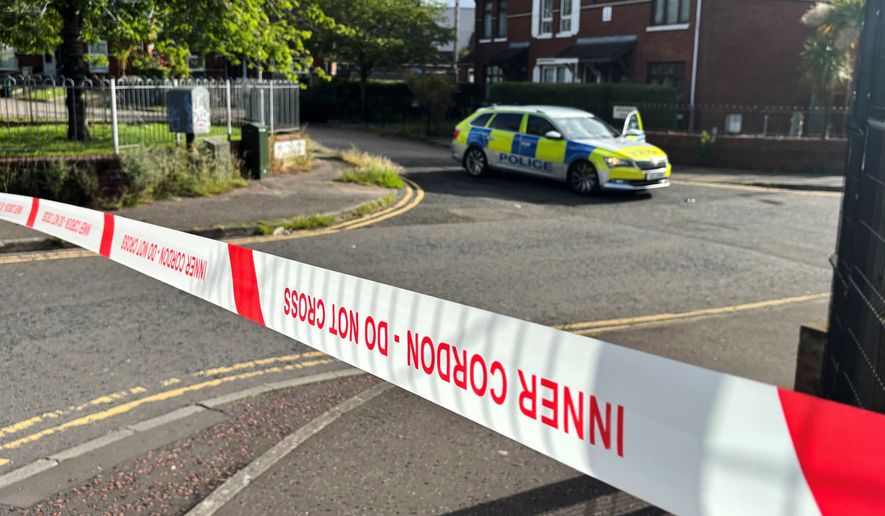

LONDON — U.K. leaders called for calm Tuesday after the arrest of a Sudanese man accused of trying to kill a man in a vicious stabbing on a Belfast street sparked fiery anti-immigration protests because the suspect is an asylum-seeker.
The victim, a man in his 40s, was taken to the hospital with serious injuries to his eyes, face and back after he was attacked late Monday in north Belfast in Northern Ireland, police said.
The suspect, 30, who was not named, was held in custody and charged with attempted murder, possession of a knife in a public place and making threats to kill. A kitchen knife was found at the scene.
People were interested in these podcasts
Police were trying to determine the motive, but there was no information to suggest the attack caught on video was terrorism-related, said Ryan Henderson, assistant chief constable of the Police Service of Northern Ireland. He added that police were not seeking other suspects.
“This brutal attack will have sent shock waves through the community, causing real concern,” he said.
Northern Ireland’s leaders and chief constable urged people not to incite hate and fear or target particular communities after reports that protests were planned.
PHOTOS: Police arrest a Sudanese suspect in a Belfast stabbing as Starmer calls for calm
Protesters in black hoodies, some wearing masks, torched a bus in east Belfast, and cars and trash bins were set ablaze as groups gathered in other parts of the city.
At the other end of the U.K., demonstrators marched in Southampton, England, where the recent sentencing of a man who killed a university student with a knife led to violent clashes with police last week.
Although the victim and convicted killer were both British, protesters stood outside a Southampton hotel that had housed asylum seekers, holding signs that said “Illegal Migration Is Destroying Our Civilisation.”
The Belfast attack sparked immediate questions about the suspect’s immigration status, including from some politicians. Gavin Robinson, the leader of the Democratic Unionist Party, urged authorities to curb “uncontrolled immigration.”
Northern Ireland’s chief constable Jon Boutcher told reporters that the suspect was living in the U.K. under a five-year visa granted in September 2023. Boutcher said he was believed to have traveled from Sudan to Paris and Dublin before claiming asylum in Belfast.
The suspect was not known to Northern Irish police, he added.
When pressed on the question in Parliament, Northern Ireland Secretary Hilary Benn said he could not confirm whether the alleged attacker came to the U.K. illegally.
Starmer condemned the attack as “sickening” and said that he had “no tolerance for abhorrent scenes of violence like this on our streets.”
His office said “it is time for calm,” adding “it’s important that police have the time and space to investigate appropriately.”
Police and senior politicians urged people not to share the graphic images of the attack that were circulating online, or to spread disinformation about the situation.
Last week a separate case of a university student who was stabbed to death in Southampton, England in December was seized on by activists and U.S. Vice President JD Vance who blamed immigration for the violence.
Henry Nowak, who was white, was killed by Vickrum Digwa, a Sikh who falsely claimed to police that he was the victim of a racist assault by Nowak. When police officers arrived, they initially treated the wounded Nowak as a suspect before noticing his injury and trying to resuscitate him.
Digwa was convicted of murder for stabbing Nowak with a Sikh dagger and sentenced last week to life in prison with a minimum 21-year term. But the case has spurred heated debates about policing and race, and a protest over Nowak’s death turned violent with some attacking police with chairs and rocks. Several people were charged with violent disorder over the protest.
____
Brian Melley contributed.

Please read our comment policy before commenting.