


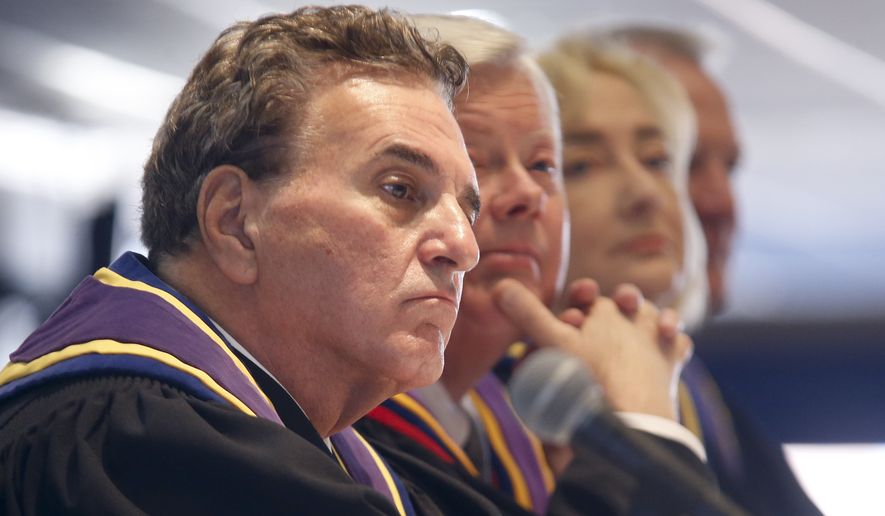

Pennsylvania Supreme Court Justice David Wecht announced Monday he is leaving the Democratic Party and registering as an independent, saying antisemitic hatred has moved from the party’s fringe into its mainstream.
“Nazi tattoos, jihadist chants, intimidation and attacks at synagogues, and other hateful anti-Jewish invective and actions are minimized, ignored, and even coddled,” Justice Wecht said in a statement distributed through the state court system. “Acquiescence to Jew-hatred is now disturbingly common among activists, leaders and even many elected officials in the Democratic Party.”
Justice Wecht, 63, had been a member of the court’s liberal 5-2 majority and was retained for a second 10-year term in November in an election that drew millions in Democratic spending. His departure shifts the court’s partisan balance to 4-2-1.
People were interested in these podcasts
The justice, who is Jewish, grounded his statement in personal history. In 1998, he and his wife married at Pittsburgh’s Tree of Life Congregation, where he also served on the board of trustees. Twenty years later, the same synagogue was the site of the deadliest antisemitic attack in American history. Justice Wecht said that assault was driven by right-wing ideology, acknowledging that “Jew-hatred has always festered on the fringe” of the right — but argued the same hatred has since spread on the left.
Justice Wecht’s statement included an apparent reference to Maine Democratic Senate candidate Graham Platner, who became the presumptive party nominee after Gov. Janet Mills suspended her campaign. Mr. Platner faced widespread condemnation last year after a Totenkopf tattoo — a skull-and-crossbones symbol the ADL identifies as closely associated with the Nazi SS — was discovered on his chest. Mr. Platner said he had been unaware of the symbol’s Nazi origins when he received it while on leave from the Marines in Croatia and subsequently had it covered with another tattoo.
Pennsylvania Sen. John Fetterman, a Democrat whose own party future has drawn recent media attention, posted on X that he knew Justice Wecht and his father and said he “fully understood” the justice’s personal choice. “The Democratic Party must confront its own rising antisemitism problem,” Mr. Fetterman wrote, while affirming he would not be changing his own party affiliation.
Justice Wecht’s announcement came amid a broader intraparty debate over antisemitism that has included an opinion piece by New Jersey Rep. Josh Gottheimer accusing fellow Democrats of applying a “double standard” on the issue.
Despite his registration change, Justice Wecht said his jurisprudence would remain independent.
“My jurisprudence and adjudication have always been independent, and they always will be,” he said. “Now, my voting registration reflects that independence as well.” He also pledged to “vindicate the legal rights that haters and extremists of all stripes enjoy” in Pennsylvania and the nation.
Before joining the Pennsylvania Supreme Court in 2016, Justice Wecht served as an Allegheny County Common Pleas Court judge for nearly a decade and as a Superior Court judge for four years. He had previously served as vice chair of the Pennsylvania Democratic Party.
With Justice Wecht now unaffiliated, Democrats retain a 4-2 majority over Republicans on the Pennsylvania Supreme Court.
This article was constructed with the assistance of artificial intelligence and published by a member of The Washington Times' AI News Desk team. The contents of this report are based solely on The Washington Times' original reporting, wire services, and/or other sources cited within the report. For more information, please read our AI policy or contact Steve Fink, Director of Artificial Intelligence, at sfink@washingtontimes.com
The Washington Times AI Ethics Newsroom Committee can be reached at aispotlight@washingtontimes.com.

Please read our comment policy before commenting.