



Another Senate Republican joined Democrats’ quest Wednesday to end the U.S. war with Iran, as Congress grappled with its role in authorizing military force and leaders in both nations confronted mounting economic woes from the standoff.
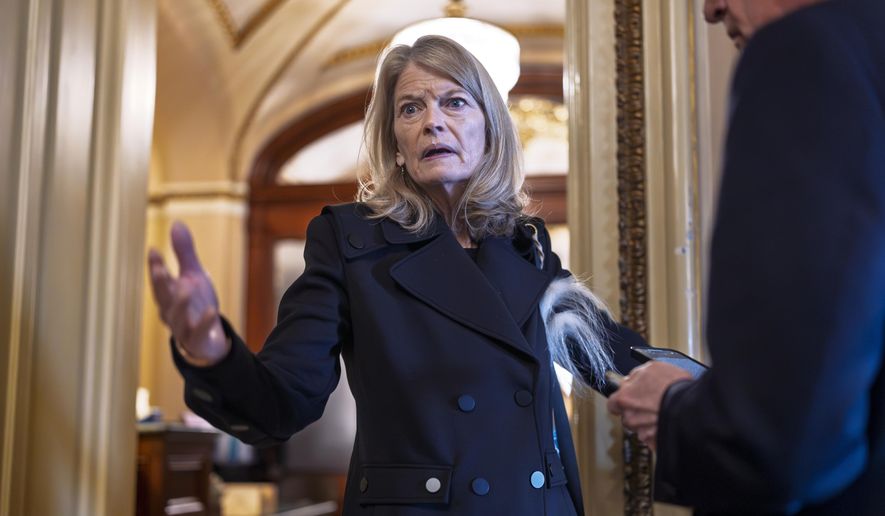
Sen. Lisa Murkowski, an Alaska Republican who has suggested that Congress must authorize the use of military force before the president can wage war in Iran, voted for the war powers resolution for the first time.
“We’re in a different place than we were last time we voted on this,” she said, citing the War Powers Act’s 60-day deadline for the president to end hostilities or obtain congressional authorization for continuing them.
People were interested in these podcasts
The 49-50 vote was still two supporters shy of the 51 votes needed to advance the war powers resolution, which would direct the president to end hostilities with Iran unless he obtains congressional approval.
Senate Democrats have forced similar votes every week that the Senate has been in session since the early days of the war, and Republican support has crept from one senator to three as the Iran conflict drags on.
Sen. Rand Paul, Kentucky Republican, has sided with Democrats on every vote since the war started. Sen. Susan M. Collins, Maine Republican, offered her support on the 59th day of hostilities.
President Trump sent a letter to Congress on May 1, the 60-day deadline, declaring hostilities against Iran were “terminated” because there had been “no exchange of fire” since he ordered a ceasefire on April 7.
However, the U.S. and Iran have since launched attacks in and around the Strait of Hormuz as they have sought to use the oil shipping passageway as leverage in negotiations to end the conflict.
“A statement has been made that hostilities are at an end, but it certainly wouldn’t appear to be that way,” Ms. Murkowski said.
Other Republicans said the war powers measure would constrain Mr. Trump when it appeared that his blockade of Iranian ports was working and might force Tehran to accept American terms in peace talks.
“Iran is losing $500 million a day in revenue. They’re going to lose that much today, yesterday, and they will again tomorrow,” Sen. John Barrasso, Wyoming Republican, said before the vote. “Iran’s cash cow of oil exports has collapsed.”
Beyond oil exports, Iran’s currency is falling and layoffs are rampant.
Inflation for many goods in Iran exceeds 50%. The International Monetary Fund projects the Iranian economy will contract by about 6% in the coming year.
Iranian President Masoud Pezeshkian urged the Agriculture Ministry on Wednesday “to employ their full capacity to control prices.”
“Our duty is to stand by the people with all our being,” Mr. Pezeshkian said on social media.
Americans are finding higher costs too, as supply shocks in the Middle East filter through the economy.
Democrats are highlighting that dynamic as they try to stymie Mr. Trump’s war plans.
Wholesale prices rose 6% for the year ending in April, the highest rate in more than three years, the U.S. government said Wednesday. On Tuesday, the Consumer Price Index report showed an acceleration of 3.8% annually in what shoppers pay at the checkout counter.
The Bureau of Labor Statistics said three-quarters of the increase in the Producer Price Index for April could be traced to a large jump in energy prices.
“What has absolutely reached consumers is the energy shock itself. Gas prices, airline fares, home heating costs — those were visible in [Tuesday’s] CPI and they’ve been visible at the pump for weeks. Those transmission channels have almost no lag,” said a joint statement by Ken Foster and Bernhard Dalheimer, professors of agricultural economics at Purdue University.
They said the Iran war’s potential impact on food prices, however, will become visible in the coming months after higher costs for industrial chemicals and packaging filter through to store shelves and as transportation, processing and shipping contracts are renewed to reflect higher energy costs.
“The research on this topic suggests the supply chain between an energy shock and a retail food price increase runs three to six months for most products — and up to a year for some. So, we’re still in the early stages of food price transmission from the conflict itself,” they told The Washington Times.
Iran has maintained an effective blockade of all Western-linked ships transiting the Strait of Hormuz since early March.
The blockade has throttled global energy markets, with hundreds of ships and millions of barrels of oil trapped in the Persian Gulf.
Mr. Trump is expected to discuss the situation and possible solutions with Chinese President Xi Jinping during meetings in Beijing on Thursday.
In the meantime, Iran moved one step closer to formalizing its management over the Strait of Hormuz, which could further weaken a ceasefire between Washington and Tehran.
Ebrahim Azizi, the chairman of the National Security and Foreign Policy Committee in Iran’s Islamic Consultative Assembly, told state-affiliated media that Iran aims to use the strait as a “power-building lever” even after the war ends and that recent parliamentary moves are intended to create a legal framework for that strategy.
“A plan for managing the Strait of Hormuz has reached a final conclusion in the commission and has been uploaded to parliament’s system for review and approval,” Mr. Azizi said. “The Islamic Republic of Iran wants to use this geographic capacity as a source of leverage.”
Secretary of State Marco Rubio and other global leaders reject the idea that Iran can maintain control over the strait after hostilities end. They have called Iran’s clampdown a violation of international law that is hurting energy consumers worldwide.
The price of Brent crude oil, an international benchmark, stood at about $107 per barrel Wednesday, up from around $70 per barrel at the start of the war.
Gasoline is refined from crude oil, so Americans are feeling it at the pump.
The average U.S. price of a gallon of gas stood at $4.51 Wednesday, a 51% increase from the start of the war on Feb. 28, according to AAA.
Mr. Trump says the short-term pain of higher U.S. prices is worth the goal of preventing Iran from having a nuclear weapon.
“As soon as this war is over, which will not be long, you’re going to see oil prices drop and you’re going to see the stock market, which is already at the highest point in history, go through the roof,” he said Tuesday. “You’re going to see the Golden Age of America.”
Democrats, sharpening their midterm campaign message, say Mr. Trump launched a war of choice that has driven up prices despite his 2024 campaign promise to rein in costs.
Senate Minority Leader Charles E. Schumer, New York Democrat, said the war powers vote offered Republicans a chance “to withdraw our troops from hostilities with Iran and stop the economic fallout from this historic blunder.”
“Americans’ financial situation is dire,” he said, “and Republicans don’t think about anyone other than Donald Trump.”
Mr. Rubio recently told reporters that Mr. Trump was complying with notification requirements of the War Powers Act out of respect for Congress but that the president, like past presidents, believes the law is unconstitutional.
Many Republican lawmakers disagree, but even some who believe Congress needs to authorize the war in Iran now that it has hit the 60-day deadline say that is not reason enough to support Democrats’ war powers resolutions.
“All this is is a poke at the president,” said Sen. John Curtis, Utah Republican.
Sen. Todd Young, Indiana Republican, agreed that Democrats’ war powers votes have become “a political exercise” without a plan for what would happen if the U.S. were to immediately pull troops from the region.
“I continue to think that Congress needs to not only be involved in these decisions to go to war and stay at war, but we need to have serious debates about it,” he said.
House Democrats are set to force a war powers vote in their chamber Thursday.
Contact the author




Please read our comment policy before commenting.