


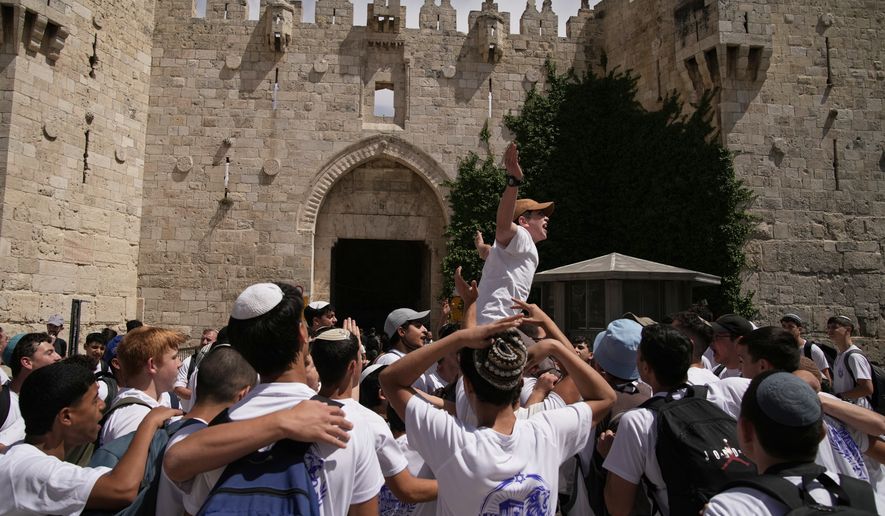

JERUSALEM — Jerusalem was bracing for tens of thousands of ultranationalist Jews to parade through Palestinian areas of the Old City on Thursday during an annual march that is often characterized by racist chants and violence.
The march commemorates Jerusalem Day, which marks Israel’s capture of east Jerusalem, including the Old City and its holy sites sacred to Jews, Christians and Muslims, in the 1967 Mideast war.
This year it comes as Israel’s far-right government, where settler leaders hold key positions, is heading toward elections and is eager to bolster support among its base.
People were interested in these podcasts
The procession often leads to violent confrontations between ultranationalists and the Old City’s Palestinian residents. In past years, crowds have chanted slogans like “Death to Arabs” and “May your villages burn.”
The route travels directly through the Old City’s Muslim Quarter, entering at the Damascus Gate and spilling down a market street that is normally bustling with Palestinians doing their shopping. By early Thursday the street was a ghost town, as Palestinian residents locked themselves in their homes and shopkeepers hung heavy padlocks on the doors, closing down early for safety.
Earlier in the day, Israel’s National Security Minister Itamar Ben Gvir staged another provocative visit to Jerusalem’s most sensitive holy site, home to the Al-Aqsa Mosque, the third holiest site in Islam. Jews revere the site as the Temple Mount, where the biblical temples once stood and the holiest site in Judaism.
Ben Gvir raised an Israeli flag, singing and claiming “the Temple Mount is in our hands,” referencing a famous statement from the Israeli paratrooper commander in 1967 which announced Israeli control of parts of the Old City during the height of fighting.
His visit threatened to inflame tensions that are rife in the city after two and a half years of near-constant war and fragile ceasefires. Four years ago, clashes between Palestinian protesters and Israeli police at the site set off an 11-day war between Israel and Hamas.
The plaza of Damascus Gate was full of Israeli police, who designated a barred-off space for journalists to cover the event. In past marches the crowds have beaten up journalists.
Scuffles broke out when groups of young marchers entered the Old City before the start of the march, encountering Palestinians in the Christian quarter. They threw chairs at each other. Activists from Standing Together, an Israeli-Palestinian coexistence group, moved in between to try to stop the confrontation, video circulated by the organization showed.
“When we put our bodies on the line, it oftentimes reduces the violence because settlers are less willing to attack when there are Jews there or when we document what’s going on,” said Ori Shaham, the group’s international spokesperson.
Another group opposed to extremist Jewish violence called Tag Meir held an annual “flower march” before the crowds descended, handing out flowers to shopkeepers before they closed early.
Jerusalem lies at the heart of the conflict between Israelis and Palestinians. Each sees the city as a key part of their national and religious identity. It is one of the most intractable issues of the conflict and is often a flashpoint.
Israel considers all of Jerusalem to be its eternal, undivided capital. Its annexation of east Jerusalem is not internationally recognized. Palestinians want an independent state with east Jerusalem as its capital.

Please read our comment policy before commenting.