



KYIV, Ukraine — First, Russia took Ukrainian land. Now, Ukrainian officials and legal experts say, Moscow is stripping and selling what lies above and beneath it.
The Ukrainian government and international organizations warn that Russia is seizing grain, coal, industrial assets and mineral deposits in the territories it occupies and folding them into Russian supply chains through ports, railways, shell companies and occupation authorities.
President Volodymyr Zelenskyy first raised the alarm May 6 after a briefing from Ukrainian intelligence.
People were interested in these podcasts
He said Russia was preparing to exploit at least 18 mineral deposits in occupied southern Ukraine, including titanium, lithium, tantalum, niobium, zircon, molybdenum and graphite. The plan, he said, involved geological exploration and the rapid extraction and export of raw materials.
He also accused Moscow of preparing further measures to seize and export this year’s grain harvest from occupied areas.
“These are the same processes of plunder and deindustrialization that Russia has already carried out in the occupied Donbas,” Mr. Zelenskyy said.
For Kyiv, the issue goes beyond looting by soldiers or opportunistic profiteering by occupation officials. Ukrainian officials say Moscow is intent on transforming the territories it occupies into a productive rear base, connected to Crimea and Russia by new roads, railways and ports.
The resources bring in much-needed money, feed Russian industry and give the Kremlin a financial stake in prolonging its grip on the territories it has seized.
The strategy also jeopardizes Ukraine’s postwar reconstruction.
Kyiv has sought to attract Western investment into its mining sector, including titanium, lithium and graphite, but Russia now controls roughly a fifth of Ukraine’s territory and a significant share of its coal and metal resources, according to Reuters reporting and Ukrainian estimates cited by the agency.
The seizure of Ukrainian grain has been widely documented for years.
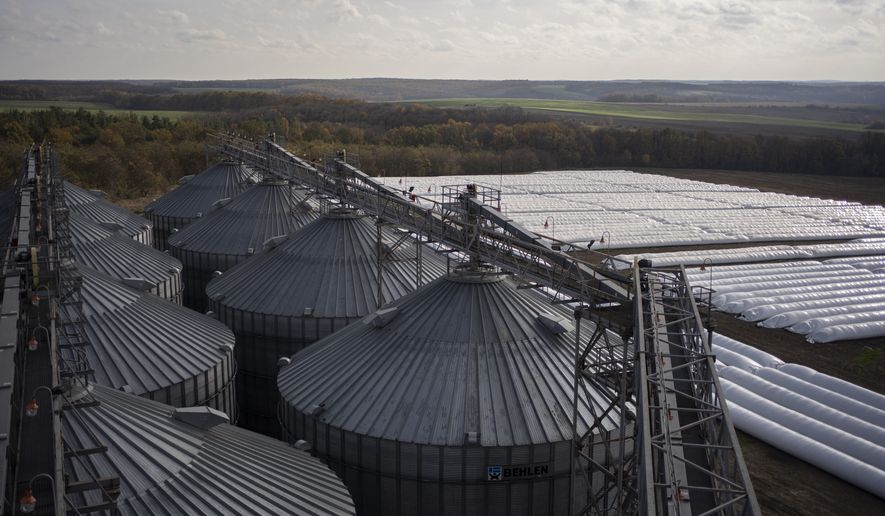
Since the first months of the full-scale invasion, Ukrainian officials, journalists and legal organizations have traced grain taken from farms and elevators in occupied areas, moved through Crimea, Mariupol or Berdiansk, and then sold as Russian-origin cargo.
Global Rights Compliance, a legal organization that has worked with Ukrainian prosecutors, said in a 2023 report that Russia had developed a large-scale plan to seize and export Ukrainian grain, potentially worth more than $1 billion a year.
The investigation found that Russian-affiliated actors and occupation authorities had taken control of grain storage and export infrastructure in occupied areas of Luhansk and Zaporizhzhia.
“Several indicators show how these practices fit into a broader pattern of Russia weaponizing food and essentials in Ukraine and in occupied territories,” Rebecca Bakos Blumenthal, starvation and humanitarian crisis lead at Global Rights Compliance, told The Washington Times.
Russian forces seized grain elevators “from the first days of occupation,” she said. Facilities were re-registered under Russian law. Entities linked to the Russian state or Russian oligarchs entered the logistics and transport sectors.
In one case examined by Global Rights Compliance, a logistics company linked to a sanctioned Russian defense contractor had bought three grain carriers before the full-scale invasion.
The organization assessed that the ships were sized to fit the Sevastopol grain terminal in occupied Crimea.
“Taken alone, this type of element remains circumstantial,” Ms. Bakos Blumenthal said. “But when you piece it together with the rest, it indicates a degree of planning.”
Ukraine now faces the same problem with other resources.
In March, Reuters reported that Russia had begun auctioning natural resource assets in occupied Ukraine. One of the largest sales identified was the Bobrykivske gold deposit in occupied Luhansk. The rights to develop it were sold for $9.7 million to a company controlled by Russian mining firm Polyanka, although auction data valued its reserves at 1.64 metric tons of gold, worth nearly $260 million at market prices.
Russian authorities have also pushed ahead with transport and infrastructure projects in occupied Donetsk, Luhansk, Zaporizhzhia and Kherson.
Reuters reported that Moscow had spent an estimated $11.8 billion on roads, railways, ports and industrial projects in the territories, including the “Novorossiya Railways” and the “Azov Ring” highway linking occupied southern Ukraine more closely to Russia and Crimea.
Those routes serve both military and economic purposes, allowing the movement of troops, ammunition and fuel, as well as helping move coal, grain and other goods out of occupied Ukraine.
Coal from Ukraine’s occupied territories has entered foreign markets. Reuters reported that coal from Russian-occupied parts of Ukraine found buyers abroad, including in Turkey. Meanwhile, Ukrainian reporting based on trade data identified shipments of coal, coke and anthracite from occupied territories to buyers in Turkey, the United Arab Emirates, India, Indonesia, Egypt and Algeria.
The trade is difficult to stop because the evidence is often fragmented.
Grain can be mixed with Russian harvests. Cargo documents can be changed. Ships can switch off transponders near occupied Crimea. Companies can operate through intermediaries.
“There are structures precisely put in place to conceal provenance and to conceal how this is being seized and exported and where,” Ms. Bakos Blumenthal said.
Investigators rely on satellite images, customs records, shipping data, Telegram and VKontakte posts, social media videos and, in some cases, material published by occupation authorities themselves.
“There is no one piece of information, no smoking gun,” she said. “Each data point is just a small piece of the puzzle.”
The legal framework is clear on the basic principle: Pillage is prohibited under international humanitarian law.
The difficulty lies in proving who ordered, enabled, transported, bought or insured the goods once they left occupied territory.
That is where companies and third countries come in.
Kateryna Buriakovska, a business and human rights legal adviser at Global Rights Compliance, said foreign buyers, carriers, insurers, ports and traders cannot treat suspicious cargoes from Russia as ordinary commerce if there is a risk they originated in occupied Ukraine.
“Buyers, carriers, insurers, port operators — they are all part of supply chains,” she told The Washington Times. “They are functional elements of it.”
Under business and human rights standards, companies are expected to carry out due diligence, especially in conflict-affected areas. That means checking suppliers, routes, documents, ownership structures and warning signs before entering a transaction.
The U.N. Guiding Principles on Business and Human Rights, endorsed in 2011, set out companies’ responsibility to respect human rights and states’ duty to help prevent corporate involvement in abuses.
Global Rights Compliance says that the pillage of Ukraine’s natural resources has weakened the country’s economy and recovery prospects and that minerals, coal, oil, gas and other assets are allegedly being extracted and trafficked by Russian state-linked and private actors.
Ms. Buriakovska said a company that is warned a cargo may contain resources from occupied Ukrainian territory is facing “a very big red flag.” If it goes ahead anyway, she said, it may expose itself to sanctions-related action, customs measures, civil liability and, in some cases, criminal liability.
“Companies cannot claim that they could not have known,” she said. “The business and human rights framework says that they should have known.”
That argument has become more urgent as Ukraine pushes foreign governments to act. Kyiv recently urged Israel to block the Panormitis, a vessel it accused of carrying stolen Ukrainian grain. The ship left Israeli waters without unloading. Ukrainian officials have also accused Russian vessels of moving grain from Mariupol or Sevastopol toward Egyptian ports while changing documentation along the way.
For now, enforcement remains uneven. Sanctions can target vessels, firms and officials, but the networks adapt. Shell companies appear. Routes shift. Papers are rewritten.
Ms. Buriakovska said sanctions remain useful but cannot replace accountability. In some jurisdictions, affected parties may be able to sue companies. In others, executives could face criminal liability if they knowingly helped facilitate trade linked to pillage or unlawful appropriation.
The International Criminal Court can prosecute individuals, but not companies. That leaves much of the work to national courts, sanctions agencies, customs authorities and corporate due diligence laws.
For Ukraine, the resource trade is part of a wider pattern: Russia destroys Ukrainian cities, seizes Ukrainian property, rewrites local laws, reopens ports, builds railways and hands assets to Russian companies.
As each step makes the occupation more entrenched, the fight over Ukrainian resources has become another front in the war.

Please read our comment policy before commenting.