



OPINION:
Sen. Bill Cassidy, the Louisiana Republican who lost his effort to be reelected to another term in the U.S. Senate as a result of President Trump’s energetic opposition to him, on Tuesday returned the favor. He became the 50th vote in the Senate to advance a war powers resolution on Iran and voted against funding for the White House ballroom.
Just to be clear, I do not particularly care for Mr. Cassidy. His unreflecting and unrelenting embrace of a federal carbon dioxide tax (which would, of course, hurt the poor, the elderly, those on fixed incomes and local institutions, such as schools and hospitals, the most) was sufficient disqualification for reelection.
That said, at a certain point, it is fair to ask Republicans for what goals or purposes, exactly, are we spending their time, money and energy.
The answer to that question seems to center mostly on one’s adherence to whatever the president wants, irrespective of other considerations such as policy coherence, intellectual consistency, concerns about precedent-setting or simply common sense that would avoid making unnecessary enemies.
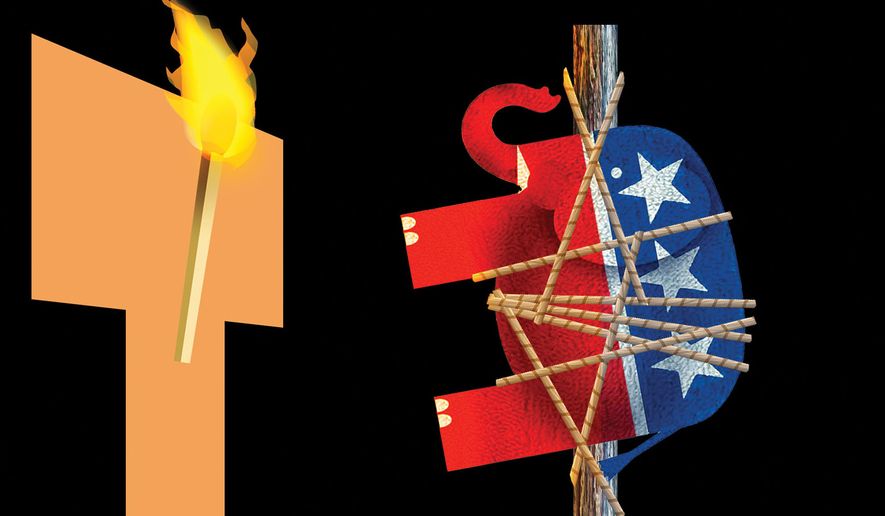
So far in this cycle, Republicans and their allies have spent hundreds of millions of dollars and have yet to defeat a single Democrat. In other words, the party and its partisans have spent enormous amounts of cash defeating one another.
I may be crazy, but that doesn’t really seem like an approach that will expand the party or help it preserve congressional majorities in what is going to be a difficult cycle, anyhow.
It would be one thing if the primaries in question were meritorious because they laid bare and involved debating relevant points of either policy or politics on which there were substantive and meaningful differences. These are not those primaries.
Apart from the obvious problems associated with this political fratricide, the casual dismissal of senators and representatives who are still in office complicates and retards the president’s own legislative agenda.
In addition to Mr. Cassidy’s newfound opposition to the ballroom and concern about the Iran conflict, Rep. Thomas Massie, Kentucky Republican, will very likely figure out ways to be difficult after he lost his reelection bid to a Trump-supported challenger on Tuesday.
The emphasis on adherence to the existing hierarchy also distracts from issues that are actually important to voters. The increase in gas prices is the obvious example; so, too, is its progenitor: the decision to attack Iran this year rather than in 2027.
I understand that the Trump administration was really annoyed by Mr. Massie; he can be annoying. Still, it seems reasonable to ask whether it was worth the time, mindshare and cash it cost to go from a lawmaker who votes with you 95% of the time to a lawmaker who votes with you 99% of the time.
That sort of thing is likely to appear (and be) much less important if the Democrats take the House and start their own vendetta tour, including oversight and impeachment.
In the event the Democrats take control of the House, what message might the president’s willingness to spend time and energy dispensing with Messrs. Massie and Cassidy send to their friends and colleagues? What message does his endorsement of Texas Attorney General Ken Paxton over Sen. John Cornyn, who has raised money for each and every Republican in the Senate, send to Mr. Cornyn’s friends and colleagues?
If the purpose is to remake the Republican Party as more moderate or more conservative or shorter or taller or whatever, then the selection of opponents and champions has not reflected that. If the purpose is to refocus on pragmatic governing and win more legislative victories, that is not immediately apparent either.
It is easy to understand the president’s very natural desire to settle scores. All of us are, unfortunately, motivated to one degree or another by the desire to prove that we were right. Yet it is not clear how this primary season has set the stage for the president to succeed in the final two years of his presidency.
One of the simple truths about the world is that those who seek converts are almost always better off (and usually happier) than those who hunt heretics. Politics is no exception.
• Michael McKenna is a contributing editor to The Washington Times.
Follow the author


Please read our comment policy before commenting.