



President Trump said Wednesday that he is eagerly waiting to see whether Iran provides “100% good answers” to a U.S. peace proposal or whether he needs to restart crippling military strikes in the coming days.
The president said U.S. forces are “all ready to go” if Iran fails to meet his demands.
“It’s right on the borderline, believe me,” Mr. Trump said. “We’d have to [get] complete 100% good answers. And if we do, we save a lot of time, energy and lives.”
People were interested in these podcasts
Tehran responded in kind, promising to expand the war if Washington resumes airstrikes.
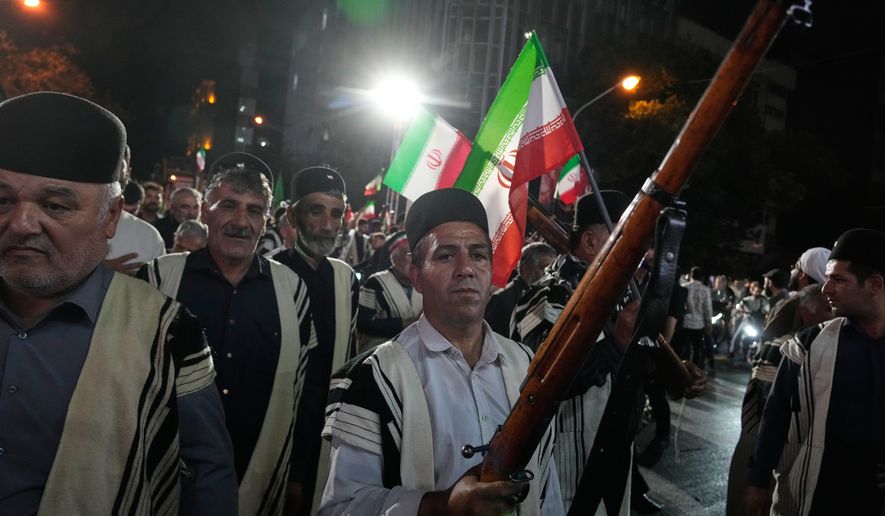
“If aggression against Iran is repeated, the promised regional war will this time be taken beyond the region,” the Islamic Revolutionary Guard Corps said in a statement.
The dueling rhetoric signaled that the conflict was entering a critical stage.
Pakistani negotiators are working feverishly to reach a lasting peace. The war has caused global economic upheaval and jarred U.S. allies in the Persian Gulf region.
Negotiators are effectively facing a weekend deadline to get signatures on paper. Otherwise, violence could flare again.
Mr. Trump said some Iranians are working constructively with the U.S. and that the situation is in its “final stages.”
“We’ll either have a deal, or we’re going to do some things that are a little bit nasty, but hopefully, that won’t happen,” Mr. Trump said.
Negotiators have teased progress before, only to fall short of Mr. Trump’s goal of preventing Tehran from gaining a nuclear weapon. Still, both sides face pressure to wind down fighting because of domestic economic pain.
The U.S. average price for a gallon of gas stood at $4.56, up 53% from the start of the war, according to the AAA auto club.
The average price in all 50 states is more than $4 per gallon.
Mr. Trump said he would not be rushed into a bad deal with Iran simply because it is an election year. He underscored that other foreign wars lasted much longer than the Iran conflict, which started three months ago.
“I’m in no hurry. You know, everyone is saying, ‘Oh, the midterms.’ I’m in no hurry,” the president said.
Days earlier, he told Tehran that the “clock is ticking” and they needed to make a deal that prevents Iran from getting a nuclear weapon.
Mr. Trump said he would resume military strikes, perhaps by the weekend, if he does not see a breakthrough.
“Ideally, I’d like to see few people killed as opposed to a lot,” he said.
Iranian President Masoud Pezeshkian, writing on social media, said his country “honored its commitments and explored every avenue to avert war; all paths remain open from our side.”
“Forcing Iran to surrender through coercion is nothing but an illusion. Mutual respect in diplomacy is far wiser, safer and more sustainable than war.”
The IRGC used more aggressive rhetoric. It said it could exact revenge on places beyond the Middle East and surprise Israel and the United States.
Its comments echoed those of Iranian Foreign Minister Abbas Araghchi, who said Wednesday that “many more surprises” await Iran’s enemies if they attack again.
“Our powerful Armed Forces are confirmed as 1st to strike down a touted F-35,” Mr. Araghchi wrote on X. “With lessons learned and knowledge we gained, return to war will feature many more surprises.”
Where outside the Middle East Iran would plan to strike if open war with the U.S. and Israel restarted was unclear.
In addition to striking at dozens of U.S. military installations across the Middle East, Iranian missiles flew 2,000 miles to strike at the U.S.-British Diego Garcia military base in the Indian Ocean.
NATO air defenses intercepted several missiles targeting Turkish territory.
Iranian proxy groups in Lebanon, Yemen and Iraq also could launch new offensives if the U.S. and Israel restart strikes. The United Arab Emirates on Wednesday blamed Iran-backed Iraqi militia groups for launching six drones at the country this week. One struck near the Barakah nuclear power plant.
The U.S. and Israel started the war Feb. 28 with airstrikes that killed Iran’s top leaders and decimated its military infrastructure. Iran retaliated by clamping down on maritime traffic in the Strait of Hormuz, a vital oil chokepoint.
The U.S. and Iran entered a ceasefire in early April, though there have been skirmishes in the Strait of Hormuz, and the United Arab Emirates accused Iran of striking its assets.
Sen. Lindsey Graham, a South Carolina Republican and national security hawk, said any deal must be comprehensive and prevent Tehran from acting as a top sponsor of terrorism.
He reiterated his skepticism about Pakistani mediators’ efforts to broker the deal.
“I’m hearing that Pakistan’s Field Marshal may travel to Iran — what could go wrong?! Maybe he’ll report the status of Iranian military aircraft being housed on Pakistani air bases?” the senator wrote on X. “Like so many, I’m watching very closely what unfolds regarding, yet again, another effort to reach a deal with the Iranian regime. I wish all involved success that is real.”
Mr. Trump is seeking leverage in talks by squeezing Iran economically with a crippling blockade of its ports. He said popular pressure is mounting against the regime as Iranians suffer from high prices and mass layoffs.
“There’s a lot of foment that we haven’t seen before so much, and we’ll see what happens,” Mr. Trump said.
U.S. Marines boarded an Iranian-flagged tanker ship traveling in the Gulf of Oman, U.S. Central Command said Wednesday, after the vessel tried to break through the Pentagon’s blockade of Iranian ports.
CENTCOM, which oversees U.S. military operations in the Middle East, said in a social media post that American forces searched the ship and ordered the crew to alter course. The post did not clarify what the ship was carrying.
“U.S. forces continue to fully enforce the blockade, and have now redirected 91 commercial ships to ensure compliance,” CENTCOM added.
Iranian authorities have not commented on the seizure. In the past, Iran has asserted that U.S. seizures of and attacks on commercial vessels amount to war crimes and piracy.
Meanwhile, the IRGC said Wednesday that 26 ships had successfully transited the Strait of Hormuz under its guidance over the last 24 hours, as Tehran works to solidify its control over the waterway.
In a statement provided to state-affiliated media, the IRGC said vessels from various nations had completed the requisite paperwork and safely moved through the strait under guidance from authorities.
The statement comes as Iranian authorities work to legalize Tehran’s control over the Strait of Hormuz, through which at least 20% of the world’s oil travels each year.
Markets on Wednesday seemed hopeful of a breakthrough in the conflict. Brent crude oil, an international benchmark, fell nearly 6% to about $105 per barrel, and U.S. stocks rallied.
Still, an increasing number of U.S. lawmakers are losing patience with the war.
Senate Democrats and four Republicans voted Tuesday to advance a resolution to end the war.
The 50-47 procedural vote discharges the Democratic-led war powers resolution from committee, sending it directly to the full Senate for a vote.
Mr. Trump says Congress should not interfere with his effort to keep Tehran from gaining a nuclear weapon and that his war aims will be worth the economic pressure that some Americans are feeling.
“Can you believe this guy? Donald Trump thinks the hundreds of extra dollars Americans are shelling out at the gas station each month are peanuts, a pittance,” said Senate Minority Leader Charles E. Schumer, New York Democrat. “What does he know? Does he ever fill up his own tank with gas? No.”
Mr. Trump said the conflict can end if Iran comes to the table and agrees to his terms.
“The only question is, do we go and finish it up, or are [the Iranians] going to be signing a document?” Mr. Trump said in a commencement address to the U.S. Coast Guard Academy in Connecticut. “Let’s see what happens.”
Contact the author



Please read our comment policy before commenting.