


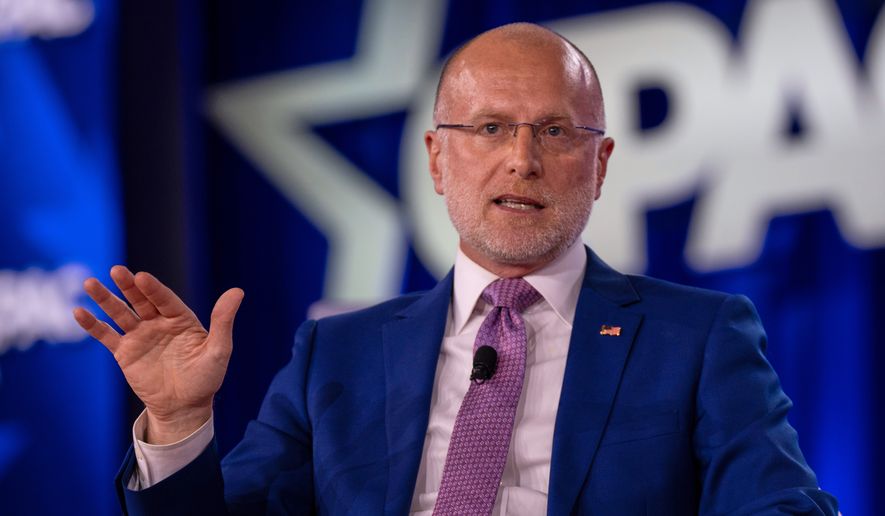

Federal Communications Commission Chairman Brendan Carr said the agency is seeking public comment on whether the television ratings system should include parental warnings for children’s programming that features transgender or gender identity themes, as the FCC reviews whether current ratings adequately inform families about what their children are watching.
Mr. Carr discussed the issue at a press conference, explaining that the FCC Media Bureau has opened a public comment proceeding on possible updates to the television ratings framework. The move comes amid complaints from some parents that children’s programming increasingly features content they consider inappropriate without adequate disclosure.
The existing ratings system traces its origins to the Telecommunications Act of 1996, under which Congress determined that parents should have timely information about programming and the ability to block content they consider harmful to children. TV companies chose to create their own voluntary system, forming the TV Oversight Management Board, which developed the TV Parental Guidelines widely used today across broadcast, cable, and many streaming platforms — though streaming services are not required to adopt them and some use modified or platform-specific standards. The law also required TV manufacturers to develop what became known as the V-chip, allowing parents to block violent, sexual, or otherwise age-inappropriate content.
People were interested in these podcasts
Mr. Carr told reporters the original system was built around a different set of concerns.
“If you go back, Congress passed a law because they wanted parents to be informed about the types of TV programming that their children get,” he said. “At the time there was a lot of focus on violent programming, but the rating system was designed to cover a lot of different issues that parents care about, and increasingly there had been concern raised about some of the transgender content that has been put in children’s television programming.”
The FCC’s public notice, filed under MB Docket No. 19-41, states that “parents have raised concerns that controversial gender identity issues are being included or promoted in children’s programs without providing any disclosure or transparency to parents,” and that shows featuring transgender and gender nonbinary themes are being rated as appropriate for young children without informing parents. The FCC does not directly control the industry’s voluntary ratings system but has statutory authority to review its adequacy.
The agency is seeking feedback on whether the TV industry’s voluntary ratings need to be updated, with a comment deadline of Friday and reply comments due June 22. The inquiry is broader than transgender content alone, also covering board composition and transparency, ratings accuracy and consistency, the handling of public complaints, and whether streaming platforms are applying ratings standards uniformly. Among the specific questions posed: whether programs rated TV-Y, TV-Y7, and TV-G that contain gender identity themes should be rated differently or carry new descriptors, and whether the TV Parental Guidelines Monitoring Board is sufficiently balanced to include perspectives beyond the entertainment industry.
Mr. Carr framed the effort as one of parental empowerment rather than government censorship.
“I think even people that are on different sides of issues as a general matter, I think they all agree fundamentally parents should be informed and parents should make the decision, not the government for them,” he said. “But few parents have the information that they need to truly make those informed decisions, and that’s what this is ultimately about.”
Anna Gomez, the FCC’s sole Democratic commissioner, pushed back on the rationale. “This is a solution in search of a problem, and another example of this commission prioritizing culture war politics over the real issues that affect consumers every day,” Ms. Gomez said. She pointed to the agency’s own data: the most recent annual report from the TV Parental Guidelines Monitoring Board found only 11 pieces of public correspondence relevant to the board’s work, and spot checks turned up just two instances where a rating needed to be changed.
The FCC’s ratings review is among several recent moves by Mr. Carr to scrutinize broadcast and cable content standards. The FCC at the same meeting also passed measures addressing illegal robocall scams, reducing regulatory burdens, modernizing the Disaster Information Reporting System, and launching an initiative to expand next-generation broadband access in rural areas.
This article was constructed with the assistance of artificial intelligence and published by a member of The Washington Times' AI News Desk team. The contents of this report are based solely on The Washington Times' original reporting, wire services, and/or other sources cited within the report. For more information, please read our AI policy or contact Steve Fink, Director of Artificial Intelligence, at sfink@washingtontimes.com
The Washington Times AI Ethics Newsroom Committee can be reached at aispotlight@washingtontimes.com.

Please read our comment policy before commenting.