



OPINION:
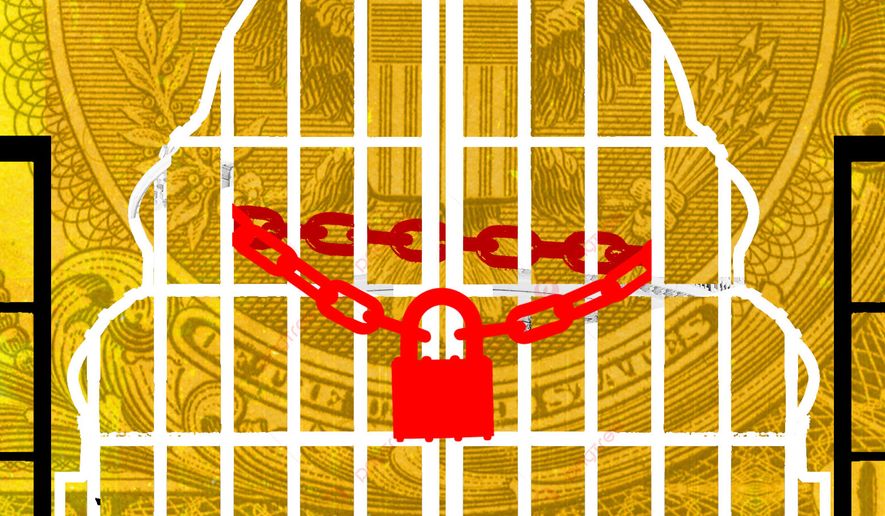
Government shutdowns cause nothing but pain for most Americans.
Our national park rangers, FBI agents and Centers for Disease Control and Prevention scientists work without pay. Airports begin to resemble the game room at a psych ward.
And our economy loses an estimated $15 billion a week in gross domestic product.
People were interested in these podcasts
For some politicians, though, government shutdowns can be a win-win. They can throw the country into chaos to further their political agenda, and they never miss a single paycheck along the way.
In turn, government shutdowns have become the default solution for members of Congress who refuse to work together to overcome political differences.
That’s why my Democratic colleagues chose to shut down the entire government for a record-breaking 43 days in October rather than come to the negotiation table to address their concerns about Obamacare subsidies.
It’s also why my Democratic colleagues refused to fund the Department of Homeland Security for another record-breaking 76 days when they didn’t agree with the way the Trump administration was handling the deportation of illegal immigrants.
Instead of talking through the reforms U.S. Immigration and Customs Enforcement had already made — including an agreement to wear body cameras — Democrats let more than 100,000 Homeland Security Department employees languish without pay until Republicans could refund the agency through other means.
During that time, the department faced an assassination attempt against President Trump and four apparent terrorist attacks, including a gunman at a bar in Austin, Texas, a bombing outside Gracie Mansion in New York City, a shooter at Old Dominion University and an attack at a synagogue in Michigan.
It faced all of these without knowing whether DHS offices would be able to afford printer paper because of the never-ending shutdowns.
In total, DHS employees have worked under shutdown conditions for 56% of the past seven months because my Democratic colleagues refused to work through our differences in good faith.
Meanwhile, senators took every one of their paychecks during both shutdowns. (I voluntarily stopped taking mine.) It’s enough hypocrisy to trigger the gag reflex of every fair-minded American.
That’s why I’ve been working to change the rules of the Senate to block members from receiving paychecks during a shutdown. My effort began in October, when my colleagues and I began introducing resolutions that would make it much more painful for senators to choose to shut down the government.
We considered permanently cutting the pay of senators for every day of a government shutdown. We also considered a resolution that would force senators to remain in Washington during government shutdowns. No visits home until the government reopens.
Some of my colleagues believed these changes were unconstitutional. They pointed to the 27th Amendment, which states, “No law, varying the compensation for the services of the Senators and Representatives, shall take effect, until an election of Representatives shall have intervened.”
That’s why I carefully crafted a resolution — with the support of Republican Sens. Katie Britt of Alabama, Susan M. Collins of Maine, John Cornyn of Texas and Ashley Moody of Florida — that would comply with the 27th Amendment. It would change the Senate rules to require the Senate secretary to temporarily withhold each senator’s pay for the length of the shutdown.
Our paychecks would sit in a vault until the government reopens. When the government reopened, back pay would be given out.
After months of pressure, my colleagues finally saw the light. Last week, my resolution passed the Senate through a voice vote.
I’m not saying this will stop all shutdowns. To start, my resolution affects only senators. The House will have to come up with its own rule if it wants its members to feel the financial sting of a government shutdown.
Additionally, to comply with the language of the 27th Amendment, my resolution cannot take effect until after the midterm elections in November.
Our current budget agreement lasts until Sept. 30, 2026. My Democratic colleagues will once again face a choice: Work together for the American people or shut down the government.
I hope I’m wrong, but I fear Senate Democrats will choose to throw the country into chaos ahead of the midterms one more time because they know they will be paid through November.
If I were king for a day, my resolution would take effect immediately. No senator would be able to leave Washington during a government shutdown, and we wouldn’t get back pay. But I can’t get the votes for that.
This current resolution is an important first step in ensuring that every senator has some skin in the game when they vote to shut down the government. It’s called shared sacrifice.
Every Senate Democrat voted to pass my resolution. I hope this is a sign that my colleagues will no longer resort to shutting down the country as their default response to our disagreements — but I regret to say that I won’t be holding my breath.
• Sen. John Kennedy, a Republican, has served as a U.S. senator from Louisiana since 2017.

Please read our comment policy before commenting.