



The U.S. has gone nearly 18 months without a Senate-confirmed surgeon general, cycling through failed nominations and acting replacements — and now some are asking whether the position needs to exist at all.
For more than 200 years, the surgeon general has served as the nation’s top doctor, a figure trusted to cut through partisan noise and speak plainly about public health, but the position has been diminished in recent years.
The vacant position has prompted some libertarians and MAHA influencers to call for the Office of the Surgeon General to be dissolved and for its responsibilities to be shifted to other agencies, such as the Department of Health and Human Services.
People were interested in these podcasts
Jeffrey Singer, a senior fellow at the libertarian Cato Institute’s Department of Health Policy Studies, said few Americans have noticed the lack of a surgeon general, and having one doesn’t make anyone healthier.
“We don’t need a federal position telling people to drink their milk and eat their vegetables,” said Dr. Singer, a practicing general surgeon for more than three decades.
“In the last few years, we’ve had [the] surgeon general issue reports on healthy recipes, workplace well-being, health worker burnout, and social media usage. Why do we need a surgeon general telling us this stuff? I could ask my doctor about all this stuff,” he said.
Former U.S. Surgeon General Richard Carmona, who held the position for four years under President George W. Bush, disagrees.
He said the surgeon general is vital to America’s national security. During his tenure, he helped develop the nation’s response to public health emergencies such as bioterrorism and bird flu, and his office provided medical care and vaccines to those displaced by Hurricane Katrina.
“Can you go to your local doctor and ask them about the hantavirus or bioterrorism?” he said. “The surgeon general is always at the table when there are discussions about health, safety or national security because public health is national security. You can eliminate it, but then that’s one less person speaking truth to power.”
The office has been abolished before. In 1968, President Johnson eliminated it and relegated the surgeon general to an advisory position. Congress reestablished the office in 1979, and by 1987, it had returned to a fully staffed office.
Since being restored, questions surrounding the office’s necessity have persisted. That chorus has grown in recent years.
During Mr. Trump’s first term, Surgeon General Jerome Adams was largely relegated to the sidelines while infectious disease specialist Dr. Anthony Fauci took center stage as the COVID-19 pandemic raged around the globe. At the time, Dr. Fauci was director of the National Institute of Allergy and Infectious Diseases.
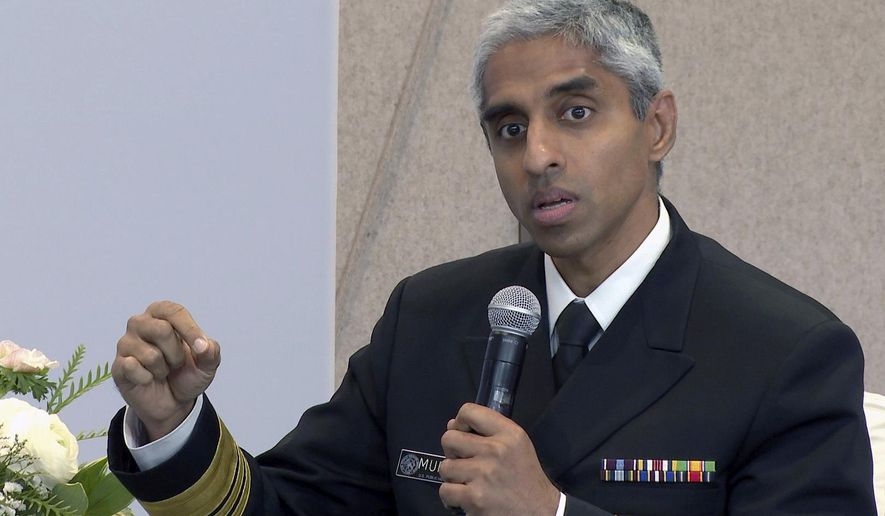
That trend continued for the first half of the Biden administration with Dr. Fauci, who became chief medical adviser to the president, overshadowing President Biden’s pick for the surgeon general’s position, Vivek Murthy.
Mr. Trump last year pulled his nomination of Janette Nesheiwat for surgeon general after questions arose about her medical qualifications and background. Dr. Nesheiwat said she had a medical degree from the University of Arkansas School of Medicine when she actually earned her degree from the American University of the Caribbean School of Medicine, located in St. Martin.
The president quickly replaced her with Casey Means, whose nomination was withdrawn last month over her vaccine skepticism and lack of an active medical license, which lapsed in 2024. He then put forth his third nominee for the position, Nicole Saphier, a radiologist and medical journalist.
Health and Human Services Secretary Robert F. Kennedy Jr. on Wednesday tapped the top staffer in the Office of the Surgeon General, Dr. Stephanie Haridopolos, to take over some of the surgeon general’s duties until the role is filled by a Senate-confirmed nominee.
Dr. Haridopolos, who is married to Rep. Mike Haridopolos, Florida Republican, will assume some of the responsibilities but will not take over the U.S. Public Health Service, a critical role for the surgeon general. She will also not serve in uniform, unlike typical surgeon generals.
There is no guarantee of Dr. Saphier’s confirmation. She was reportedly weighed as a potential surgeon general pick after the 2024 election, but was initially dismissed because of concerns that her radiology specialty had not put her in direct enough contact with patients.
Dr. Saphier has already come under fire from those in the Make America Healthy Again movement because of her criticism of Mr. Kennedy Jr.’s approach to treating autism.
Popular MAHA influencer Alex Clark called Dr. Saphier “a catastrophic mistake on messaging and communicating with MAHA at a time when the coalition is very fragile.”
“It will be perceived as the [administration] breaking another promise to them and embracing the status quo in health care that ended us smack dab in the middle of the chronic disease epidemic we now find ourselves in,” Ms. Clark wrote on X.
Dr. Carmona said picking a candidate to become a mouthpiece for an administration’s political affiliation has eroded public trust in the office.
He called on Congress to pick an independent surgeon general rather than having a president select a candidate based on ideology.
“If you want to fix this, return to a true meritocracy,” he said.
Several controversies have involved former surgeon generals, including C. Everett Koop’s now-debunked claim that video games increased violence among children; Joycelyn Elders, who was fired after saying masturbation should be taught in schools to prevent AIDS; and Dr. Murthy’s controversial labeling of gun violence as a public health crisis.
“We don’t have one and people get upset about it, but they are sparking unnecessary controversies, cultural wars that are completely avoidable,” Dr. Singer said. “We’ve got enough things to fight about, why add this to the mix?”
The surgeon general’s only statutory responsibility is to manage the Public Health Service Commissioned Corps, a little-known government agency that employs about 6,000 uniformed medical professionals. The agency is obscure; it was barely mentioned during Ms. Means’ confirmation hearing.
The corps dispatches its workers to 37 different federal agencies, but a Cato study concluded that 51% of those agencies have a minimal relation to public health and 38% have a partial relationship to public health.
It operates with a $34 million budget, which is paid for by the agencies. That’s in addition to the $24 million budget of the Office of the Surgeon General, which includes the surgeon general’s $200,000 annual salary.
Cato estimates that eliminating the Commissioned Corps would save the government $1.3 billion a year. That number does not include the health and retirement benefits the government is paying to the corps members or the cost of the Office of the Surgeon General.
Dr. Carmona said eliminating the position makes Americans less safe, saying the public doesn’t get to see a lot of the behind-the-scenes national security initiatives that involve the surgeon general. He said the lack of the position would make Americans less healthy and less protected.
“Do you need a vice president? Do you need a senator? Do you need any of the federal leadership positions?” he said. “The fact that you don’t have one doesn’t mean you don’t need it. It’s an important leadership position to carry out the presidential mandates for what needs to be done for the safety and security of the nation.”
Correction: An earlier version of this story misstated the role of Stephanie Haridopolos, who will be taking over some of the surgeon general’s duties.

Please read our comment policy before commenting.