


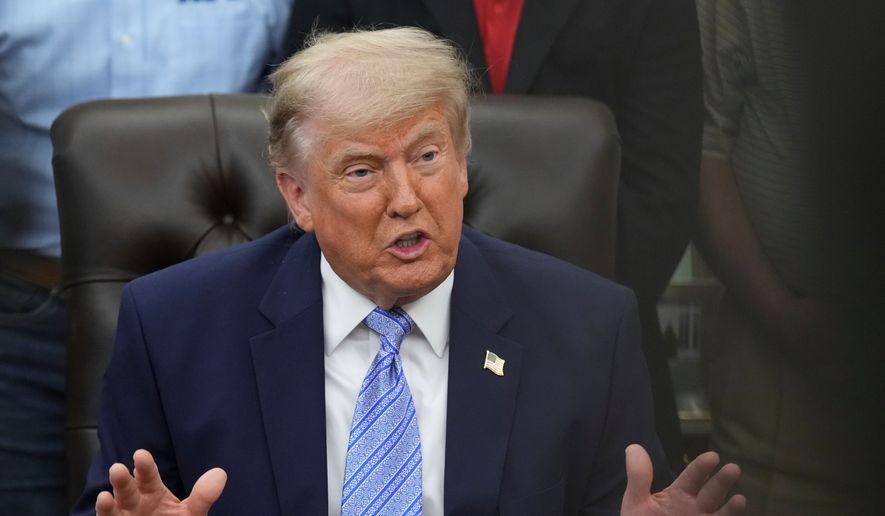

President Trump scrapped his plans to sign an executive order regarding artificial intelligence and cybersecurity that would have invited AI companies to voluntarily give the federal government early access to test their anticipated releases.
In the president’s own words, he did not like some of it.
Thursday’s move came hours before the anticipated White House signing ceremony, with AI executives expected to be in attendance. Meta CEO Mark Zuckerberg, SpaceX CEO Elon Musk and AI adviser David Sacks reportedly spoke with the president before the order was put on hold.
People were interested in these podcasts
Mr. Trump, however, pinned the postponement on himself and China.
“I didn’t like certain aspects of it. I postponed it,” he told reporters. “I think it gets in the way of — we’re leading China. We’re leading everybody, and I don’t want to do anything that’s going to get in the way of that.”
He added that he was concerned that the presidential mandate “could have been a blocker.” It is unclear when the signing might be rescheduled.
The draft executive order, released by Politico, says the U.S. “continues to lead the world in Artificial Intelligence (AI) because of the enormous talent and innovation of our AI industry, and because we refuse to stifle this innovation with overly burdensome regulation.”
While advanced AI capabilities come with their benefits, they “also introduce new national security considerations that require coordinated action across executive departments, agencies, and components.”
The order would have established a policy of collaborating with the private sector to modernize and harden government and critical infrastructure systems, protect American intellectual property from foreign theft and develop advanced AI-enabled capabilities.
It would have created a back-channel between the government and AI labs where, before a powerful AI model is released to the public, the government would preview it for up to 90 days — ahead of release to partners, let alone the general public.
The Treasury Department, National Security Agency, and Cybersecurity and Infrastructure Security Agency would jointly create a classified benchmarking process to assess AI models’ advanced cyber capabilities and define a threshold for designating a “covered frontier model.” A voluntary framework with AI developers would be designed where companies could collaborate with the government to select trusted partners for early access to promote secure innovation.
The Committee on National Security Systems and the defense secretary would also have been required to prioritize cyber defense of their respective systems. The CISA would have issued binding directives to speed up cyber defense of civilian government systems, expand AI-enabled defensive tools, and give federal agencies, state and local government, and critical infrastructure operators access to cybersecurity tools — including frontier AI models.
The treasury secretary would lead a new voluntary body with industry and critical infrastructure operators to coordinate scanning for software vulnerabilities, validate them and prioritize patches.
The Office of Management and Budget would assess whether existing grant programs could be redirected toward AI vulnerability detection, while the Office of Personnel Management would expand U.S. Tech Force cybersecurity specialist hiring pathways.
Lastly, it would call on the attorney general to prioritize prosecution under existing federal computer fraud, identity and wire fraud statutes against anyone using AI to illegally access or damage computer systems, or using AI agents to unlawfully access data for criminal purposes.
The AI-friendly Trump administration will continue to work closely with the industry to “ensure that the best and most secure technology is deployed rapidly to confront any and all threats to our country,” the draft reads.
Contact the author


Please read our comment policy before commenting.