


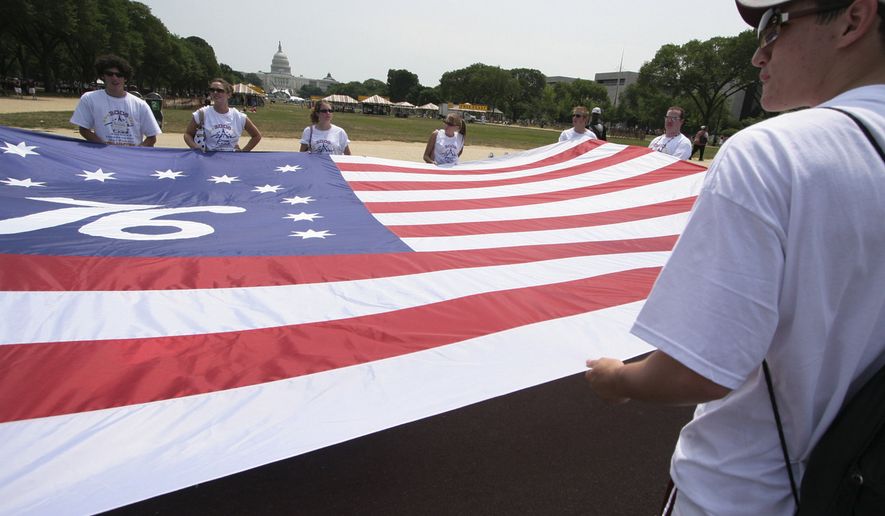

As the nation’s 250th birthday approaches, pollsters, researchers and media outlets have focused attention on the future via the hopes and aspirations of young Americans.
For example, a Harvard Institute of Politics survey found that 59% of young Americans say the country is on the wrong track, 13% say it’s on the right track and 26% are unsure. The nationwide survey of 2,018 Americans between 18 and 29 years old was conducted March 26-April 3.
Meanwhile, the Carnegie Endowment for International Peace survey found that 64% of Generation Z (those born between 1997 and 2012) say it would be better for the country to take an active part in world affairs and 36% say it would be better not to be active in world events.
People were interested in these podcasts
And a PPRI survey found that members of Gen Z adults tend to be more liberal and religiously diverse than their elders, while Gen Z teens are more moderate politically and attend church more often than older folks.
The Washington Times posed four questions in a nonscientific, online survey to find out what millennials (those born between 1981 and 1996) and Gen Z think about the past 250 years and what they foresee for the next 250.
What lessons from the past 250 years can or should apply to the next 250 years?
“That democracy is fragile and needs to be protected. Our country was founded on an ideal of ‘liberty and justice for all’ at a time when, as we all know, only meant White men who owned property. However, I believe the ideal is a mighty one to fight for. We have seen these principles be manipulated to serve a few, but we’ve also seen them allow populations of people to flourish like when women had autonomy over their bodies, trans people had access to gender-affirming care, immigrants could live here without the fear of being kidnapped and deported. For now, queer people can marry who they love and we still have laws in place fighting discrimination. The people of the United States have worked tirelessly for generations to give themselves liberty and justice. We’ve lost a lot of that in recent years. However, I believe as a collective we can restore the rights of the American people. We have the power to do better than we’ve done.” — Emma Shafer, 30, Iowa
“Hurting the environment will hurt the economy and Americans’ health. Protect our planet and we’re protecting ourselves.” — Griffin Kelly, 32, New York
“George Washington suggested in his Farewell address to stay away from political parties.” — Rani Singh, 23, New York
“The power of the executive branch is incredibly broad and thus easily lends itself to populist takeovers. The executive can ‘move fast and break things,’ often waiting years for any chance for judicial intervention (if ever). No other modern western democracy vests this much power in their president or prime minister. Gerrymandering is all too easy. Without a rigidly defined way to create districts, it will always lend itself to warring and unfairness. The system relies on both sides playing by the rules, and too often that’s not the case. It is very clear that there is only one party that benefits when fewer people choose to vote, and to this end, central to that party’s agenda is making the voting process more difficult. If it’s more difficult, fewer people vote. This means that this party has a vested interest in the nation’s democracy being less perfect, and as long as this is the case, American democracy will have on it a massive blemish.” — Michael J. Smith, 27, Massachusetts
“I think the U.S. can learn the importance of inclusion, and making space for everybody to belong. If we collaborate with one another and accept each other for who we are, we can make a more cohesive and equal land!” — Maxine Van Nortwick, 19, New York
“Humanity should be better equipped and prepared for global warming, pandemics, climate change and financial crises.” — Tiara Brownie, 32, New York
What problems should be resolved over the next 250 years and how?
“Moving away from oil and renewable energy becoming the primary energy source for the country.” — Nick Song, 26, California
“I think the United States is too politically polarized. Social media and political rhetoric has divided the nation. I think the best way to combat polarization is to have people from different viewpoints and political backgrounds sit in conversation with one another to discuss issues and to propose solutions. I think many Americans are also so disillusioned by the economy, the current war and our foreign policy that many Americans are lost or confused on whether to trust the people they put in power. I think there must be transparency between the government and the people and also the government should be responsive to their constituents’ needs instead of slashing funding from government organizations. Lastly, what needs to be resolved is the inflation crisis. Americans need to afford to have living wages to afford to buy groceries, afford rent or buy homes. In certain cities/states, like New York City, it’s almost impossible to live in.” — Rani Singh, 23, New York
“We should fix the issues of violence and corruption in our police department. There should be stricter background checks and mental evaluations.” — Alexia Cervantes, 23, New York
“The laundry list is long. However, for me, I believe the decision if and when to have a child is at the center of a lot of our problems. When women have autonomy over their bodies, they have autonomy over their lives. If they have that autonomy, their lives flourish and therefore communities become healthier. … It snowballs from there. The right to an abortion needs to be enshrined into law in every state. How? … electing more individuals like [New York City Mayor Zohran] Mamdani into office. Funding places like Planned Parenthood. Providing comprehensive sex education in schools for all ages (not just one class in seventh grade). Supporting mutual aid funds and clinics that are still open. Being loud about what we need.” — Emma Shafer, 30, Iowa
What role will religion, artificial intelligence and socialism/capitalism play over the next 250 years?
“I think these human behaviors will change and morph as time goes on, as they are not static ideas. Our conceptions of things adapt alongside our needs and environment.” — Maxine Van Nortwick, 19, New York
“I hope 250 years from now religion is no longer being co-opted by American exceptionalism. We don’t need power-hungry grifters in government operating with a window dressing of religion. That’s disrespectful to faiths, to Americans and to our institutions.” — Griffin Kelly, 32, New York
“AI will replace many jobs.” — Will Gomez, 40, New York
“I think new religions will form in those years and artificial intelligence will change the way our economy works.” — Alexia Cervantes, 23, New York
What role do you think the U.S. will play on the global stage over the next 250 years?
“Smaller one than in years past but still a great power.” — Nick Song, 26, California
“The role I think the U.S. will play is based on dominance decreasing in the country. Decreasing dominance usually coincides with the fragmentation of global trade.” — Tiara Brownie, 32, New York
“A monumental one. We can see the negative impact and role that the United States is playing in the genocide in Gaza, the war in Iran, the energy crisis in Cuba just to name a few. Due to the position of power that the United States holds globally, a lot of insane damage can be done to other countries people and our planet at large. My hope is that the people of the United States can continue to resist, put pressure on reps, protest, and use our collective voice to stop the harm the Unites States is doing on a global scale now and in the future.” — Emma Shafer, 30, Iowa
“Much less of a role as it was in 2023, as other countries come to the realization that pinning global prosperity and security on a handful of midwestern American states and impotent institutions is a failing strategy. This blow is entirely self-inflicted.” — Michael J. Smith, 27, Massachusetts
Contact the author


Please read our comment policy before commenting.