


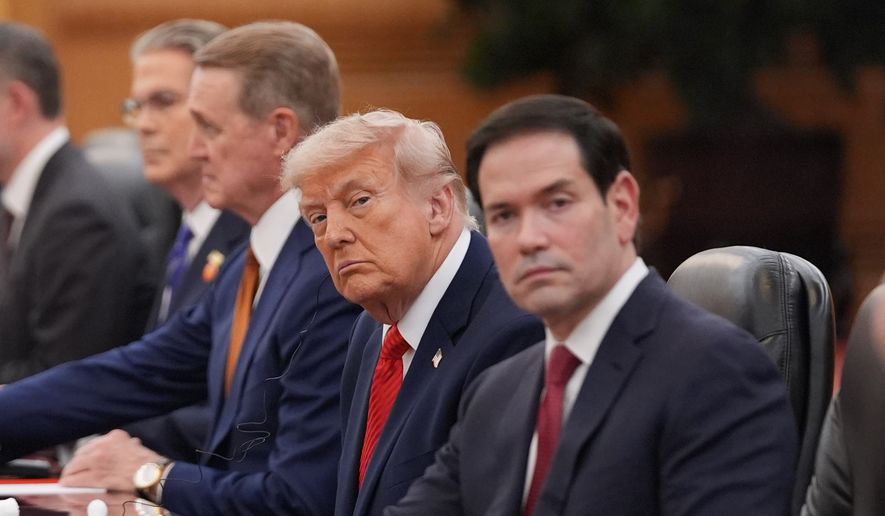

President Trump teased signing a peace deal to end the war in Iran on Monday, following a weekend of mixed signals regarding negotiation progress.
Mr. Trump and Secretary of State Marco Rubio both sounded optimistic Monday regarding the possibility of a peace deal with Iran, but Tehran warned that unresolved issues remain.
Over the weekend, Mr. Trump said a peace deal with Iran is “largely negotiated,” while Mr. Rubio said an agreement to reopen the Strait of Hormuz could be announced imminently.
People were interested in these podcasts
“We thought we might have some news last night. Maybe today,” Mr. Rubio told reporters in New Delhi, adding, “I wouldn’t read too much into it. It takes a little while to hear back from Iran.”
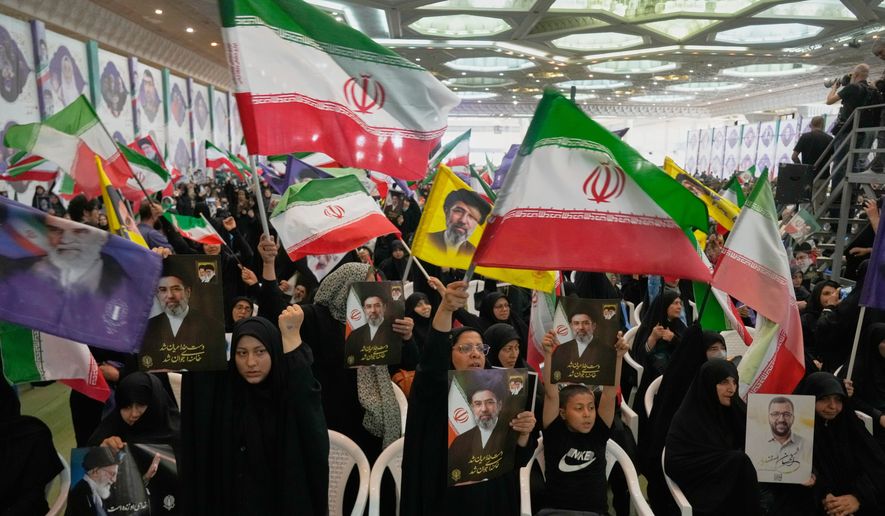
However, over the weekend, Mr. Trump instructed negotiators “not to rush into” a peace agreement.
While Iran nodded toward agreeing with certain aspects of a deal, its leaders argued that “frequent changes” and contradictions by the U.S. side present “problems and obstacles.”
SEE ALSO: Oil prices dip as markets anticipate potential U.S.-Iran peace deal
There was a break in the cease fire Monday night, as the U.S. military hit Iranian missile-launch sites and minelaying boats around the Strait of Hormuz.
In a statement, U.S. Central Command said the strikes were defensive.
“U.S. forces conducted self-defense strikes in southern Iran today to protect our troops from threats posed by Iranian forces. Targets included missile launch sites and Iranian boats attempting to emplace mines,” said CENTCOM spokesman Capt. Timothy Hawkins.
“U.S. Central Command continues to defend our forces while using restraint during the ongoing ceasefire,” he said.
Iran’s parliament speaker and its foreign minister, Mohammad Bagher Qalibaf and Abbas Araghchi, respectively, met with Qatari leadership Monday, “aimed at resolving outstanding issues” in the way of a U.S.-Iran peace deal, Qatari government-owned Al Jazeera network reported.
Oil prices dropped amid hopes of a deal.
SEE ALSO: U.S. conducts ‘defensive’ strikes in response to ‘threats posed by Iranian forces’
Brent crude, the global benchmark, fell 7.15% to $96.14 per barrel Monday afternoon, as crude oil prices dipped below $100 for the first time in a month amid negotiations to reopen the strait, the vital waterway through which about 20% of the world’s oil and gas is shipped. The stock markets, meanwhile, were closed for Memorial Day.
The price, while significantly lower than its peak of $120 during the conflict, is still much higher than the $72 a barrel crude was trading at as the war began Feb. 28.
Pump prices, meanwhile, have dropped slightly. The national average for a gallon of regular gasoline is now just over $4.50, according to AAA. That is just 1 cent lower than Sunday’s average and a few cents lower last week’s. It is, however, about 40 cents higher than last month’s average. When AAA projected record travel numbers for Memorial Day weekend, the national average sat at $4.56.
Israeli Prime Minister Benjamin Netanyahu has reportedly complained of his limited ability to influence Mr. Trump’s negotiations, Reuters reported, citing anonymous sources. Mr. Netanyahu allegedly wants the freedom to continue operations against perceived threats, including in Lebanon, home to Iran-based Hezbollah, which could derail a peace deal if Iran opposes.
He also has reportedly expressed concerns about the memorandum of understanding currently being negotiated.
Israeli opposition leader Yair Lapid, who is part of an alliance attempting to unseat Mr. Netanyahu in elections this year, said the details of the emerging deal are “disturbing.”
“The deal is bad for Israel, bad for the region, bad for the citizens of Iran,” Mr. Lapid told reporters in Jerusalem.
The terms in the draft memorandum of understanding reportedly include a 60-day extension of the current ceasefire; Iran immediately reopening the Strait of Hormuz; Iran, the U.S. and their allies ending military operations; and Iran agreeing that it will never develop nuclear weapons and that its stockpile of enriched uranium will be disposed of.
“Negotiations with the Islamic Republic of Iran are proceeding nicely! It will only be a Great Deal for all or, no Deal at all — Back to the Battlefront and shooting, but bigger and stronger than ever before — And nobody wants that!” Mr. Trump posted on Truth Social on Monday morning.
He said that during his Saturday discussions with the leaders of Bahrain, Egypt, Jordan, Pakistan, Qatar, Saudi Arabia, Turkey and the United Arab Emirates and, he told them that they must sign the Abraham Accords — a “minimum” requirement after “all the work done by the United States to try and pull this very complex puzzle together.”
He said the Abraham Accords — a series of landmark normalization agreements brokered by the U.S. to establish formal diplomatic, economic and security ties between Israel and Bahrain, Kazakhstan, Morocco, Sudan and the UAE — has been a “Financial, Economic, and Social BOOM, even during this time of Conflict and War.”
“It should start with the immediate signing by Saudi Arabia and Qatar, and everybody else should follow suit. If they don’t, they should not be part of this Deal in that it shows bad intention,” Mr. Trump said, adding that the countries’ leaders said that they would be “honored” to have the Islamic Republic of Iran join the Abraham Accords.
“Therefore, I am mandatorily requesting that all Countries immediately sign the Abraham Accords, and that, if Iran signs its Agreement with me, as President of the United States of America, it would be an Honor to have them also be part of this unparalleled World Coalition,” he said.
Mr. Trump asked his representatives to begin and complete the process of signing the countries into the Abraham Accords.
However, Saudi Arabia and Qatar each has said that they will not join the accords until there is an irreversible path to a fully sovereign Palestinian state, an idea that is not currently viable in domestic Israeli politics. Pakistan and most of the other Middle Eastern nations not already signed onto them have spoken similarly.
The war, launched by the U.S. and Israel on Feb. 28, aimed to prevent Iran from holding onto a nuclear weapon.
• Ben Wolfgang contributed to this article, which is based in part on wire service reports.
Contact the author


Please read our comment policy before commenting.