



The Supreme Court is preparing to close out its term with mammoth rulings that could shape the contours of elections and presidential power and plow new ground on transgender rights.
Rulings are expected through the end of June, when the justices will close out their scheduled work for the 2025-2026 court term.
People were interested in these podcasts
President Trump’s immigration plans will dominate the court’s remaining caseload, with a decision expected on whether he can roll back a humanitarian protection program meant to help people from countries recovering from natural disasters, war or instability.
Known as Temporary Protected Status, it has become a loophole to the regular immigration system, with hundreds of thousands of people living in the U.S. on TPS since the turn of the century. The Biden administration added a million more people to the program, which functions as an amnesty from deportation.
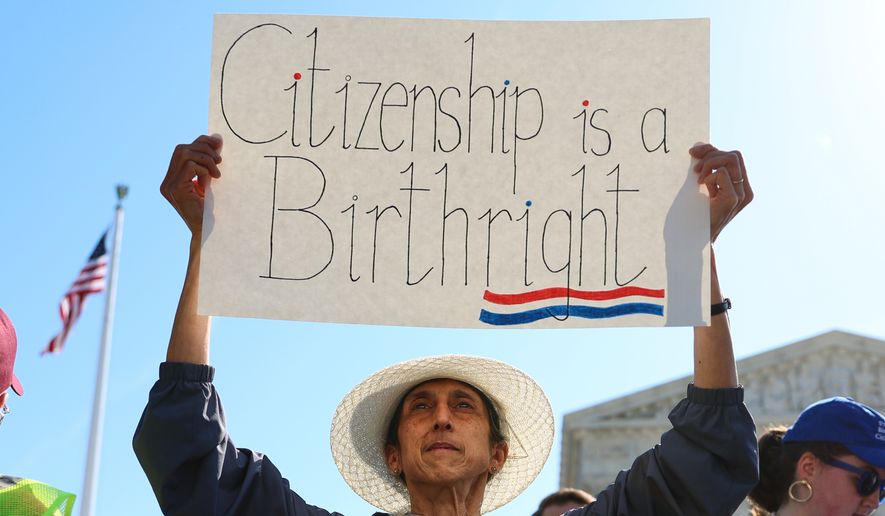
Even bigger will be the high court’s decision on Mr. Trump’s attempt to roll back birthright citizenship for children born to immigrants who are in the U.S. illegally and temporary migrants — such as those on TPS.
Mr. Trump told reporters last week that he expects to lose that case, saying it would be “a disgrace.”
The issue is whether the 14th Amendment, which guarantees automatic citizenship to children born under the jurisdiction of the U.S., was intended to include babies of illegal immigrants and temporary visitors.
An 1898 Supreme Court ruling, a 1940 law and more than a century’s worth of legal scholarship and official practice have backed the idea that the 14th Amendment does cover them.
“I think you have a number of hurdles,” Justice Ketanji Brown Jackson told the government’s lawyer.
Mr. Trump’s power to fire government officials is also on the line, in a series of cases dating to last year’s attempt to sweep anti-Trump workers from the ranks of agencies.
The court seemed poised to overrule a 91-year-old precedent that has limited firing powers at so-called independent agencies.
In 1935, the court said President Franklin D. Roosevelt couldn’t boot a member of the Federal Trade Commission over political differences.
But the justices signaled during oral arguments last year that Mr. Trump’s ouster of FTC Commissioner Rebecca Slaughter over policy disagreements was likely valid.
The justices were less inclined to bless Mr. Trump’s attempt to fire Federal Reserve Governor Lisa Cook. Unlike Ms. Slaughter in the FTC case, Mr. Trump said he was removing Ms. Cook for cause, citing allegations of mortgage fraud.
Mr. Trump fired Ms. Cook with a social media post, denying her a chance to challenge the ouster as unfair or illegal, then argued that the courts had no role in refereeing the matter.
Even before the final month’s cases, it has been a historic court session, with one decision constraining the president’s tariff powers and another rewriting the underpinnings of the Voting Rights Act, prescribing a more colorblind approach for states when they draw their legislative maps.
That case, Callais v. Louisiana, has ignited a new round of redistricting in Republican-led Southern states and left Democrats vowing retribution when they redraw lines in states they control.
“I don’t think there is going to be a bigger case when we look back at this term in the election area than Callais,” said Ilya Shapiro, director of constitutional studies at the Manhattan Institute. “We have campaign finance cases, we have how ballots are counted, we have voting rights cases, so there is a lot of a mix of election cases that on their own would be a big one for any given year.”
The ballot-counting case challenges the growing sense that Election Day is really election season.
The Republican National Committee challenged Mississippi’s law that allowed mail-in ballots to be counted if they are received up to five days after Election Day, as long as they were sent by the actual day.
Opponents say late-counting ballots increases suspicion about elections chicanery. Proponents say it expands access to voting.
Should the RNC prevail, it could affect laws in roughly 30 states that allow ballots received after Election Day to be counted. Some allow that only for military voters overseas, while others are more permissive. The District of Columbia allows ballots received up to three weeks after Election Day to be counted.
The justices also will decide a case testing rules limiting how much political party committees can coordinate on spending with their preferred candidates.
The National Republican Senatorial Committee and Vice President J.D. Vance asked the high court to remove the limits policed by the Federal Election Commission, arguing it infringes on their First Amendment speech rights without producing much benefit to the political process.
They said coordination happens anyway, but through a clunky process.
Jessica Furst Johnson, who practices election law at Lex Politica, worked on the case. She said this term has been filled with hefty cases.
“I’ve been practicing for almost two decades now and 20 years ago when I said I was going into election law, no one knew what that was or whether you could make a career out of that. People thought I was crazy,” Ms. Furst Johnson said.
“It’s definitely a hot topic. I think Americans are focused on it and ensuring that their elections are safe and secure so I am not surprised we are seeing these cases bubble up to the court,” she said.
On transgender rights, the high court is pondering whether transgender students have a right to participate in girls’ and women’s sports leagues.
Most states have laws restricting transgender girls and women. Cases out of Idaho and West Virginia reached the justices, who appeared sympathetic to the states.
The case follows one in 2025 in which the justices allowed a state law that restricted medical providers from performing surgery or prescribing medications intended to foster a gender transition.
This year’s ruling could lay the groundwork for future cases on transgender students’ bathroom and locker use.
Even as it plows new ground on sex, the court will revisit the persistent issue of gun rights, with cases challenging restrictions on who can possess firearms and limits on where they can be carried.
One case comes out of Hawaii, where the law says that even those who are permitted to carry concealed weapons must get explicit permission to carry on private property, even if that property is generally open to the public, such as a store.
A second case tests whether someone who used marijuana a few times a week would qualify as a dangerous habitual user whose gun rights could be denied.
Contact the author



Please read our comment policy before commenting.