


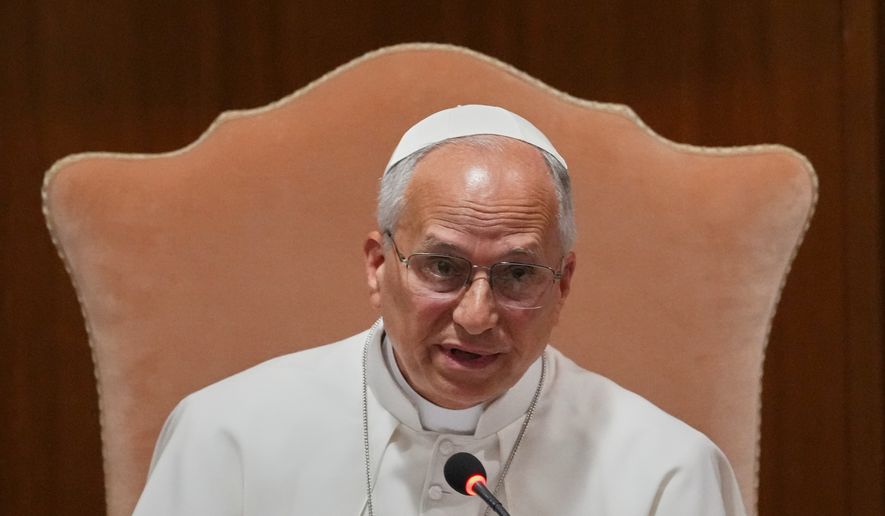

VATICAN CITY — Pope Leo XIV made a historic apology on Monday for the Holy See’s role in legitimizing slavery and for having failed to condemn it for centuries, calling the Vatican’s record a “wound in Christian memory.”
Past popes have apologized for Christians’ involvement in the trans-Atlantic slave trade. But no pope had ever publicly acknowledged, much less apologized for, the role that past popes played in giving European sovereigns explicit authority to subjugate and enslave “infidels.”
History’s first U.S.-born pope, whose family history includes both enslaved people and slave owners, delivered the apology in his first encyclical, “Magnifica Humanitas,” (Magnificent Humanity), which was released Monday.
People were interested in these podcasts
The sweeping manifesto is about safeguarding humanity in an era of increasing reliance on artificial intelligence. Leo raised the slave trade in relation to what he called the new forms of slavery and colonialism that the digital revolution is fueling.
Black American Catholics, activists and scholars have long called for the Holy See to atone for its role in the colonial-era trade in human beings, beyond generic apologies for the involvement of individual Christians.
“It is impossible not to feel deep sorrow when contemplating the immense suffering and humiliation endured by so many in stark contrast to their immeasurable dignity as persons infinitely loved by the Lord,” Leo wrote. “For this, in the name of the church, I sincerely ask for pardon.”
The Vatican has insisted that it always upheld the dignity of all human beings as children of God. But a series of 15th-century directives from the Vatican authorized Portuguese sovereigns to conquer Africa and the Americas and enslave non-Christians.
In 1452, for example, Pope Nicholas V issued the papal bull Dum Diversas, which gave the Portuguese king and his successors the right “to invade, conquer, fight and subjugate” and take all possessions — including land — of “Saracens, and pagans, and other infidels, and enemies of the name of Christ” anywhere.
The bull also gave the Portuguese permission “to reduce their persons to perpetual slavery.”
Anthea Butler, senior fellow at the Koch History Center, Oxford University, said Leo needed to acknowledge and atone for the church’s complicity in historic slavery if he wanted to credibly “speak to the current issues of technological enslavement.”
The pope also called for robust regulation of artificial intelligence and for its developers to work for the common good rather than profit, issuing a sweeping manifesto on safeguarding humankind as the technology impacts everything from work to war.
Leo has said that he considers AI to be the biggest challenge facing humanity today.
On Monday, he denounced the “culture of power” driving the AI race, especially in developing ever more sophisticated methods of remote warfare. He declared that it was “not permissible” to entrust irreversible, lethal decisions to AI systems, setting up another flash point between the American pope and the Trump administration, which has worked aggressively to deregulate AI development.
“Artificial Intelligence now demands to be disarmed, freed from logics that turn it into an instrument of domination, exclusion and death,″ the pope told a special Vatican presentation of the encyclical, one of the most authoritative types of teaching documents a pope can issue.
Experts in the tech industry, academia and Catholic morality said the document will likely become a benchmark in the debate over AI, a point of reference for policymakers, researchers and ordinary folk alike. It comes as the near-daily developments in the technology trigger concerns over AI replacing human jobs and even human intelligence.
Taylor Black, a Microsoft AI executive and director of Catholic University of America’s AI institute, said the document would prompt people “at the forefront of these tools” to ask questions such as “What does it mean to be human?”
The Vatican launch also included remarks by the co-founder of Anthropic, which is currently locked in a legal battle with the Trump administration over access to its AI technology. The Vatican decided to involve Anthropic as part of its decade-long effort to engage Silicon Valley in dialogue over the human cost of AI.
And yet in his text, Leo repeatedly blasted the concentration of power and data in the hands of so few people in the private sector as a danger, especially to children and the most vulnerable, and called for external regulation of their work.
“It is not enough to invoke ethics in the abstract; robust legal frameworks, independent oversight, informed users and a political system that does not abdicate its responsibility are required,” he wrote. “A more moral AI is not enough if that morality is determined by a few.”

Please read our comment policy before commenting.