



The column is taking a mini-break with the long holiday weekend, even as we keep a close eye on the 13th Cherry Blossom Classic, a nine-round Grand Prix event that wraps up this week in Sterling, Virginia. As our small contribution to the Memorial Day observations, we offer this week excerpts from two past columns honoring all those who wore the uniform.
—-
Excerpt from a column first printed May 30, 2018:
People were interested in these podcasts
As we marked Memorial Day this week, let us also remember the ways chess has done its part to cheer and console those who go to war.
Many soldiers, sailors and airmen have been strong chess players, and chess has long been a popular way to pass the time in bivouacs, military hospitals and POW camps.
A 2015 World Chess Hall of Fame exhibit on chess and World War II shone a light on a little-known episode in which some of the country’s top women players took part in a program called “Chess for the Wounded,” playing chess with convalescing GIs and training other young women on how to teach the game in military hospitals.
Among those who volunteered their time were champions such as Gisela Gresser, Leslie Bain and Mona May Karff, the three strongest American women players of their day. The colorful, Russian-born Karff won or shared the women’s national title seven times between 1938 and 1974, and was one of the first U.S. players to earn the women’s international master title.
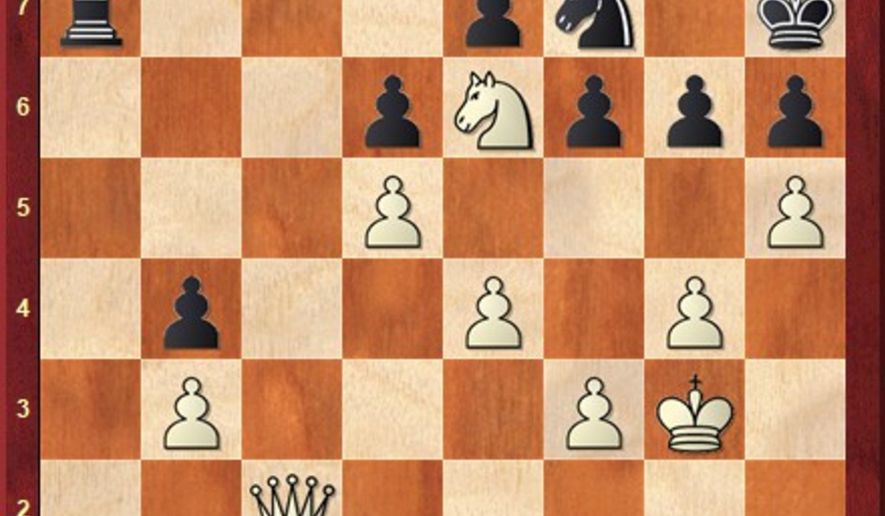
Her talent was on display in a game against Polish champion Krystyna Radzikowska at the 1971 women’s Interzonal in Macedonia. In a Saemisch King’s Indian, Karff bests her higher-rated opponent by repeatedly exploiting moves that weaken Black’s defenses.
After 17. Bh6 Ng8?! (Black is equal on 17…Be6 18. Bxg7+ Kxg7 19. h4 Qb6) 18. Bxg7+ Kxg7 19. Kg2 f6?! 20. h4 h5 21. Rfe1, White has a pleasant variety of pawn breaks to choose from, while the hole created at e6 will come back to haunt Radzikowska. Again, on 30. Nc2 h6?! (Rcb7 practically begs to be played here, with 31. Nd4 Rc3 32. Rxc3 Rxc3 33. Re3 Qc8 fine for Black) 31. Nd4 Kh7 32. Nfe6 Bxe6 33. Nxe6, Black’s knight on e5 is nice, but White’s knight on e6 is a monster, dominating the center and supporting threats on both wings.
The floodgates open after 34. Re3 Rxe3? (a last chance to cover up was 34…Rxc1 35. Qxc1 Ra7 36. Re2 Qb5 37. Rf2 Qa6!, keeping the White queen from infiltrating) 35. Qxe3 Ra7 36. Kg3 Rb7 (an admission that things have gone wrong, but 36…Ra2 37. Rc7 Qe8 38. Qb6 leaves Black tied down) 37. Qe2 Ra7 38. Qc2 Nf7 39. h5! (see diagram), and suddenly there’s no way to hold back the White attack.
The finale: 39…g5 (Ne5 40. hxg6+ Nxg6 [Kxg6 41. Qh2 Qg8 42. f4 Nf7 43. Rc8! Qxc8 44. Qh5+ Kh7 45. Qxf7+ Kh8 46. Qg7 mate] 41. Rh1 Ra5 42. Rxh6+! Kxh6 43. Qh2+ Nh4 44. Qxh4+ Kg6 45. Qh5 mate) 40. e5+ Kh8 41. exf6 exf6 42. Qg6 Ne5 (Black may have banked on 42…Qg8, but 43. Rc8! wins on the spot) 43. Qxh6+ Kg8 44. Qxf6 Kh7 45. Nxg5+ Kg8 46. Qe6+, and Black resigned because 46…Kg7 47. Rc8 is deadly.
—-
Excerpt from a column first printed Sept. 26, 2023:
Chess, by and large, is a war game played by nonmartial people who would have trouble identifying the business end of an M16 or explaining the difference between an embrasure and a sally port.
Happily, there are some notable exceptions, including one annual tradition celebrating the intersection of the military and the chess life.
NATO, as you may have heard, is a powerful military alliance dominated by a single superpower — Germany. Since NATO began organizing a team chess championship in the 1990s, Germany has captured far more titles than any other nation and medaled in 24 straight competitions. It was a bit of a shock last year when Team Germany finished off the podium as Greece scored an upset win.
The Germans returned to their winning ways at the recent 33rd NATO Chess Championship in Portoroz, Slovenia, earlier this month, taking home the gold medal. The U.S. squad grabbed bronze after just being edged out by Greece for the silver medal. German FIDE Master Robert Stein took home the individual gold medal for top score on the top board.
U.S. Airman First Class and FM Patrick Aizpurua had a fine tournament as the American squad’s anchor and was atop the leaderboard at 4-0 before an epic clash with Stein in Round 5.
In an Open Catalan, Stein as White grabs the chance for a central break with 14. e4 g6 15. d5!?, and the pressure grows on the Black defense after 18. Nb3 Qb8?! (a somewhat artificial way to address Black’s shortcomings; something like 18 … b6 looks better) 19. Nc5 Rd8 20. Qf4 Bg7 21. Rfe1, already setting up the threat of 22. Re7 Be8 23. Nb5.
Aizpurua spends several moves liberating his queen from her dungeon, giving White more time to prepare another powerful central break: 24. Red2 Qb6 25. d6! cxd6 26. Nf6+!? (Black is reeling, and the simple 26. Nxd6 Rd7 27. Ncb5 Re7 28. Qh4! might have put him over the edge) Bxf6 27. Qxf6 Bc6 27. Rxd6 Rxd6. White is close to winning, with 30. Rd7 Rf8 31. Bd5 Nxd5 32. Nxd5 Qc5 33. Ne7+ one looming threat, but Black refuses to go down quietly.
Thus: 29 … Qc5! 30. Bxc6 bxc6 31. Ne4 (Qe7!, threatening 32. Rxg6+!, looks stronger here) Qc1+ 32. Kg2 Nc2 33. h4 Ne1+ (Black must keep up the pressure before White’s kingside attack crescendos) 34. Kh2 Qc4! 35. Rd8+?! — perhaps frustrated by his opponent’s dogged refusal to fold, White releases the pressure too soon; on 35. Ng5 Rf8 36. Kg1! h6 37. Ne6! Nf3+ 38. Qxf3 fxe6 39. Qe3, Black will struggle to protect all his weaknesses.
Sadly for Black, he lets down his guard just when his hard work should have saved the half-point in a tricky knight-and-pawn ending: 44. Nd6 Kg7?! (already 44 … Nd3! 45. Nxf7+ Kg7 46. Nd8 Nxb2 47. Kg2 Nxa4 48. Nc6 would be an honorable draw) 45. Nb7 Nd3 46. b3 Nc1? — the last mistake as Black can still hold after 46 … Kf6 47. Nxa5 Nb4 48. Kg2 Ke6 49. Kf3 Kd6, and if 50. Nb7+? Kc7 51. Nc5 (Na5 Kb6), the White knight is trapped after 51 … Kc6.
Black’s passed d-pawn looks dangerous, but after 50. a5 Nd4 (d2 51. Ne3 Nd4 52. a6 Nb5 53. Kg2 Nc3 54. a7 and wins) 51. a6 Nb5 52. Kg2, Black’s passer is stopped and his knight immobilized on the queenside. Stein soon collects the advanced d-pawn and in the final position, Black must concede facing lines such as 61 … g5 62. b5 gxh4 63. gxh4 Nf6 64. Kd4 Kc7 65. Ke5 Ne4 66 h5 Nxf2 67. Kxf5 and wins.
(Click on the image above for a larger view of the chessboard.)
Karff-Radzikowska, Women’s Interzonal, Ohrid, Macedonia, 1971
1. c4 Nf6 2. Nc3 g6 3. d4 Bg7 4. e4 d6 5. f3 c6 6. Be3 a6 7. Qd2 b5 8. a3 Nbd7 9. Rd1 O-O 10. cxb5 cxb5 11. Nh3 Nb6 12. Nf2 Bd7 13. Be2 Rc8 14. O-O Nc4 15. Bxc4 Rxc4 16. g4 Kh8 17. Bh6 Ng8 18. Bxg7+ Kxg7 19. Kg2 f6 20. h4 a5 21. Rfe1 b4 22. axb4 axb4 23. Nd5 Qb8 24. Ne3 Rc7 25. Nd3 Rb7 26. d5 Nh6 27. Rc1 Nf7 28. b3 Ne5 29. Nf4 Rc8 30. Nc2 h6 31. Nd4 Kh7 32. Nfe6 Bxe6 33. Nxe6 Rc3 34. Re3 Rxe3 35. Qxe3 Ra7 36. Kg3 Rb7 37. Qe2 Ra7 38. Qc2 Nf7 39. h5 g5 40. e5+ Kh8 41. exf6 exf6 42. Qg6 Ne5 43. Qxh6+ Kg8 44. Qxf6 Kh7 45. Nxg5+ Kg8 46. Qe6+ Black resigns.
Stein-Aizpurua, 33rd NATO Chess Championship, Portoroz, Slovenia, September 2023
1. d4 Nf6 2. c4 e6 3. g3 d5 4. Nf3 Be7 5. Bg2 O-O 6. O-O dxc4 7. Qc2 a6 8. a4 Bd7 9. Qxc4 Bc6 10. Bg5 a5 11. Nc3 Na6 12. Rad1 Nb4 13. Bxf6 Bxf6 14. e4 g6 15. d5 exd5 16. exd5 Bd7 17. Nd4 Re8 18. Nb3 Qb8 19. Nc5 Rd8 20. Qf4 Bg7 21. Rfe1 Be8 22. Re2 Qa7 23. N5e4 Qa6 24. Red2 Qb6 25. d6 cxd6 26. Nf6+ Bxf6 27. Qxf6 Bc6 28. Rxd6 Rxd6 29. Rxd6 Qc5 30. Bxc6 bxc6 31. Ne4 Qc1+ 32. Kg2 Nc2 33. h4 Ne1+ 34. Kh2 Qc4 35. Rd8+ Rxd8 36. Qxd8+ Kg7 37. Qf6+ Kg8 38. Qd8+ Kg7 39. Qf6+ Kg8 40. Nd6 Qd5 41. Qd8+ Kg7 42. Ne8+ Kh6 43. Qxd5 cxd5 44. Nd6 Kg7 45. Nb7 Nd3 46. b3 Nc1 47. Nxa5 d4 48. b4 d3 49. Nc4 Nb3 50. a5 Nd4 51. a6 Nb5 52. Kg2 Kf6 53. Kf3 Ke6 54. Ke3 Kd5 55. Kxd3 f6 56. Ne3+ Kc6 57. Ng4 f5 58. Nf6 Kb6 59. Nxh7 Nd6 60. Nf8 Ne4 61. Ke3 Black resigns.
• Got a hot tip or a cool game to share? David R. Sands can be reached at davidrsands18@gmail.com.

Please read our comment policy before commenting.