


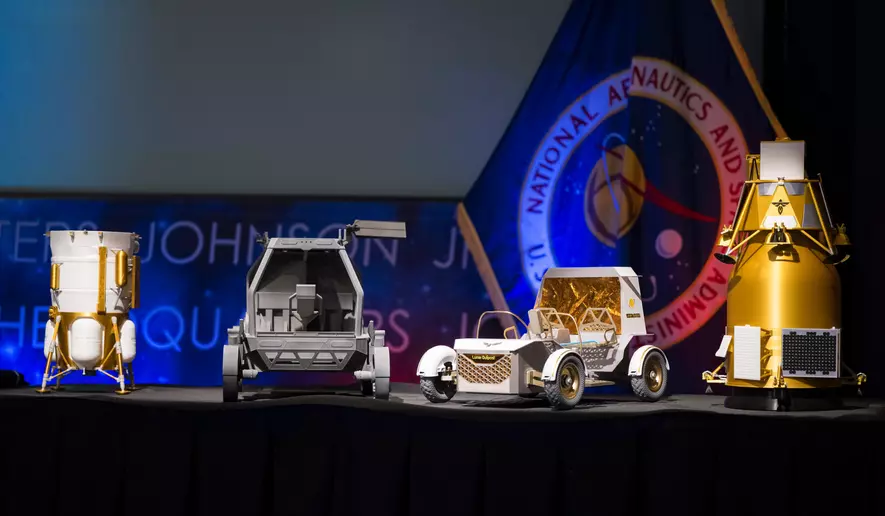

NASA unveiled new Moon Base infrastructure plans Tuesday, announcing rover contracts, cargo lander missions and a fleet of survey drones as the agency works to establish a sustained lunar presence near the Moon’s South Pole ahead of future crewed Artemis landings.
NASA Administrator Jared Isaacman said the Moon Base will serve as humanity’s first outpost on another celestial world. NASA said the missions are intended to generate operational data and reduce risk before astronauts return to the lunar surface.
The agency outlined three initial Moon Base missions. The first, Moon Base I, is targeted for launch no earlier than fall 2026 and will use Blue Origin’s Blue Moon Mark 1 Endurance lander to deliver NASA payloads to the Shackleton Connecting Ridge, a site selected to demonstrate capabilities intended to reduce risk for future crewed Artemis landing missions targeted for 2028. Payloads include instruments designed to study how lander thrusters interact with the lunar surface and improve spacecraft positioning using reflected laser light.
People were interested in these podcasts
Moon Base II, one of several early Moon Base-designated missions planned for later this year, will deliver more than 1,100 pounds of cargo aboard Astrobotic’s Griffin lander, including Astrolab’s FLIP rover, to help mature lunar mobility systems for future lunar terrain vehicle operations.
Moon Base III, also targeted for this year, will fly aboard Intuitive Machines’ Nova-C Trinity lander and carry NASA’s Lunar Vertex investigation, along with international payloads from the European Space Agency and South Korea’s Korea Astronomy and Space Science Institute, to study lunar swirls — light spots on the Moon’s surface that scientists hope will improve understanding of surface evolution and material behavior under extreme conditions.
NASA said the three missions are the first of more than a dozen missions expected to be announced this year.
On the rover front, NASA awarded contracts to two companies to build and deliver the first phase of lunar terrain vehicles. Astrolab received $219 million to develop its Crewed Lunar Vehicle, a roughly 2,000-pound rover capable of reaching speeds of more than 6 mph on level terrain. Lunar Outpost received $220 million for its Pegasus rover, a lighter vehicle capable of operating for up to a year in manual, autonomous or teleoperated modes at speeds exceeding 9 mph.
Both rovers are slated for deployment by 2028 through NASA’s Commercial Lunar Payload Services initiative.
To transport the rovers to the Moon’s South Pole region, NASA awarded Blue Origin a $188 million contract with an option period worth up to $280.4 million tied to two task orders under the agency’s CLPS framework.
NASA also provided an update on MoonFall, a mission targeted for launch in 2028 that will deploy four drones being developed by NASA’s Jet Propulsion Laboratory to survey potential Artemis landing sites. Firefly Aerospace was selected to build the spacecraft that will transport the drones from Earth orbit to the Moon.
The drones will make short hops across the lunar surface over the course of a single lunar day to gather high-resolution imagery of difficult-to-reach terrain. After each drone’s final flight, its onboard “survive-the-night” payload is expected to continue operating for several months, contributing to a sustained U.S. presence near the lunar South Pole.
This article was constructed with the assistance of artificial intelligence and published by a member of The Washington Times' AI News Desk team. The contents of this report are based solely on The Washington Times' original reporting, wire services, and/or other sources cited within the report. For more information, please read our AI policy or contact Steve Fink, Director of Artificial Intelligence, at sfink@washingtontimes.com
The Washington Times AI Ethics Newsroom Committee can be reached at aispotlight@washingtontimes.com.

Please read our comment policy before commenting.