


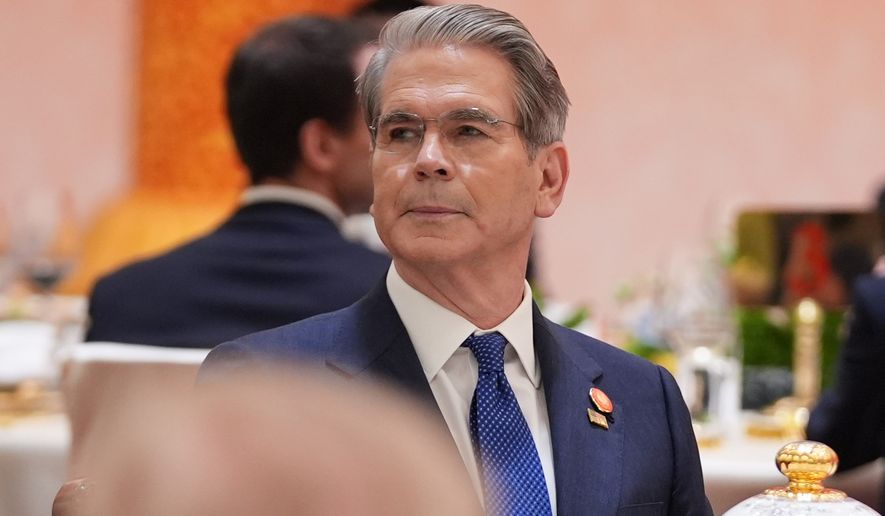

Treasury Secretary Scott Bessent on Thursday said Iran must satisfy U.S. demands in peace negotiations to “end the downward spiral” of its economy.
Mr. Bessent said the U.S. Navy formed a “wall of steel” around Iran to thwart the regime from exporting oil and gaining critical revenue. He said the pressure from President Trump’s blockade is obvious throughout Iran.
“Their troops are not getting paid, the police are not reporting for work, and Kharg Island is shut down. The Iranian economy and currency are in free fall,” Mr. Bessent said on social media.
People were interested in these podcasts
Kharg Island is a critical oil depot in the Persian Gulf off the Iranian coast.
Mr. Trump imposed his blockade of Iran to squeeze the Islamic republic economically and bring the regime to the negotiating table. It’s also a response to Tehran’s decision to block maritime traffic in the Strait of Hormuz, a critical chokepoint for oil shipments.
Mr. Bessent said the Treasury Department is sanctioning anyone who cooperates with the Persian Gulf Strait Authority, an entity Tehran set up to control strait traffic and collect tolls.
SEE ALSO: Trump declares Strait of Hormuz must remain open in peace deal
Administration officials and global leaders say the Strait of Hormuz is an international waterway, so Iranian attempts to control it and impose tolls are illegitimate.
“Iran’s Persian Gulf Strait Authority (PGSA) is a joke, and today Treasury has sanctioned it,” Mr. Bessent said on X. “We have warned any corporate or state entities against paying tolls or hiding them as aid payments.”
Mr. Bessent said moving forward, the U.S. will shut down Iranian airlines’ access to landing spots, refuelling and ticket sales.
“Only a satisfactory outcome in negotiations will end the downward spiral,” he said.
Mr. Trump launched Operation Epic Fury against Iran on Feb. 28 to prevent it from gaining a nuclear weapon, constrain its missile program and stop its support for terror proxies in the Middle East.
Early strikes killed top Iranian leaders and decimated the Islamic republic’s military. Both sides entered a ceasefire in early April to allow space for peace talks, though it has been difficult for the sides to reach a pact that satisfies Mr. Trump’s demands.
SEE ALSO: U.S. military confirms Iran launched attacks at Kuwait in further test of ceasefire
The countries are negotiating a pact that reopens the Strait of Hormuz and sets a timeline for talks on Iran’s nuclear ambitions, though disturbances in the region threaten the negotiations.
The U.S. military said Iran launched ballistic missiles toward Kuwait on Wednesday as retaliation for defensive U.S. strikes on southern Iran earlier in the week.
The American side called it an “egregious” violation of the ceasefire.
Contact the author


Please read our comment policy before commenting.