


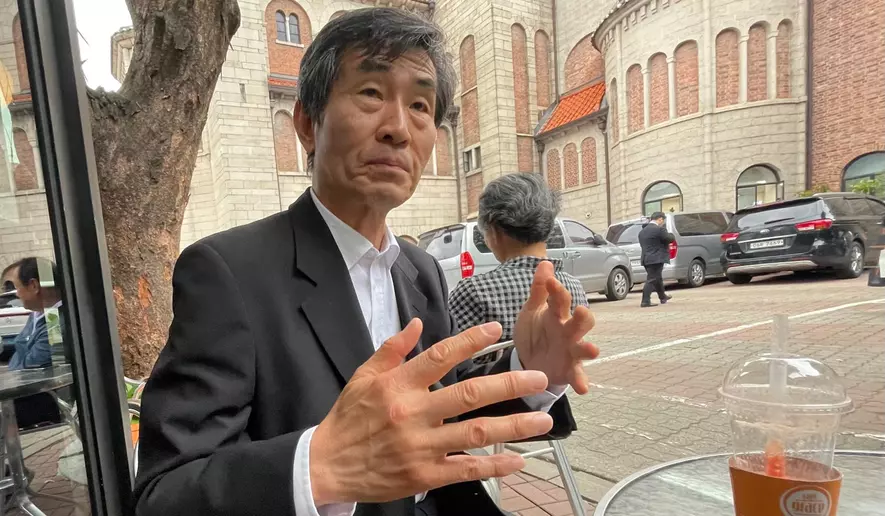

SEOUL, South Korea — Stepping into the coffee shop, Lee Tae-ha asked the server, “Are you from Hamgyong Province?”
The server appeared startled at the mention of a province north of the Demilitarized Zone before sternly replying, “It’s a secret!” The small, tree-shadowed cafe in the courtyard of a church in central Seoul is run by North Korean defectors.
Mr. Lee, 69, an entrepreneur in corporate communications who has done business in and with North Korea, is the product of a family divided by the 1950-53 Korean War.
People were interested in these podcasts
As someone who feels emotive bonds to those north of the frontier, he is increasingly unusual in South Korea. Few citizens remember the peninsula before its 1948 division, and with divided family members dying out, youth interest is evaporating.
“They are not informed about the benefits and values of unification, they don’t care, they are not interested,” Mr. Lee told The Washington Times. “It’s a dying issue — a disappearing issue.”
Southern indifference is mirrored in Northern policy. In March, Pyongyang revised its constitution, redefining the two Koreas as two separate states, not one divided nation.
What average North Koreans think is unknowable. Constitutional change is the function of Pyongyang’s elite; ordinary citizens’ opinions are not surveyed.
But they are in South Korea. The Korean Institute of National Unification, a think tank that has conducted the longest-running survey on the issue, has found falling support for unification since its first poll in 2014.
In its 2025 survey, 51% of 1,000 respondents said “unification is not necessary,” 63.2% said it’s unnecessary “if the two Koreas can co-exist peacefully” and 68.1% said they are “uninterested” in North Korea.
Those findings came alive last week.
For the first time in eight years, a North Korean team came South to play two matches in the Asian Football Confederation’s Women’s Club Championship.
The North’s Naegohyang beat the South’s Suwon on May 20, then lifted the cup after beating Japan’s Tokyo Verdey Beleza on May 23.
In the absence of North Korean fans, Seoul’s Ministry of Unification used about $200,000 to fund South Korean civic groups who welcomed North Koreans at the airport, then cheered them on in their match against Suwon.
Sensing the poignancy of the occasion, media reported the warm feelings expressed by mostly older spectators, who ignored torrential rain. South Korean President Lee Jae Myung, who seeks to unfreeze relations with North Korea, hailed the match on social media.
“Lose or win, we are the same team,” insisted Mr. Lee, the entrepreneur. “Everyone said, ‘This game is our game, our team.’”
Yet only 5,763 seats were occupied in Suwon’s 11,808-seat stadium.
In the second match, with no financial support offered, the lack of organic interest was even more glaring: Despite blazing sunshine on a Saturday afternoon, only 2,670 spectators attended.
The sparse turnout spoke volumes, given the location of both matches.
Suwon, known for its semiconductor industry, forms the southern edge of the vast Incheon-Seoul-Suwon area — a megacity of 26 million citizens.
Some criticized government support.
“I think it’s wrong for the minister of unification to set a cheering fee of 300 million won,” said Lee Ae-ran, a North Korean defector-turned-restaurateur. “I don’t know if [Unification Minister Chung Dong-young] is a minister of South Korea or a spokesperson for [North Korean leader] Kim [Jong-un].”
She sympathized with youth disinterest in the North.
“Most young people don’t want reunification,” said Ms. Lee, the defector. “They think that North Korea’s backwardness and economic problems would be a burden.”
While unification costs would be colossal, the long-term upside could be seismic. In 2014, former conservative President Park Geun-hye called it “hitting the jackpot.”
• South Korea would reconnect to the contiguous Eurasian continent, enabling road, rail, pipeline and overflight access.
• The South’s aging, 51 million people could be rejuvenated with the North’s young, 26 million-strong population.
• Southern conglomerates would have an entire infrastructure to rebuild and a new market to service.
• Defense spending could be culled, and a reason for war in Northeast Asia would disappear.
Yet even baby steps toward unification, initiated in 1998, led nowhere. Current inter-Korean relations are frozen: There is zero trade, logistic, telecommunications or personnel exchange.
Mr. Lee worked in public relations for the 1998-2003 Kim Dae-jung government that took those first baby steps under the “Sunshine Policy.”
He also conducted personal business in two inter-Korean projects — the Kaesong Industrial Complex and the Mount Kumgang Tourism Zone, which operated with North Korean labor and South Korean capital.
He discovered that it was not just Northern practices that were barriers to business.
“I was offered a job in North Korea — they understood PR as propaganda, and said it is a very important job — and I was thinking of a travel agency: Unlike South Korea, it is undeveloped, and very beautiful,” Mr. Lee said. “I asked a friend in South Korean intelligence about it, and he said, ‘Don’t do it. Your South Korean business will be ruined.’”
While operating at Kaesong, Mr. Lee won the trust of North Korean officials who told him he had three half brothers in the North. All were children of his father’s former wife. She had remarried after he was trapped in the South during the Korean War; he never returned to the North.
Even so, Mr. Lee was unable to make contact with his Northern family. Kumgang and Kaesong were both shuttered amid cross-border tensions. He blames policy discontinuity between Seoul administrations.
“South Korea is always changing, the conservative and progressive positions are always different,” he said. “But the North Korean leader is always same guy. He must be fed up.”
However, Lee Ae-ran, the defector, reckons Pyongyang’s recent constitutional shift is a simple recognition of reality: North Korea cannot unify with the richer, stronger, bigger, freer South.
“North Korea said it won’t unify, but that is because it can’t, with their leadership dictatorship and socialist system,” Ms. Lee said. “I don’t think unification can be realized just by dialogue with North Korea, or by inter-Korean exchanges.”
That leaves extreme circumstances — such as a Northern regime implosion or war. The first is unlikely, the second could be apocalyptic.
The receding prospects for unification depress Mr. Lee.
The Odaesan Observatory, which offers binocular views across the Yellow Sea into North Korea, is just an hour’s drive from his home. From there, he can view a mountain close to his father’s ancestral village.
His hillside villa in northwest Seoul lies within walking distance of the Committee for the Five Northern Provinces. Established in 1949, that is a de jure South Korean governance body for the North. Its cluster of buildings, set in a scenic, low-rise district, is frequently passed by hikers on weekends, but gets little foot traffic.
“I’ve been in there many times as I wanted to donate,” Mr. Lee said. “But I found they do nothing.”
Before all North-South ties were severed, his last cross-frontier project was an eco-sanctuary for cranes. For Koreans, the birds are poignant symbols of unity.
“Cranes are on screens, on paintings, even on the 500-won coin: They represent harmony, as they live in couples,” Mr. Lee said. “This is always on my mind.”
Contact the author


Please read our comment policy before commenting.