



New York’s state reparations commission convened its final public hearing Saturday in Harlem, where residents called on officials to make direct cash payments to Black Americans as the only path to what one attendee described as “true justice.”
According to a commission announcement, the New York State Community Commission on Reparations Remedies held the hearing — themed “From Extraction to Repair: Closing the Racial Wealth Gap” — at the National Urban League Conference Center at 117 West 125th Street in Manhattan.
Testimony gathered through the series of hearings will be reviewed alongside research and data as the commission compiles its findings for a formal report to the governor and the Legislature. New York officials have twice extended the deadline for that report — originally due last summer, then pushed to 2027, and now to 2029, nearly four years beyond its original target — citing the shifting political climate and the scope of the work involved.
People were interested in these podcasts
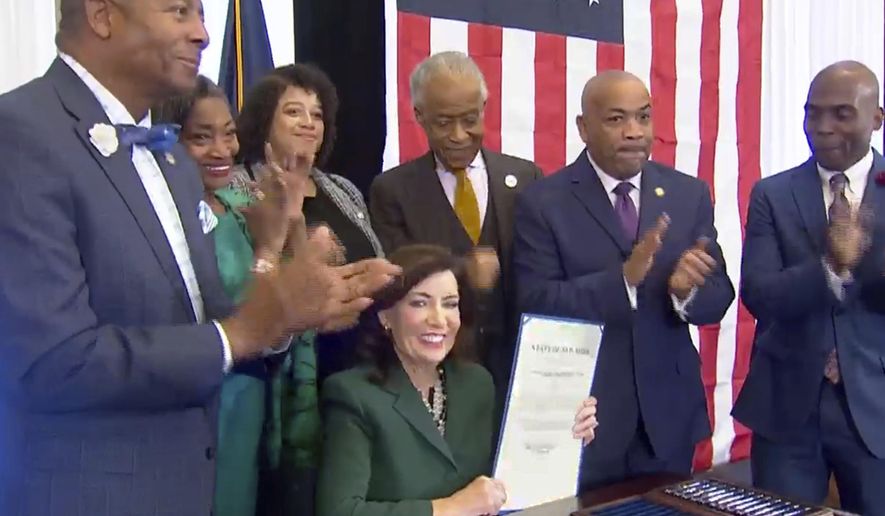
The commission was established after Ms. Hochul signed legislation in December 2023 creating a community commission to study the state’s history of slavery and how to repair its lasting impacts on descendants of enslaved New Yorkers. The panel was tasked with examining potential remedies, including monetary reparations, housing policy changes and criminal justice reform.
At Saturday’s hearing, commissioner Seanelle Hawkins opened by welcoming attendees and framing the session’s purpose.
“Certainly grateful that you all came up here today to enjoy and participate and lend your voice to this public hearing,” Ms. Hawkins said, according to Fox News Digital. “Our theme today is truth before repair.”
The question of who would be eligible for any eventual payments emerged as a central point of debate. Several speakers identified themselves as members of “The United States Freedmen Project,” a group of self-described “foundational Black Americans” who argue that reparations eligibility should be tied to lineage from enslaved people — not extended to all immigrants from Africa or the Caribbean. The organization describes itself on its website as a nonpartisan group seeking to fulfill the abandoned missions of the Freedmen’s Bureau and the Freedmen’s Savings and Trust Company.
Aubrey Muhammud, one of the attendees, told Fox News Digital that the figure should be straightforward.
“We need $800,000 for each foundation of Black Americans,” Mr. Muhammud said. “That’s — in New York — that’s about the cost of living that’ll get you a home or a small business or for you to recover from any financial duress.”
Rex Burns said he preferred a structural solution over a single check.
“I think it should be, me personally, I think there should be a new Freedmen’s Bureau back and that is like a central bank almost to Black America and would be distributed to Black communities,” he said.
Brooke Lean argued that direct payments must come first, before other remedies are addressed.
“It shouldn’t only be a check, but it should start with a check,” Ms. Lean said, adding that financial restitution needs to precede efforts to address education inequality, redlining, and policing. “Then we can start addressing education issues, redlining issues, policing issues, all of these other issues that are badges and incidents of slavery.”
Tanasia Poke said financial compensation was the only way to achieve genuine repair. “It’s been the greatest impact to our community overall, generationally,” Ms. Poke said. “And so, by policy and finance, it’s how it’s been institutionalized in the first place. It is the way to repair it.”
New York joins a growing list of jurisdictions weighing or enacting reparations-related measures. The city of Evanston, Illinois, has issued $25,000 reparations payments to Black residents as part of a program established in 2019 and approved by the city council in 2021, providing direct payments to Black residents and descendants of Black residents who lived in Evanston between 1919 and 1969, with payments intended to cover housing expenses.
In San Francisco, Mayor Daniel Lurie signed an ordinance in December 2025 establishing a “Reparations Fund” for eligible Black residents, based on a 2023 advisory committee recommendation of up to $5 million per person. The ordinance creates a legal framework but does not allocate any city money for direct payments; the fund is designed to hold private and philanthropic contributions. Mr. Lurie said the city would not direct public money to the fund given a $1 billion budget deficit.
This article was constructed with the assistance of artificial intelligence and published by a member of The Washington Times' AI News Desk team. The contents of this report are based solely on The Washington Times' original reporting, wire services, and/or other sources cited within the report. For more information, please read our AI policy or contact Steve Fink, Director of Artificial Intelligence, at sfink@washingtontimes.com
The Washington Times AI Ethics Newsroom Committee can be reached at aispotlight@washingtontimes.com.

Please read our comment policy before commenting.