


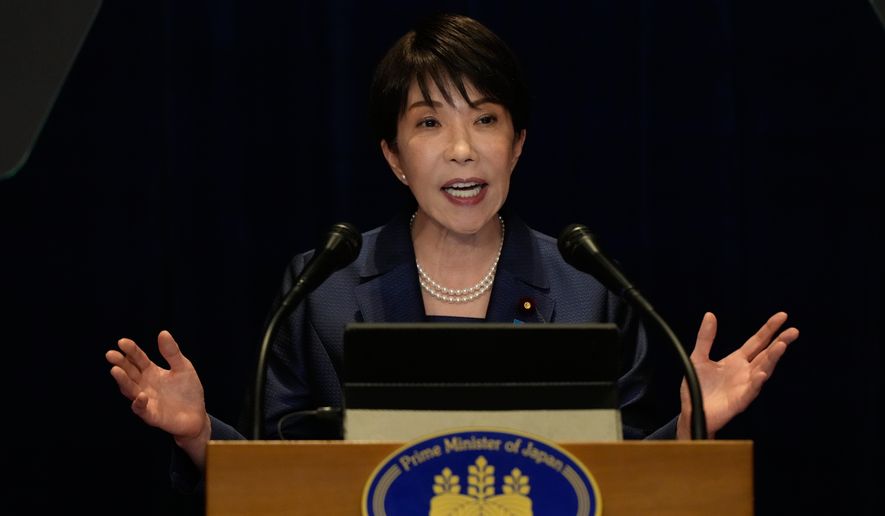

SEOUL, South Korea — Even for customarily upbeat Japanese Prime Minister Sanae Takaichi, the Asia Pacific Economic Cooperation summit this week proved to be a trial by fire.
Going into the two-day conference, it was never going to be easy for the conservative premier.
Japan’s relations with China have been dire since November 2024. Relations with Russia have plummeted since August. And there is widespread Japanese concern about the massive price increase the United States is demanding to host U.S. troops on its soil.
People were interested in these podcasts
All those chickens came home to roost in Shenzhen, the high-tech southern Chinese city where the Asia-Pacific leaders’ huddle was held.
On APEC’s sidelines, Ms. Takaichi held a reported 30-minute meeting with Russian President Vladimir Putin, but nothing appears to have been agreed on, despite a simmering, bilateral near-crisis.
Outside of official greetings, she had no face time with Chinese President Xi Jinping, despite yearlong Beijing-Tokyo friction. To cap it off, she was apparently ignored by President Trump.
Meanwhile, media have dissected the series of alleged slights she suffered.
Putin meeting as relations flag
After meeting Mr. Putin — in a 30-minute stand-up format — Ms. Takaichi conceded that issues remain unresolved.
“The biggest progress was that President Putin and I were able to create an environment where we can communicate directly,” she told a press conference Thursday.
There is much for them to discuss.
The day before Ms. Takaichi departed for Shenzhen, two Russian aircraft breached Japan’s southeastern airspace, sparking a scramble by Japanese fighters.
While violations of Air Defense Identification Zones are frequent — no ADIZ has standing in global law — airspace violations are rarer. In 2015, Turkey downed a Russian jet for exactly that.
Japan-Russian affairs are deteriorating elsewhere.
On Nov. 5, Moscow took “temporary management” of Japan Tobacco International’s investments in Russia. It has not been relinquished. The seizure follows takeovers of other Russian-based businesses headquartered in nations the Kremlin considers unfriendly, including France, Germany and Switzerland.
The tobacco company has since written off its Russian operations as a $8.9 billion loss, slicing the group’s global profits 25%, according to Japanese media.
Earlier, Japanese journalist Yuki Imai was arrested by Russian security agents on Oct. 13. Moscow says he was gathering intelligence on residents of the Kuril Islands fighting against Ukraine.
The Kurils are hyper-sensitive. Mr. Putin made his first-ever visit to the island chain, which lies northeast of northern Japan, in August, sparking protests from Tokyo.
The Kurils were captured by Moscow’s forces in the last days of, and after, World War II. Tokyo never accepted their loss.
Mr. Imai’s newspaper, the Hokkaido Daily, is based in the closest Japanese prefecture to the Kurils.
Ms. Takaichi did speak to Mr. Putin — the first time since she took power in 2024 and the first time in seven years any Japanese leader spoke with Russia’s leader face to face.
Freeze with Xi
Not so Mr. Xi. China’s president smilingly shook her hand during a meet and greet and a photo op, but did not appear to respond to her and did not offer her a sideline meeting.
That suggests the ongoing relationship freeze will continue.
Bilateral relations iced over in November 2024, when Ms. Takaichi said Tokyo would activate its armed forces in the event of a Taiwan contingency.
Beijing, which insists the democratically governed island is a wayward Chinese province, demanded a retraction.
With none forthcoming, China unleashed tourism restrictions, seafood import restrictions, media-information campaigns related to the historical sovereignty of Japan’s southern islands and rare-earth export curbs.
Japanese media have focused in on what they consider the Chinese diplomatic snubs suffered by Ms. Takaichi.
She was seated near the end of the APEC multilateral conference table, several places away from the leaders of China, Russia, the U.S. and South Korea.
The supposedly wide gap between Ms. Takaichi’s aircraft cabin door and the Chinese steps rolled up to them after her plane landed generated heated comment.
Critics also homed in on the modest welcoming entourage on the tarmac, comparing it to the military bands and cheering crowds of youth who greeted other VIPs.
An honor guard-lined red carpet was rolled out, but the low rank of the official who greeted Ms. Takaichi — a former Chinese ambassador to Greece — garnered unfavorable comment.
Yet another issue was the choice of tune — 1961’s “Ue o Muite Arukou” (“I Look Up When I Walk”), better known in English as “Sukiyaki” — that played at the gala banquet as Ms. Takaichi arrived.
The catchy pop song, arguably the most iconic Japanese tune to international ears, is about holding one’s head high in troubled times. However, its composer supposedly wrote it after attending an anti-U.S. demonstration, indicating a subtle Chinese attempt to drive a wedge between Tokyo and Washington.
Commentators are divided over whether these incidents were custom-engineered snubs or bad luck.
Reuters reported that Ms. Takaichi “cut an isolated figure” at the two-day summit.
A U.S. source, speaking off the record, said Beijing has mastered micro snubbing.
“Man, they are always doing this, no question,” he told a dinner of retired military personnel in Seoul.
“The situation created some angst among the commentariat and some diplomats,” said Lance Gatling, Tokyo-based principal of Nexial Research and a former officer with U.S. Forces Japan. “But that’s OK: They must have known what was coming.”
No time with Trump
Mr. Putin and Mr. Xi had a bigger target than Ms. Takaichi: Their first-ever joint summit with Mr. Trump.
He seemed equally preoccupied.
As the APEC leaders dispersed after the summit photo was taken, Ms. Takaichi was caught on camera approaching Mr. Trump from behind and attempting to grab his attention with a pat on the back.
He either ignored the approach or did not notice it.
Still, he did brief her during a reported 20-minute telephone conversation from Air Force One as he flew home across the Pacific. It is unclear if they discussed the payment for U.S. troops.
Mr. Trump, during his first term in the White House, insisted that allies should pay more for U.S. troops on their soil. Japan is the largest overseas host of American troops, with about 60,000 personnel stationed there.
Per leaks reported in multiple Japanese media outlets last week, Washington is demanding a tripling of “burden sharing” starting next year.
Contact the author


Please read our comment policy before commenting.