


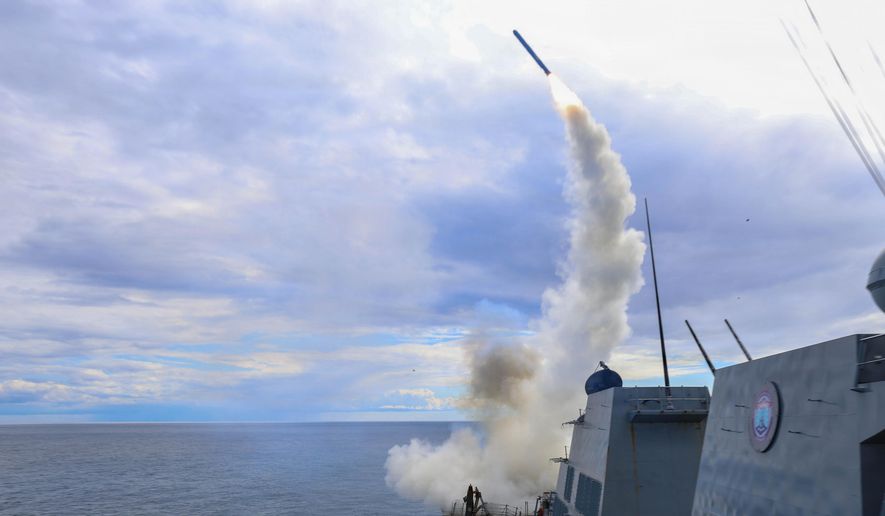

The Pentagon lacks an “overarching plan” to address shortfalls of key U.S. munitions and does not have a specific military office guiding the push to refill stockpiles of Patriot interceptors, Tomahawk missiles and other tools, a government watchdog said in a major new report this week.
The in-depth study from the Government Accountability Office, made public Thursday, offers a sweeping look at the Defense Department’s effort to restock an arsenal drained by the U.S. war against Iran and years of American military aid to key allies such as Ukraine, Israel and other Persian Gulf partners. The GAO report states the Pentagon lacks a roadmap for linking munitions production to specific goals.
“DoD doesn’t have an overarching plan that identifies long-term goals, strategies, or ways to measure its progress. Without a plan, it’s harder for DoD to know whether its munitions production efforts are really addressing department-wide needs,” the GAO said in a summary of its report.
People were interested in these podcasts
A separate analysis earlier this month from the Center for Strategic and International Studies (CSIS), a leading Washington think tank, found that it could take the U.S. until late this decade and perhaps even into the 2030s to fully replenish stockpiles of Patriot and THAAD missile interceptors, Tomahawk missiles, and other capabilities.
In compiling its report, the GAO said that Pentagon officials described an approach where the U.S. can be “reactive” to events around the world, rather than proactively amassing stockpiles of certain munitions and ensuring those levels are maintained.
“According to DoD officials, in lieu of a plan, DoD and the services can be reactive to global events rather than driven by total requirements. For example, the Army’s ramp-up in production of 155-millimeter artillery shells to address shortages exacerbated by U.S. support to allies and partners was not driven by DoD’s total munitions requirement,” the GAO report reads in part. “Without developing an overarching munitions plan that identifies long-term goals, strategies for achieving such goals, and metrics to gauge progress, DoD and the services are not well-positioned to address persistently low munitions inventories or risk, for example, investing in munitions that are projected to exceed the total munition requirement.”
The GAO also said that the Pentagon lacks a single entity leading the charge.
“The department also has not designated an office or entity to direct and assess munition inventory improvement actions. Joint Staff and officials from the Air Force, Army, Navy, and Marine Corps noted that there could be a benefit to developing an overarching plan and assigning leadership for its implementation,” the report says.
The Pentagon concurred or partially concurred with all four recommendations made by the GAO in its report, despite President Trump and Defense Secretary Pete Hegseth repeatedly pushing back on reports of serious munitions shortfalls.
Those recommendations include: the development of an “overarching munitions plan” that links production to actual munitions requirements; identifying an office or entity to lead the munitions push; and other steps.
In late September, Mr. Hegseth seemed to deny that shortages exist and said the media was lying about the issue.
“It’s your movements and bases that they reveal to the enemy. It’s your operations they jeopardize when they leak classified capabilities. And ultimately, it’s your lives they put directly at risk when they lie about munitions stockpiles,” Mr. Hegseth told U.S. troops gathered at Virginia’s Marine Corps Base Quantico.
Refilling stockpiles could take until 2030s
Sources inside the Pentagon and across the defense industry have said the most pressing shortfalls involve Patriot and THAAD — or Terminal High Altitude Area Defense — missile defense batteries. Those munitions have been used heavily by the U.S. and its allies to fend off Iranian drone-and-missile attacks on key U.S. and allied military installations across the Middle East. Ukraine has also relied heavily on those tools to intercept Russian assaults.
Sources say the shortfalls are common knowledge across the Pentagon, despite Mr. Hegseth’s public comments.
“Everybody knows,” one former senior officer told The Washington Times recently.
The GAO study does not state that the U.S. is necessarily running out of those munitions, but rather that the Pentagon may lack sufficient inventories “in the event a conflict should arise with a peer competitor.”
Analysts and military insiders generally agree that the U.S. could quickly run low on key munitions if, for example, a major military confrontation with China erupts.
In their report, CSIS senior adviser Mark Cancian, a retired Marine Corps colonel, and former research associate Chris H. Park argued that the Pentagon has enough munitions for its Middle East campaign but could encounter serious problems in a larger conflict.
“President Trump has repeatedly threatened renewed conflict with Iran to force a favorable settlement. Iran, in turn, has vowed retaliation. Does the United States have enough munitions to renew the fight? The short answer is yes — against Iran. Against China, there is great concern,” they wrote. “Rebuilding inventories will require a multiyear commitment extending beyond the current crisis.”
The exact numbers of U.S. munitions stockpiles are highly classified.
Behind the scenes, Deputy Defense Secretary Steve Feinberg has worked to establish longer-term contracts with the major U.S. defense firms producing critical munitions, committing the Pentagon to consistent purchases years into the future. That plan has paid dividends on multiple fronts, with the Defense Department establishing long-term contracts and more aggressive production schedules for Patriots, THAADs and other key capabilities.
But replenishing stockpiles will be a yearslong effort.
The CSIS researchers estimated that the U.S. has used between 130 and 250 SM-3 missile interceptors during the Iran war. The prewar inventory was 410, they said, and it could take until mid-2029 to return to that level.
For Patriots and THAADs, the numbers are even more grim. The CSIS report estimated that it could take until 2029 to return those inventories to prewar levels.
The CSIS study estimated the U.S. has used more than 1,100 of its 3,100 Tomahawk missiles in the Iran war. Getting back to 3,100, the report said, could take until 2031.
Contact the author


Please read our comment policy before commenting.