


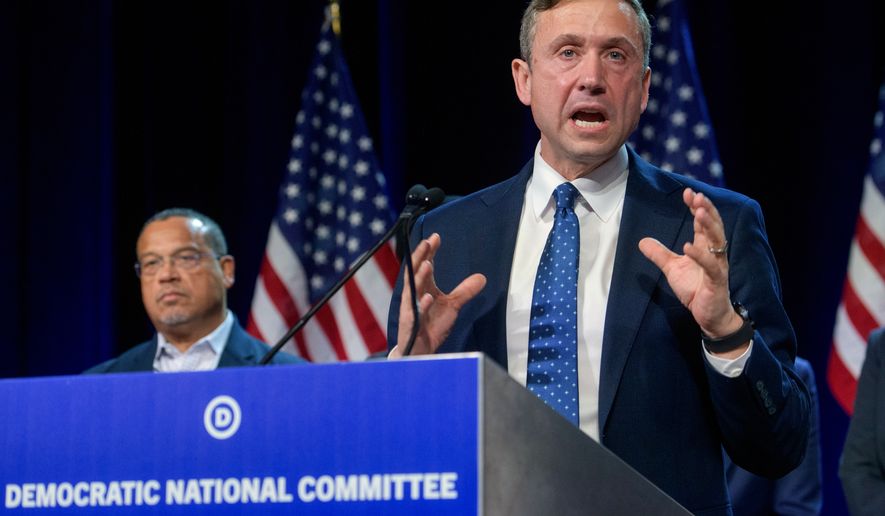

The Democratic National Committee is requiring the party’s presidential contenders in 2028 to condemn dark money spending whenever it pops up during the primary races — but their campaigns can still benefit from it.
Candidates will be required to sign a pledge committing to “denounce” dark money in the primary to qualify for debate participation, the DNC said Monday in its 2028 primary debate framework.
The DNC also announced it would hold a dozen presidential primary debates through the 2028 cycle, with five debates in 2027 and seven in 2028. The first two debates will be held in June and July 2027, with the final debate planned for March 2028.
People were interested in these podcasts
In a nod to the evolving media landscape, the Democrats’ 2028 debates will incorporate creators and influencers to help maximize viewership.
The candidates will have to meet polling and other objective measures, such as grassroots fundraising, to qualify for the debates.
Dark money is political spending by groups, mostly tax-exempt nonprofit organizations, that do not disclose the identities of donors.
Democrats have long railed against dark money, but Democratic candidates have benefited from it as much, and sometimes more, than Republicans.
While the DNC does not have the legal authority to ban dark money groups, it said the committee is requiring candidates to denounce their involvement in the Democratic presidential primary to qualify for the debate stage.
In the 2026 midterm elections, spending by these groups reached at least $1.47 billion, topping the $1.35 billion recorded in 2024, according to a late October analysis from OpenSecrets, which tracks money in politics.
“What concerns me about this last midterm election is we again saw the overall percentage increase of dark money at a little more than 12%,” OpenSecrets Executive Director Hilary Braseth said on an episode of “On Cue.”
The “Fair Campaign Practices Pledge” is intended to limit the role of dark money in the 2028 Democratic primary, the DNC said.
The new pledge follows an August 2025 resolution from DNC Chair Ken Martin, approved at the party’s summer meeting in Minneapolis, that created a panel to pursue steps to eliminate unlimited corporate and dark money in the 2028 presidential primary process.
Only a designated representative of a campaign that has signed the pledge can report suspected violations to the DNC, the committee said. The DNC will review complaints and tell campaigns whether denunciations or other fixes are required before each debate qualifying period.
The DNC will provide a uniform denunciation statement for campaigns to complete once notified of a violation. Candidates need to denounce a given group’s spending only once.
According to the DNC’s rules, when an ad opposes a candidate, all of that candidate’s rivals must denounce it. When an ad supports a candidate, only that candidate must denounce it.
Spending that occurred before a candidate launched must be denounced if it is reported and the DNC finds it violates the pledge.
The pledge covers ads that promote a Democratic candidate or oppose a rival’s candidacy, run by a 501(c)(4) nonprofit or a super PAC on television, radio, digital, billboards or mail, the DNC said. Spending by other types of groups, spending through other media, and spending that targets only Republicans is not covered.
The DNC said it will post a tracker of complaints, their status and denunciations on its website. Reporting deadlines will be announced in the coming months, and activity reported after a deadline will count toward qualification for the next debate.
Presidential candidates will also pledge not to enter into joint fundraising agreements with any Democratic Party committee or authorize any coordinated party spending during the primary, given the “importance of party committee neutrality during the presidential nominating process,” the DNC said.
Contact the author


Please read our comment policy before commenting.