


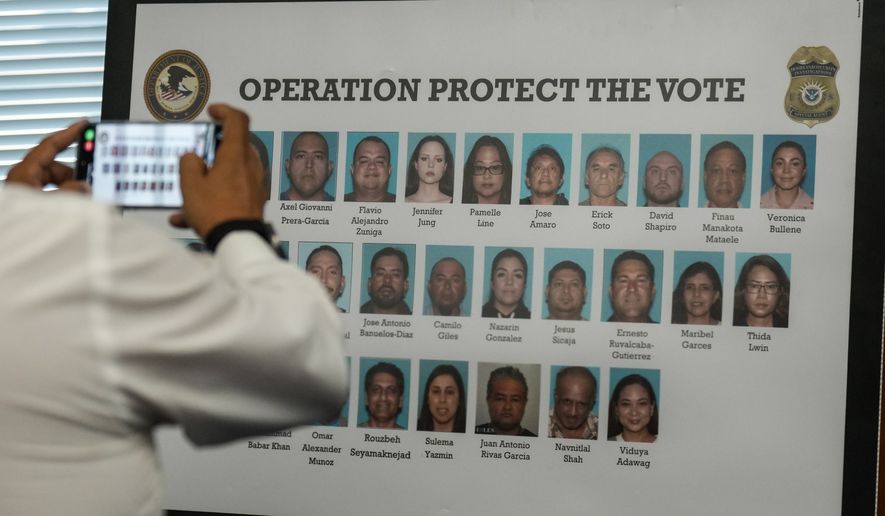

In the week before Election Day, the Trump administration publicly announced more than 75 cases against noncitizens accused of illegally registering and, in most cases, voting in American elections — including more than five dozen on Nov. 2 alone.
Most were criminal cases, brought by the Justice Department. Some were deportation cases, announced by Homeland Security.
They spanned from California to New York, and Wisconsin to Florida.
People were interested in these podcasts
Since Election Day, however, the cases have dried up, with DOJ announcing just a single case, out of New York.
The cases drew national attention — to the point that a federal judge in California ordered DHS to cool it with investigations, saying it could frighten even some newly minted citizens from showing up to vote.
With the election over, DHS is free to ramp up again.
It’s been pretty quiet, but the Trump administration says nothing has changed.
“The department’s focus on noncitizen voting did not begin or end with Election Day,” said Kiersten Pels, a Justice Department spokeswoman. “These investigations are continuing. There are hundreds of ongoing criminal investigations into fraud associated with voting and elections, and they did not stop when the election ended.”
She said the department charged nearly 200 noncitizens with illegal voting and registration offenses since August.
By contrast, the Biden administration brought fewer than 20 cases
The wave of cases ahead of the election was an attempt “to deter illegal voting and to make clear that voting by noncitizens carries serious criminal consequences,” she said.
Christian Adams, head of the Public Interest Legal Foundation, which has battled noncitizen voters on state rolls, said that reasoning made sense.
“I hope it was because of election coverage,” he said.
The last case to be announced came on Nov. 18, when prosecutors in New York announced charges against a Ukrainian woman who voted in 2024.
She was a legal permanent resident — as were the majority of people charged over the last few months.
The surge of cases has challenged voting rights groups that argue noncitizen voting doesn’t happen. They based their conclusions on the lack of prosecutions.
Critics, though, said that was a faulty metric, in part because nobody was really looking for fraud. The Biden administration brought just 13 cases during its four years.
The Trump administration equaled that total in one day, several times over, during September and October.
According to court documents, there could be another wave of cases in the works.
A DHS official, in a filing last month, said his department had 1,900 active noncitizen voter investigations.
Some of the cases appear to be near-accidental, with legal immigrants getting registered when they show up to get a driver’s license, then believing they are eligible to vote when they start getting election mail from local election officials.
Other cases seem more intentional. That includes illegal immigrants who were living here under a stolen identity, which they used to register and vote.
The statute of limitations on noncitizen voting cases is just five years, meaning only voting in federal elections dating back to 2022 is still viable for charges.
But earlier voting by noncitizens can be used in deportation cases, which DHS has brought.
One wrinkle for the Justice Department is a federal judge in the Southern District of Florida, who earlier this year ruled that the federal law criminalizing noncitizen voting was unconstitutional.
U.S. District Judge David Leibowitz said states, not Congress, get to set voter qualifications. He tossed the case against Chelsea Cox, an illegal immigrant from Jamaica who voted in four federal elections starting in 2012.
Other noncitizens facing charges have rushed to make similar arguments in their cases, citing Judge Leibowitz’s opinion.
DOJ has appealed the judge’s ruling.
Mr. Adams, at PILF, said he expects DOJ to prevail.
“Congress has the power to criminalize foreigners registering and voting in federal elections. I don’t expect other courts to adopt the reasoning of [Judge Leibowitz],” Mr. Adams told The Washington Times.
Contact the author


Please read our comment policy before commenting.