


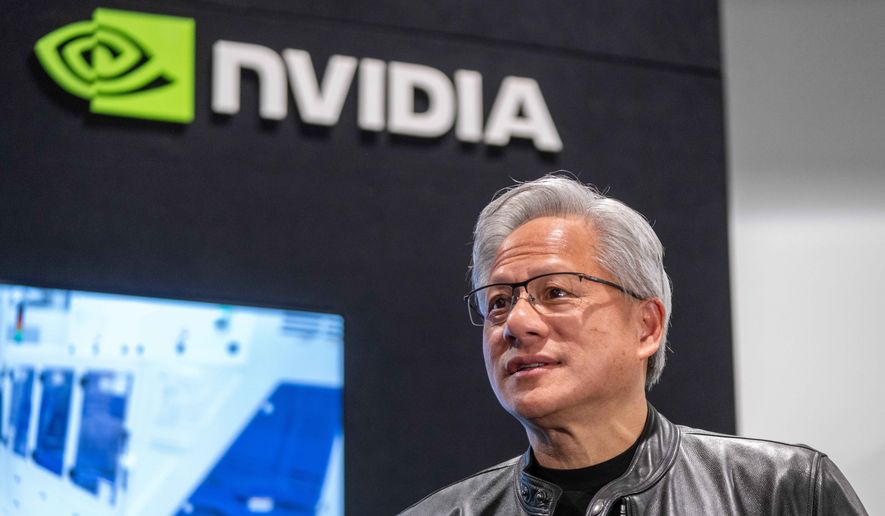

Nvidia’s board of directors voted Monday to reinstate Jensen Huang as CEO less than two weeks after he resigned, a major reversal following a worrisome selloff on Wall Street and direct intervention from President Trump.
The chipmaker’s U-turn, effective immediately, sparked an immediate debate about whether Mr. Trump’s personal support for Mr. Huang and market fears overtook national security concerns about the executive’s affair with a woman suspected of being a Chinese spy.
Nvidia pointed to input from “senior levels of the United States government” that Mr. Huang’s reinstatement did not pose a national security risk.
People were interested in these podcasts
Members of Congress in both parties called the decision irresponsible, saying it remains unclear whether Mr. Huang’s paramour, Alice Huang, helped the Communist rival gain an advantage in the race to develop artificial intelligence.
“The president is selling out our national security to keep the stock market high and probably for some [expletive] donation to his ballroom,” Sen. Ruben Gallego, Arizona Democrat, said on social media.
Mr. Huang’s reinstatement had a seismic impact on Wall Street after a selloff last week.
SEE ALSO: Trump celebrates Jensen Huang’s return to Nvidia, says DOJ saw no violation of law
The Dow Jones Industrial Average popped more than 1,000 points, and Nvidia’s stock jumped nearly 40% after the company posted its statement on Mr. Huang’s return. The tech-heavy Nasdaq index soared nearly 7% by late morning.
Analysts had warned after Mr. Huang’s resignation that turmoil at Nvidia added to pressure on AI stocks, which were already weighed down by high valuations and rising interest rates.
Nvidia lost nearly $500 billion in market value in the days after the Huang scandal broke, but shares jumped more than 30% in early trading Monday.
Mr. Trump, speaking to CNBC, said slumping stocks might have affected the decision to restore Mr. Huang, though the long-term outlook was more important.
“The bigger impact was, you know, he’s got other chips in his brain that nobody else knows about,” Mr. Trump said.
The Trump administration’s support for Mr. Huang extended beyond its general preferences. The president said the Department of Justice vouched for him.
“The United States Government has no reason to believe that Jensen’s return to NVIDIA poses any risk to National Security,” Mr. Trump said on Truth Social. “The Attorney General of the United States has confirmed that the U.S. Government does not possess evidence that he has engaged in any unlawful conduct.”
The situation underscored the extraordinary impact that Nvidia and its co-founder have on the race to develop artificial intelligence, and the technology’s role as a driving force of economic growth.
Nvidia is considered the powerhouse of the AI boom. Its advanced chips are a prized commodity in the industry and a national security matter, because China covets U.S.-made semiconductors for its AI ambitions.
Mr. Huang resigned Nov. 12 amid reports of his relationship with Ms. Huang, a tech executive tied to a Singapore-based cloud computing company, Megaspeed. Ms. Huang, who is not related to Mr. Huang, allegedly consulted with the Chinese government.
Revelations of a second affair with a subordinate employee increased internal company pressure on Mr. Huang.
The board said Monday it was “satisfied with respect to Mr. Huang’s candor and ability to lead NVIDIA.”
“In the process of reaching its decision, the Board received input from senior levels of the United States government, and based on that input, the Board is confident that Mr. Huang’s reinstatement poses no national security risk,” it said in a statement.
Board Chairman Harvey Jones said that the board believes Mr. Huang is the “right person to lead NVIDIA, and that his reinstatement is in the best interests of our stockholders, employees, partners and customers.”
“I am honored to return to NVIDIA and lead one of the most consequential technology companies in the world at the beginning of a new industrial revolution,” Mr. Huang said. “I take this responsibility with the greatest humility and renewed commitment.”
He thanked the board for its “confidence and deliberation,” as well as employees, shareholders, industry leaders and partners.
“Above all, I am grateful for the love and support of my family. I can’t wait to get back to work,” he said.
Mr. Huang is not out of the woods. Members of Congress said they will continue to investigate his affairs and their role in national security.
Mr. Huang is scheduled for a closed-door, transcribed interview with three House committees on Dec. 1. He has also agreed to testify at a public hearing of the Senate Banking, Housing and Urban Affairs Committee, but no date has been set.
Rep. Don Bacon, Nebraska Republican, said Nvidia should have moved on and “ignored the administration’s inexplicable desire to save Huang.“
“Congress needs to get to the bottom of who approved high-end computer chips sales to China. We cannot say we want to win the AI race and then give China our best technology. We need sunlight on who is responsible,” Mr. Bacon said on social media.
Illinois Gov. J.B. Pritzker, a Democrat, said the reinstatement ignored the wishes of midterm voters who elected sizable Democratic majorities in the House and Senate, in part based on fears of runaway AI development and data centers by wealthy stockholders.
“This is the greed and lack of accountability that the country just rejected,” the governor said on X.
The Nvidia scandal unfolded at breakneck speed. Mr. Huang, 63, acknowledged an affair in a Nov. 8 message to employees but did not name anyone.
Lawmakers questioned whether restricted Nvidia chips were diverted to China through Megaspeed, the company tied to Ms. Huang. Megaspeed has denied wrongdoing.
Mr. Huang stepped down Nov. 12 after 33 years leading the Santa Clara, California-based company.
Chief Financial Officer Colette Kress became interim CEO, and the board named Mr. Jones its first-ever chair.
But tech leaders including Elon Musk, Epic Games CEO Tim Sweeney, Shopify CEO Tobias Lütke and Y Combinator CEO Garry Tan publicly backed Mr. Huang’s return, as did Nvidia shareholders Brad Gerstner and Gavin Baker, who urged the board to keep “all options on the table.”
Mr. Trump, meanwhile, used his social media accounts and the White House bully pulpit to push for Mr. Huang’s return, saying the executive should be allowed to apologize for personal foibles and get back to work.
A board committee of independent directors will continue investigating reports that Mr. Huang was the target of a foreign intelligence effort, Nvidia said. Mr. Huang fully supports the investigation and is committed to cooperating, the company said.
The board also formed a National Security and Export Control Committee of independent directors on Nov. 17 to oversee trade compliance and national security risks. The committee is hiring outside counsel with national security experience, who will bring in additional advisers, Nvidia said.
Nvidia is also starting a search for a new chief compliance officer, who would oversee compliance across the company and report to the board’s Nominating and Corporate Governance Committee. The company said it will continue cooperating with ongoing government investigations and inquiries.
• Sean Salai contributed to this report.
Contact the author



Please read our comment policy before commenting.