



NEWS AND ANALYSIS:
Beijing is accelerating efforts to reshape the global order under a careful plan of coercion aimed at destabilizing the United States, according to the annual report of a congressional China commission.
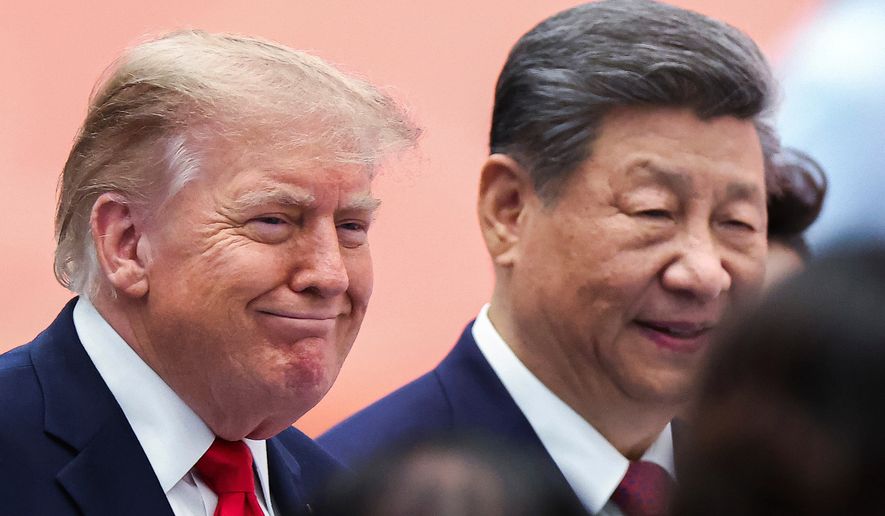
Leveraging its expanding military, economic, technological and diplomatic power, China is continuing to undermine America — despite summit meetings between President Trump and Chinese President Xi Jinping, the report by the bipartisan U.S-China Economic and Security Review Commission stated.
Chinese Communist Party actions before and after Trump-Xi summits show that its version of “constructive strategic stability” has not lessened Chinese efforts to weaken the U.S., according to the 705-page report released days before the president met Mr. Xi for the most recent summit in Shenzhen, China.
People were interested in these podcasts
“Even as Beijing sought to manage its diplomatic relationship with Washington, it continued destabilizing activities aimed at the United States, including cyber operations targeting U.S. critical infrastructure, AI-enhanced influence campaigns aimed at the U.S. public, attempts to co-opt U.S. officials and transnational repression on U.S. soil,” the report said.
Military purges carried out by Mr. Xi have resulted in the greatest concentration of military authority and war-making decision power in China since Mao Zedong, the report said.
Even with the large-scale purges, the buildup of People’s Liberation Army forces continued steady progress toward a readiness milestone for an invasion of Taiwan in 2027, the report said.
Provocative military operations around Taiwan expanded this year in both scale and sophistication while PLA military capabilities were added for a future conflict.
Globally, China continued to support the war efforts of Russia and Iran while avoiding direct involvement, the report said, noting China supplies 90% of Russian imports of sanctioned technology, drone components and missile goods sent to Iran.
In targeting the United States, the Chinese Communist Party engaged in a broad range of malign activities that the report said have “undermined U.S. sovereignty and threatened national security.”
Political influence operations in the U.S. included numerous arrests of Chinese agents for illegal activities, including co-opting political figures such as former Arcadia, California, Mayor Eileen Wang. Ms. Wang pleaded guilty to charges related to publishing CCP propaganda for Chinese handlers, the report said.
Commission Chairman Randall Schriver said: “Beijing has talked a lot about ’constructive strategic stability.’ But we should be clear-eyed that Beijing’s interpretation of that phrase emphasizes restraining the United States while China is free to pursue its strategic objectives.”
Among the major threats highlighted in the report were Chinese cyber operations gaining access to critical infrastructure using state-linked groups known as Volt Typhoon and Salt Typhoon.
“China’s efforts to shape and undermine the U.S. information environment are growing more sophisticated and more targeted,” the report said, noting that artificial intelligence has enabled more sophisticated activities to be conducted at a much greater scale.
The China-linked information attacks included systems capable of autonomously identifying target audiences, generating tailored content and more effectively masking fraudulent CCP-linked accounts.
The commission report also revealed that China is expanding its nuclear forces faster than any other nation.
Simultaneously rejecting arms talks and building up strategic power suggests the CCP views its nuclear expansion as a key part of strategic competition with the U.S., the report said.
The nuclear modernization is not limited to larger numbers and increased capabilities. The readiness to use land-based nuclear missiles also improved, the report said.
In December, China loaded more than 100 DF-31 intercontinental ballistic missiles at its three silo fields in western China, the report said.
The missiles demonstrate a “strengthening readiness posture and early warning counterstrike capability,” the report said.
Satellite imagery from May 2026 revealed “sprawling” new construction of launch pads near China’s nuclear missile silos in northwestern Xinjiang. The construction indicates enhanced operability of the growing land-based nuclear missile arsenal, the report said.
China demands U.S. adopt no-first-use nuclear policy
Despite the vague statement opposing nuclear war at the recent summit in China, the Chinese Communist Party is opposing nuclear arms talks with the U.S. and Russia and instead plans to press Washington and Moscow to adopt its questionable no-first-use nuclear weapons doctrine, according to a semi-official Chinese military commentary.
Retired People’s Liberation Army Senior Col. Zhou Bo, a former Air Force officer known for parroting official CCP views, said China remains opposed to cutting its rapidly expanding nuclear weapons stockpiles based on larger U.S. and Russian arsenals.
Three days before President Trump held the historic meeting with Chinese President Xi Jinping and Russian President Vladimir Putin in Shenzhen, Col. Bo previewed the Chinese position. He stated in a commentary that “Beijing insists Washington and Moscow should carry out substantive cuts before talking about nuclear disarmament.”
The retired PLA colonel then accurately predicted the joint statement that was issued after the Nov. 19 three-way summit. He wrote that if a nuclear dialogue goes forward, “the easiest thing to do is reaffirm the joint statement issued by the five nuclear-weapon states in January 2022: a nuclear war cannot be won and must never be fought.”
Col. Bo, senior fellow at China’s Tsinghua University Center for International Security and Strategy, then revealed Beijing’s goal for nuclear talks stating that if a nuclear war cannot be won, “what is the rationale for striking first?”
“This is in line with China’s long-standing no-first-use policy,” he stated in an article published in the pro-Beijing South China Morning Post.
The joint statement issued after the meeting stated just that, noting that “a nuclear war cannot be won and must never be fought.”
The no-first-use declaratory policy is a pledge not to use nuclear weapons in war unless attacked first by enemy nuclear weapons.
American strategic nuclear policy for decades rejected no first use over fears adversaries would be encouraged by the policy to launch surprise strategic attacks.
U.S. nuclear policy instead is based on strategic ambiguity that reinforces deterrence and assures allies with extended U.S. nuclear deterrence in Asia and Europe.
China’s nuclear buildup is described by U.S. military commanders as an “unprecedented” expansion of strategic power made more dangerous by PLA secrecy and an apparent lack of any limit to the buildup.
The Pentagon’s most recent annual report on the Chinese military said PLA nuclear weapons are no longer just for deterring a nuclear first strike and coercion. They are now being used to deter and limit U.S. military involvement in a conventional conflict, such as an invasion of Taiwan.
“China continues to reaffirm its commitment to its No First Use (NFU) policy despite seeking to deter non-nuclear military actions with its nuclear forces, complicating communication about the role of these forces during a Taiwan conflict and raising the risks of unintended escalation,” the report said.
A report by the Air Force China Aerospace Studies Institute questioned China’s approach to nuclear weapons dialogue.
“Beijing has … insisted that strategic dialogue can only occur after the United States agrees to recognize mutual vulnerability and commit to No First Use positions that Washington cannot accept without compromising the credibility of extended deterrence,” the report said.
Beijing’s additional positions on a nuclear dialogue, as previewed by Col. Bo, could include calls to adopt mutual pledges not to attack civilian nuclear power plants, and for exchanging lists of nuclear facilities that should not be included in conventional targeting lists — both key vulnerabilities for China in a future conflict that would be lessened if agreed to in proposed arms control measures.
Also, the Chinese will seek a mutual ban on anti-satellite weapons tests and a possible agreement on advance notification of missile launches, Col. Bo said.
Restrictions on the use of artificial intelligence in strategic nuclear weapons, an unverifiable arms control measure, also would be a topic for the dialogue.
Both Russia and China are suspected of having so-called “dead hand” nuclear launch systems that can autonomously launch nuclear weapons if civilian and military chains of command are wiped out in leadership decapitation attack.
China seeking advanced data-fused intelligence systems
After stealing massive amounts of data — from security clearance records on 21.5 million government employees to Equifax credit data on 145 million more — from the United States beginning in 2015, China has begun work on advanced data fusion systems that can be used to impose totalitarian control on populations and help the military track and target warships and space systems.
The process is called “pattern-of-life” analysis and new details on China’s work are in the annual report from the congressional U.S.-China Economic and Security Review Commission, which was made public last week.
For population control, China is fusing data with high-speed computers and artificial intelligence to identify patterns in how both people and entities move and interact.
The systems will permit civilian and military analysts to detect and track complex behaviors — whether warships at sea or people in streets, the report said.
“China’s data dominance strategy threatens U.S. national security,” the report said.
“The aggregation of data on Americans enables espionage, coercion, and influence operations with unprecedented precision; supports pre-positioning campaigns such as Volt Typhoon that collect critical infrastructure data to support ’system destruction warfare’ in a future conflict; and facilitates the use of stolen technical data to accelerate PLA modernization.”
Once a loosely defined intelligence tradecraft, pattern of life analysis now is capable of spotting targeted people and groups using technology to identify their face, voice, gait, fingerprint and DNA.
Early forms of the system were used during the COVID-19 pandemic to trace people and for monitoring illegal protests, the report said.
Further refining its use, Beijing also is gathering and fusing GPS data, cell phone calls, travel records, financial transactions, ATM withdrawals, social media analysis and other sources of data to map and ultimately seek to control human relationships and behaviors.
Under China’s civil-military fusion program, pattern-of-life programs will bolster People’s Liberation Army warfighting capabilities by providing faster military decision-making, vastly improved intelligence, military preparation of the battlespace and for waging cognitive warfare.
The combination of persistent surveillance, historical data gathering, behavioral analysis, and anomaly recognition will produce PLA commanders with a military decision advantage not provided by past intelligence gathering.
Contact the author


Please read our comment policy before commenting.