


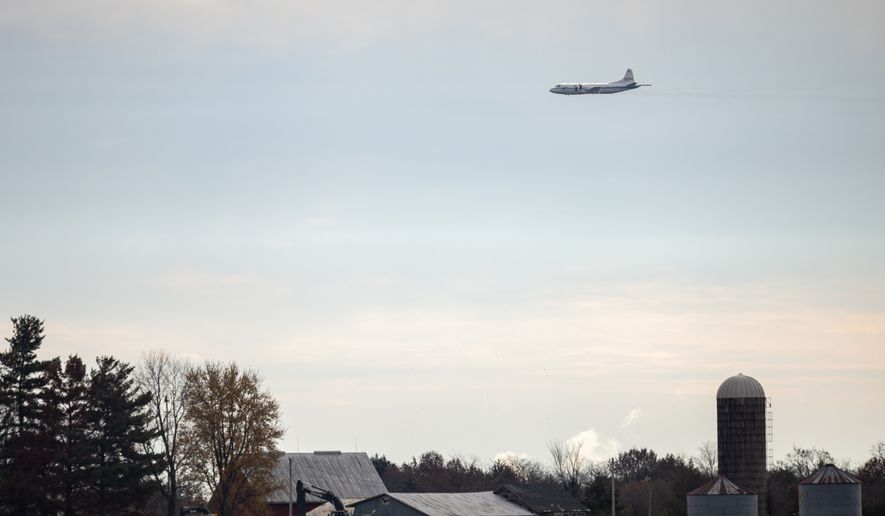

U.S. officials said Wednesday’s controlled detonation of almost 10,000 pounds of explosive lead azide at the Iowa Army Ammunition Plant was an “unprecedented” operation due to the scale of the hazard and the efforts to prevent toxic lead dust from spreading.
The Army lessened the effect of the blast with an array of barriers and dust-suppression material.
About 68 barrels of the degraded explosive material had been kept since 2009 in a pair of earth-covered ammunition bunkers identified as H-2 and H-3.
People were interested in these podcasts
The Army surrounded the bunkers with sand-filled blast barriers and poured out more than 3,600 gallons of aqueous foam and ballistic gel blocks to absorb any lead particles from the blast.
Large water tanks were installed at the site to help contain the explosion and prevent lead particles from entering the atmosphere, officials said.
The Environmental Protection Agency said its real-time air monitors did not detect any evidence of lead in the atmosphere.
The Army asked researchers from the MIT Lincoln Laboratory to review the blast plan at the site.
“Based on the Army’s documentation, we concurred that conducting the detonation under the planned controlled conditions is preferable to accepting the risks associated with a potential unplanned detonation,” the federally funded research agency said in a statement.
Rob Cekada, the director of the Bureau of Alcohol, Tobacco, Firearms and Explosives, said the barrels were in a degraded state when the nation’s stockpile of lead azide was moved to the Army ammunition plant in Middletown, Iowa.
“Once we learned about the condition of the 68 barrels that were covered with crystallized lead azide — the barrels, the lids and the openings — this administration came together quickly in March 2026 and developed a plan to properly mitigate the threat,” Mr. Cekada said after Wednesday’s controlled detonation.
Maj. Gen. Eric P. Shirley, commander of the U.S. Army Sustainment Command, described the detonation as “exceeding expectations.”
“Every indication is that all of the munitions that were employed absolutely reduced the lead azide threat. All the lead azide barrels were definitively removed,” Gen. Shirley said. “There was no secondary explosion [and] there was no infrastructure damage in or around our installation. I believe absolutely that we reduced, as close to zero as is humanly possible, the risk to the health and safety of the people in Middletown and the extended communities throughout Iowa.”
Mr. Cekada said the detonation plan designed by Army explosive ordnance disposal experts channeled much of the blast wave into the ground to minimize any possible lead dispersion into the atmosphere.
Assistant Army Secretary Jordan Gillis said the aqueous foam and ballistic gel blocks used to minimize the release of lead particulate matter would also play a part in any cleanup efforts.
“By capturing lead particles, we’re not only ensuring public health and safety, but we are maintaining our environmental responsibilities and leaving behind a clean site,” Mr. Gillis said.
Contact the author


Please read our comment policy before commenting.