


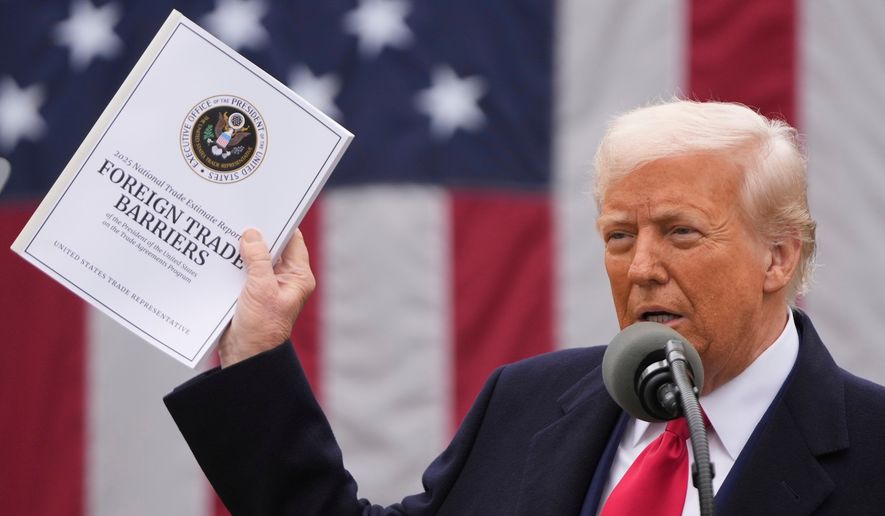

Democrats want to mow down White House tariffs but face President Trump’s resolve and veto pen, leaving a plank of their affordability agenda in doubt as consumers and businesses face two more years of political wrangling and uncertainty.
House Minority Leader Hakeem Jeffries pledged to “eradicate” Mr. Trump’s tariffs in a letter announcing his bid for speaker, while others are pushing for the swift demise of tariffs on Canadian products.
It could get messy.
People were interested in these podcasts
Mr. Trump is leaning into his tariff plans, not retreating, and Democrats would need to enlist dozens of Republicans to override his opposition to tariff-repeal bills. Even if they succeed, Mr. Trump could volley back with new levies.
“Congress has the power of the purse, and can set any tariff rate it pleases,” said Ryan Young, a senior economist at the Competitive Enterprise Institute. “They can repeal any specific Trump tariff they want. But Trump can come back with tariffs of his own, and we get a Whack-a-Mole game for the rest of the administration, and all the rest of us get is more economic volatility.”
For tariff repeals to last, lawmakers would have to reel in some of the power Congress delegated to the executive branch. Mr. Trump is using those authorities to issue his latest tariffs, but taking back that authority might be a tough lift on Capitol Hill.
For now, Democrats are basking in the afterglow of their Election Day rout. They’ve vowed broad, decisive tariff action when they seize the House and Senate gavels in January.
“Trump’s plan: tariffs, war, and cutting your health care. Our plan: end the tariffs, end the war, and lower your premiums,” Sen. Patty Murray, Washington Democrat, said in a recent social media post.
Tariffs are duties on foreign goods brought into U.S. markets. Mr. Trump says they are a great tool for protecting domestic industries, creating revenue for the Treasury and gaining leverage in foreign negotiations.
Small businesses and other critics say tariffs raise costs along the supply chain, leading to higher prices at the checkout counter.
“Tariffs are a consumption tax on the U.S. consumer,” Gary Cohn, who led the National Economic Council in Mr. Trump’s first term, told the B20 USA Summit hosted by the U.S. Chamber of Commerce in early November. “The producers and the importers don’t pay the tariff.”
The Yale Budget Lab estimates the average tariff rate on foreign goods is slightly above 11%, and that tariffs will cost households about $900 annually under current law.
Mr. Trump remains committed to tariffs, despite a midterm drubbing for his Republican Party.
The administration issued a new batch of levies on Wednesday, targeting 14 major trading partners, including the European Union and China, after an eight-month investigation into manufacturing practices that inflate capacity through government subsidies and other heavy-handed policies.
U.S. Trade Representative Jamieson Greer said the U.S. needed to punish countries for “market-distorting practices that tilt the trade balance in their favor while eroding America’s manufacturing base.”
The president says his tough approach to trade spurred tech companies, drugmakers, foreign governments and others to make multibillion-dollar investments in American manufacturing, launching a “golden age.”
White House trade adviser Peter Navarro said the administration will be “quadrupling down on tariffs.”
“We are in the midst of an incredible manufacturing renaissance,” Mr. Navarro told Steve Bannon on Real America’s Voice. “Every time we have a jobs report, we’re generating incredible amounts of manufacturing and construction jobs.”
The Bureau of Labor Statistics said manufacturing added 19,000 jobs in October, and it has created 101,000 positions since a hiring low for the sector in December 2025.
Some economists say the sector saw gains despite the tariffs, pointing to higher manufacturing gains in the months after the Supreme Court struck down Mr. Trump’s use of a 1977 economic-powers law to set nation-by-nation levies.
As it stands, the president is relying on alternate authorities, such as Section 232 and Section 338, that allow the executive to respond to unfair trade practices or national security concerns.
“Because tariffs are set by the president using authorities that Congress has already delegated to him, changes in the control of Congress are unlikely on their own to change the administration’s tariff policy. Repealing or constraining those authorities over a presidential veto requires a two-thirds majority in both chambers, and such a majority does not seem to have emerged from this midterm election,” Pierre Yared, a senior fellow at the Council on Foreign Relations, wrote in an “expert readout” following the midterms.
Erica York, a senior economist at the Tax Foundation, said the ripest targets for Democratic repeal efforts would be tariffs levied against allies using “less-tested authorities,” particularly the Section 338 tariffs on Canada.
Section 338 is a rarely used, Depression-era provision that allows the president to impose tariffs of up to 50% on a foreign country suspected of discriminating against U.S. commerce.
If legislation hits a brick wall, Democrats could focus on oversight hearings, using the bully pulpit to highlight tariff-related price concerns before the 2028 presidential election.
They could also explore whether any companies granted favors or made promises to the administration in exchange for tariff relief.
Meanwhile, U.S. firms and consumers will weather changing winds in Washington. Mr. Trump is still rebuilding his tariff plan after the Supreme Court loss, and could negotiate new deals with countries like Canada.
Some economists say the standoff between Democrats and Mr. Trump may freeze tariffs in place, providing some measure of clarity.
“While the current cost problems will persist, the greater stability with respect to tariff rates will help companies better plan, which is a positive,” said Wayne Winegarden, a senior fellow in economics at the Pacific Research Institute.
Democrats mainly object to across-the-board tariffs on friendly nations. Some Democrats have supported tariffs on rivals such as China, or limited levies to protect steelmakers or other domestic industries.
Steel tariffs “remain the single most effective trade tool the United States has to block China and other nations from flooding the U.S. market with heavily subsidized steel,” said Kevin Dempsey, president and CEO of the American Iron and Steel Institute. “AISI urges the incoming Congress to support the Section 232 steel tariffs amid the continued and growing global steel overcapacity crisis.”
Asked this month if Democrats would target all of Mr. Trump’s tariffs, or just some, Mr. Jeffries gave a broad answer.
“We’re going to work on the tariff issue in the new Congress quickly and aggressively,” Mr. Jeffries said.
Mr. Jeffries said every faction of the Democratic Party is focused on affordability, and tariffs are a key part of that.
“The Trump tariffs are deeply unpopular,” Mr. Jeffries said. “The American people know that the tariffs have been one of the reasons why toxic Republican policies have made their lives more expensive.”
Contact the author


Please read our comment policy before commenting.