



Call it Medicare for more.
That’s the healthcare agenda Democrats plan to start with next year when they take back majorities in the House and Senate.
The party is not yet united around the “Medicare for All” universal healthcare plan long promoted by Democratic Socialists such as Sen. Bernard Sanders, so they plan to start with more gradual steps to expand government-run healthcare.
People were interested in these podcasts
“We should lower the age of Medicare eligibility, we should expand coverage to include vision, hearing, and dental, and we should cover all the kids in the United States of America,” House Democratic leader Hakeem Jeffries of New York said at a press conference this month.
“Those are bold actions, meaningful actions, important actions that can be taken on our march toward universal health coverage,” said Mr. Jeffries, who is poised to become the first Black House speaker in January.
Those actions are what Mr. Sanders, the incoming chairman of the Senate Health, Education, Labor and Pensions Committee, is pitching as year one of a four-year plan to gradually move toward Medicare for all.
“The American people understand that the current healthcare system is collapsing, that it is unsustainable, that it is outrageously expensive, that we don’t have enough doctors, we don’t have enough nurses, we’re seeing rural hospitals shut down, and yet at the end of all of that, we are paying twice as much per capita as the people of every other nation, all of which guarantee healthcare to all people as a human right,” said Mr. Sanders of Vermont.
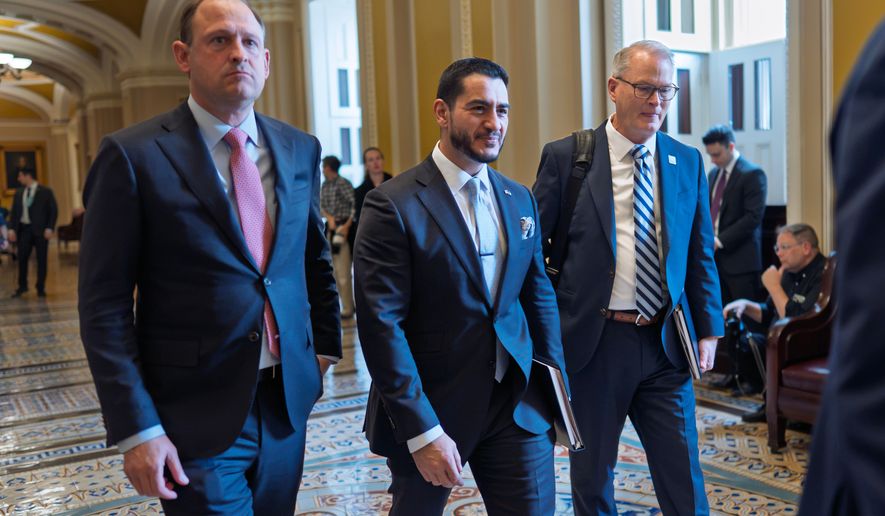
Another Medicare for All champion, Michigan Democratic Sen.-elect Abdul El-Sayed has appealed directly to President Trump, who has agreed to meet with him.
Mr. Trump told The New York Post that Mr. El-Sayed’s suggestion that the policy idea could be rebranded as “TrumpCare” if the president helped enact it was “very smart.”
“I know I’ll be meeting with him,” he said. “Maybe there’s some place in the middle that we could go.”
The interview came after Mr. Trump reposted Mr. El-Sayed’s mockup of a gold “TrumpCare” insurance card with a pitch that read: “Donald, this is on the table. Guarantee healthcare for every American, from cradle to grave.”
Mr. El-Sayed had floated the Trump rebranding idea during The Atlantic’s summit in Washington earlier this month.
“I am happy to put his name on whatever he wants to put his name on if it means that people in my state get the healthcare that they need and deserve,” he said. “The ball is in his court.”
Two-thirds of Americans support Medicare for All, according to a September poll from nonprofit health policy organization KFF.
That includes 84% of Democrats, 72% of independents and 34% of Republicans. The GOP support has increased 13 percentage points since 2020.
The overall level of support increased when respondents were presented with claims that Medicare for All would “guarantee health insurance as a right for all Americans,” eliminate premiums and reduce out-of-pocket healthcare costs for most Americans.
Support decreased in response to claims that it would eliminate private health insurance companies, threaten the current Medicare program, require most Americans to pay more in taxes and lead to delays in people getting some medical tests and treatments.
The White House Council of Economic Advisers estimates that Medicare for All would cost taxpayers $47 trillion over 10 years.
Democratic proponents say the costs of shifting to universal healthcare can be offset by raising taxes on the wealthy and that over time the program will produce savings.
A Yale School of Public Health study found that it would reduce annual health expenditures by $1 trillion and save more than 100,000 lives a year.
The Medicare for All bills in Congress, led by Mr. Sanders and Rep. Pramila Jayapal, Washington Democrat, have support from roughly half of the Democrats in the current Congress. Many of the newly elected Democrats coming in next year also back the policy.
Other Democrats prefer to keep the private insurance marketplace, while supporting a more expansive “public option” than the government’s existing Medicare and Medicaid plans.
Michigan Rep. Kristen McDonald Rivet, a member of the centrist New Democrat Coalition, said regardless of which path Democrats choose, it is clear from the election results that “the country is ready for big change.”
“Some people’s approach to that is Medicare for All. Others are talking about Medicare for All who want it,” she said. “There’s all kinds of ways to solve the solution.”
Mr. El-Sayed, like other Democrats, is willing to accept an expansion of Medicare as a starting point.
Specifically, he suggested his party start with lowering the eligibility age from 65 to 55, cover all children and combine Medicare’s various parts into a single program with no copays, premiums or deductibles.
“This is base camp, and we build from there,” he said at The Atlantic’s summit, comparing the process of enacting universal government-funded healthcare to climbing Mount Everest.
Lowering the Medicare eligibility age to 62 would cost $387.6 billion, according to an analysis from the right-leaning American Action Forum’s Center for Health and Economy.
A group of House Democrats has a bill to lower the eligibility age to 50. The exact landing point will likely be subject to debate within the party.
The call from Mr. Jeffries and others to expand government coverage to all children is more likely to occur through Medicaid, which provides insurance for lower-income families and people with disabilities, than Medicare, which focuses on seniors.
Sen. Andy Kim, New Jersey Democrat, has introduced legislation called the MediKids Act to automatically enroll children at birth in Medicaid’s Early and Periodic Screening, Diagnostic, and Treatment benefit. They would remain eligible until age 26, but could opt out at any time.
Rep. Joe Neguse, a Colorado Democrat who will serve as assistant speaker next Congress, recently introduced a companion version in the House.
“MediKids has momentum,” Mr. Kim said in a statement. “This is the next step towards universal care and one we can deliver with a growing coalition ready to deliver for every child.”
• Seth McLaughlin contributed to this report.
Contact the author


Please read our comment policy before commenting.