



OPINION:
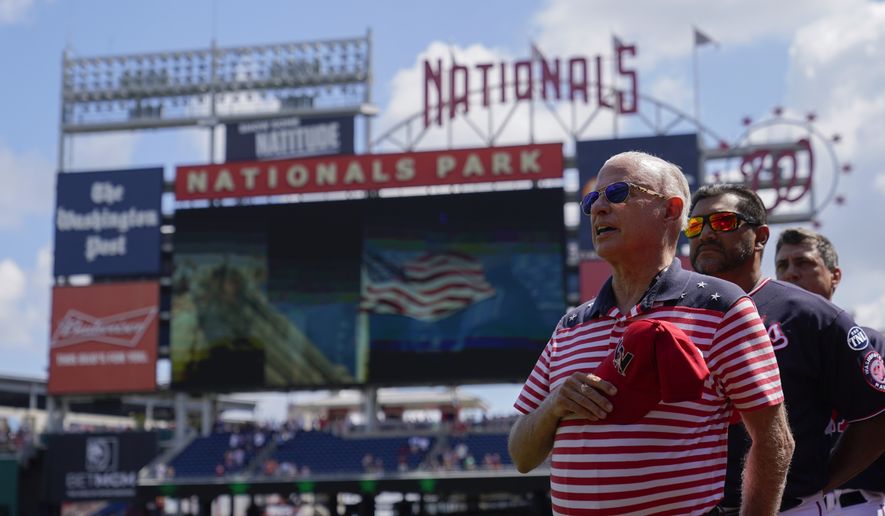
It’s Christmas time at Nationals Park.
“Enchant Christmas” the holiday attraction featuring colorful lights in a maze, exhibits for photo moments and “new experiences” featuring seasonal food, drinks and entertainment, is open at the ballpark.
The Lerner family, owners of the baseball franchise, perhaps hoping to cash in on the holiday spirit, are asking the city for $380 million to renovate the ballpark, which opened in 2008.
People were interested in these podcasts
Jason Sinnarajah, president of the business operation, made the request at the D.C. Council’s Nov. 13 hearing, citing the team’s need for upgraded concessions, concourses and high-priced seating areas.
I’m not sure why they need to upgrade concourses, given the diminishing attendance at Nationals games — 1.83 million and dropping yearly. It’s not like people are bumping into each other on those crowded concourses.
And it’s not like the prestigious Terra Club seats are filled up on a regular basis — or ever. Nationals fans are too familiar with the scene of empty seats behind home plate during game telecasts.
The city paid for those, too, by the way — those renovations were tucked into the $515 million the District approved for the Capitals to stay in the city instead of bolting for Virginia.
That plan ended after Virginia said no.
See how easy it is, D.C. Council members?
You could do the same. Only, in the holiday spirit, perhaps, the city could offer an exchange of presents. Taxpayer money, for example, in return for a payroll spending guarantee from the Lerners.
Extreme measure? Maybe. But city officials should ask the right question — what are we paying for when some concession stands are often closed and seats often empty?
How can you justify investing $400 million in a product that the owners themselves have refused to put financial resources into?
The answer can’t be some statement from a hired hand who has been here for 15 minutes. No, you’ve got to drag the invisible Lerner family into a council hearing and demand answers – and a guaranteed spending promise.
You can’t settle for some generic verbal commitment, either, because you can’t trust the Lerners.
Mark Lerner claimed in an interview at the end of the 2023 season that ownership was committed to giving then-general manager Mike Rizzo whatever he needed.
“We are totally in on building this back to where we all expect it to be, to where our fans expect it to be,” Lerner said in a “Nats Xtra” interview. “It’s (Rizzo) his call how he wants to fill the holes in the lineup. He comes to me when he is ready, whether it’s a player or a free agent or whatever. Whatever he desires, he has the resources and he has always had the resources since the day we took over the team to build a winner.”
Instead, the owners repeatedly refused personnel and other requests from Rizzo.
The Nationals have been a bottom-feeding franchise when it comes to payroll for five years now, including last year’s 77-win season, which exceeded expectations despite a payroll less than $100 million.
Paul Toboni, the president of baseball operations hired after the Lerners fired Rizzo in July 2025, wrote a letter to Nationals fans several weeks ago. There was no assurance — no pledge or promise — to put money on the field for fans who are paying major league prices for tickets and concessions.
“The most visible measure of progress is what happens on the Major League field,” Toboni wrote. “But most of the work that will determine our long-term success is happening out of view: developing players throughout our Minor League system, improving our processes, strengthening our staff, investing in infrastructure, and building better ways to identify, acquire and develop talent. Our ownership group has devoted resources toward helping our players become the best versions of themselves, and it’s something none of us takes for granted.”
The future faces much uncertainty because of the anticipated lockout by baseball owners, expected to begin Dec. 1.
Financial commitments are difficult to make because no one is sure what the salary structure will be in any new labor deal. The owners want a salary cap, and the players’ union wants no part of it. It could be a lengthy work stoppage.
Part of the owners’ stance includes a payroll salary floor – $180 million, a minimum which clubs will have to spend. That would certainly be a drastic improvement in payroll spending for Washington.
But there are no guarantees that will happen, and if history is any guide, the players will never agree to a salary cap.
Uncertainty or not, District leaders could still show some guts by seeking a pledge of payroll spending from the Lerners that would assure the club would be in the top 15 in Major League Baseball, whatever a new salary structure would be.
A tough sell? Yes.
But so should handing over $400 million to Nationals owners for renovations to a ballpark with an inferior product driven by the owners’ stingy ways be as well. There’s nothing enchanted or festive about that.
• You can hear Thom Loverro on “The Kevin Sheehan Show” podcast.
Follow the author


Please read our comment policy before commenting.