


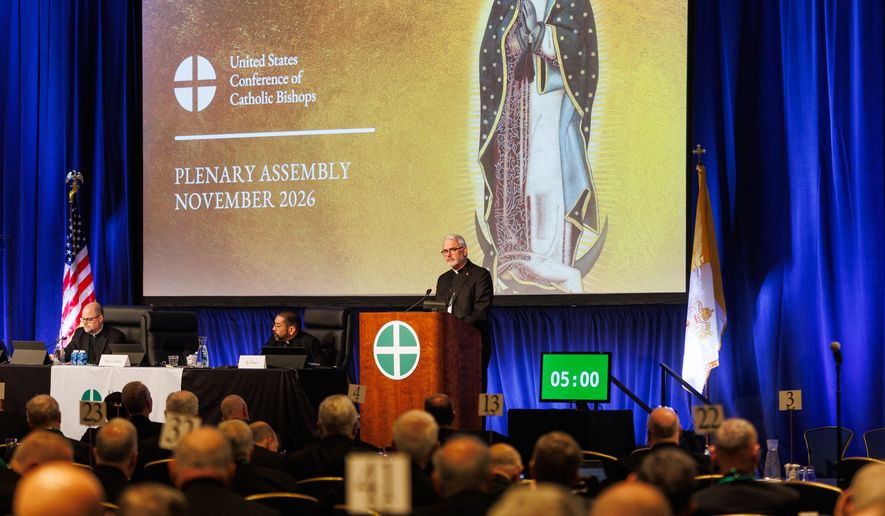


The parents of a Bucks County, Pennsylvania, teenager are one step closer to seeing their daughter become a saint, after the U.S. Conference of Catholic Bishops this month voted to advance her cause for beatification and canonization.
Maria Middleton, 18, died in 2020 of an incurable brain tumor. But even as her health declined, she made a church mission trip to Uganda and kept a journal that has become an inspiration to others.
People were interested in these podcasts
She cast her illness as the purpose of her life, saying that God had a plan for her in her suffering and that she was able to serve as a witness to His love.
Her parents, Brian and Susan Middleton, said that message continues to resonate.
“God is clearly raising her up to be that messenger and that voice for that spiritual battle,” Mr. Middleton said. “Maria didn’t mean optimism — she meant hope in God’s eternal promises, and that is how she lived out her life.”
Schools have taught from Maria’s writings, which her parents published last year as part of a book, “Think Hope: Maria Middleton’s Life of Unyielding Trust in God.”
Her parents told “Seen, Heard & Whispered” that they tried to demonstrate a faithful, Christian life for their children and advised others on how to raise a potential saint.
“You transform the world when you transform yourself,” Mr. Middleton said, noting he and his wife were older when they became parents. “The way you raise holy kids is you, yourself trying to pursue God on a daily basis.”
The formal vote by the bishops allows the Archdiocese of Philadelphia to pursue Maria’s cause for sainthood by gathering evidence and testimonials about her life.
That will be forwarded to the Vatican for review.
Beatification, which usually requires proof of one miracle attributed to a deceased person’s intercession, is permission for veneration. Canonization, which usually requires proof of two miracles, is formal recognition of sainthood.
Middleton could be the first saint from Generation Z. The first millennial, Saint Carlo Acutis, was canonized last year.
The process can take decades, but Maria’s parents said they were hopeful about the progress.
“Things have gone quickly up to this point, so we will see what God has planned,” Mrs. Middleton told “Seen, Heard & Whispered.”
GOP’s youth wipeout
Rich Baris, director of Big Data Poll, saw Republicans’ youth disaster in this year’s elections building, and said the GOP did nothing to stop it.
Conservatives had cheered when more young voters embraced President Trump in the 2024 election, but saw them swing wildly against the GOP this year.
Mr. Baris, co-author of “Burn It Down: What the Polls Say Young Americans Really Want,” said those who thought 2024 was an ideological realignment were mistaken. Young people did not go conservative, but rather were rebelling against the dominant institutions.
For Mr. Trump, running on an anti-war message in 2024, that worked. For a Republican Party running alongside Mr. Trump and his war in Iran in 2026, it was a catastrophe.
Mr. Baris said affordability issues — particularly wages and housing costs — are at the front of younger voters’ minds.
“It was harder for millennials and Gen Z to achieve the American dream,” Mr. Baris said.
He said Republicans have stumbled on that, saying party leaders “do not want to accept it and it’s a problem.”
According to data from NORC Civic Health & Elections Project and AP VoteCast data, 59% of young men supported Democrats this election cycle. That’s a major change from 2024, when 56% supported Mr. Trump.
Mr. Baris said the Make America Great Again movement needs those younger male voters if it is to outlast Mr. Trump’s tenure.
“You have to course correct or it will be potentially irreversible because of the generational shift,” he told “Seen, Heard & Whispered.” “You need a brand overhaul.”
Prepare for a rise in Trump Derangement Syndrome
Psychiatrist Carole Lieberman says she expects the election to produce a surge of Trump Derangement Syndrome, or TDS.
Much like sports team supporters who go overboard in celebration of their team’s win, she said voters who turned out to oppose Mr. Trump in the balloting and unleashed a Democratic wave across the country are likely to kick their TDS up a notch.
“One might think that the midterms where Trump got trounced or his candidates got trounced would diminish TDS because people would feel like they socked it to him or he got what he deserved … but no, it’s the opposite,” she said.
“People are smelling blood after the midterms and they are feeling as though they are validated in all the things they hate about Trump that the midterms prove they were right all along to have TDS,” Dr. Lieberman told “Seen, Heard & Whispered.”
Dr. Lieberman, who raised eyebrows in 2011 by suggesting video games can cause aggressive behavior, says TDS is deeper than simply disliking the president. It’s when people project their own experiences on him, blaming him for what’s happening to them.
She said those who lack purpose in life are particularly susceptible, turning to politics — particularly leftist politics — to provide some meaning.
Dr. Lieberman made her case for TDS as an authentic diagnosis to the American Psychological Association last month.
• Seen, Heard & Whispered is a weekly column taking you inside the conversations happening in Washington’s power corridors, the moves being made and the whispers that explain what’s really going on in the nation’s capital. Email tips to whispered@washingtontimes.com. Click here to receive this in your inbox every Friday morning.
Contact the author


Please read our comment policy before commenting.