



Homeland Security Secretary Markwayne Mullin was explaining what might have caused the Nov. 13 air-traffic stoppage, then he stopped short when a reporter mentioned the potential role of artificial intelligence.
“We call it SI around here, remember – SI,” he told reporters in the White House driveway.
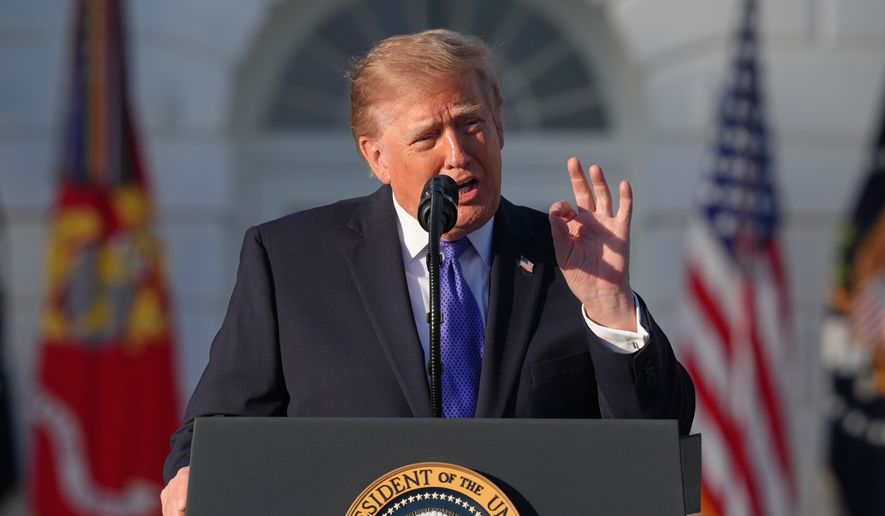
Mr. Trump is pushing hard to rebrand AI as “super intelligence” or SI, saying it is a better fit for the society-changing technology.
People were interested in these podcasts
Getting the name to stick is another matter.
Two months after Mr. Trump directed federal agencies to use SI instead of AI on websites and in correspondence, the administration is adopting the term. It’s a mixed bag outside government.
Some companies jumped at the chance to rebrand.
Salesforce, the customer-management software company, renamed one of its tools days after Mr. Trump’s directive.
“The era of Super Intelligence is here. AIForce is officially SIForce,” Salesforce Chairman and CEO Marc Benioff said on X.
But OpenAI, the maker of ChatGPT, is not renaming itself, and “artificial intelligence” remains the default in company filings, the news media and everyday conversation.
“Every time I see SI or super intelligence, it reminds me of Gretchen Wieners in ‘Mean Girls’ trying to make ‘fetch’ happen,” said Jessica Tillipman, associate dean for Government Procurement Law Studies at The George Washington University Law School. “AI is the global term, and SI already had other meanings before the rebranding.”
Before Mr. Trump’s name change, the term superintelligence referred to hypothetical systems that could surpass human abilities.
Government contractors also use SI to mean “systems integrator.”
Ms. Tillipman does not believe many companies will adopt the term unless they do business with the government.
“It is the same dynamic we saw with the Department of War. If their customer uses the term, contractors use the term. But it is uneven, and I am finding this to be a much more awkward transition,” she said. “I see no benefits to this rebranding for the government, contractors, or taxpayers. There are only downsides: confusion and cost to the taxpayer to change documents, websites, etcetera.”
Mr. Trump’s rebranding is part of a deeper effort to promote AI as a make-or-break opportunity for the U.S. economy.
He urged U.S. cities and towns to embrace data centers that power the technology, even as Democrats leverage doubts about the noisy, energy-consuming centers for political gain.
“The United States is the world leader in super intelligence, and the federal government should use a name that reflects the full promise and opportunities of this technology,” assistant White House press secretary Liz Huston said. “The name super intelligence reinforces the administration’s focus on advancing American innovation, strengthening our economy, and harnessing these cutting-edge technologies to improve the lives of the American people.”
While Mr. Trump’s directive cannot reach private companies, Mr. Trump said he expects people to adopt his preferred term.
“The White House considers anyone who uses the term, ’Artificial Intelligence,’ as opposed to the highly accepted new and more accurate term, ’Super Intelligence,’ THE ENEMY!” Mr. Trump said on Truth Social.
Government entities and officials have fallen in line, as expected, making them the strongest adopters.
The State Department, for instance, says it is “harnessing the potential of Super Intelligence (SI) to advance diplomacy in the 21st century.”
Mr. Trump’s business allies are also on board. Elon Musk said he would rebrand SpaceX AI operations as SpaceXSI.
Mr. Musk, who worked to cut federal spending and payrolls early in Mr. Trump’s second term, even corrected himself during a White House meeting.
“It is worth highlighting the positive benefits of AI – pardon me, SI,” Mr. Musk said at the gathering of tech leaders.
“Thank you,” Mr. Trump said.
Others are taking a mixed approach.
“Microsoft uses a range of terms for this technology, including super intelligence,” the tech giant told The Washington Times. “We’re focused on ensuring this technology empowers people, preserves human agency and control, and helps our customers achieve their goals.”
Nvidia has used the terms AI or SI depending on the context. A closely watched earnings report this month repeatedly used AI to describe products, factories and collaborations. But a separate page about federal government services used SI.
“With secure, scalable SI and accelerated computing, NVIDIA enables government agencies and partners to address national challenges, improve public services, and build safer, more connected communities,” its webpage says.
A spokesman for General Dynamics, an aerospace and defense corporation with federal contracts, said the company uses “both terms interchangeably.”
Companies might want to be nimble with their language when doing business with the government.
“Because the EO says the Executive Branch will not acknowledge the old terms, companies should carefully assess the language they use in proposals, filings, and responses to agency requests,” the Arnold & Porter law firm said in a website item on Mr. Trump’s order. “When citing existing statutes, regulations, contracts, or grants, companies may still want to use the terms reflected in those documents.”
Mr. Trump says AI could be a bigger development than the Industrial Revolution or the internet, and that whichever country wins the race to develop the technology will be a dominant power.
Despite the competition, Mr. Trump said his top rival, Chinese President Xi Jinping, likes his rebrand to SI.
“He likes that name too, by the way. He likes it better,” Mr. Trump said of Mr. Xi. “It’s not artificial. It’s super. Problem is, it may be too super.”
Contact the author


Please read our comment policy before commenting.