


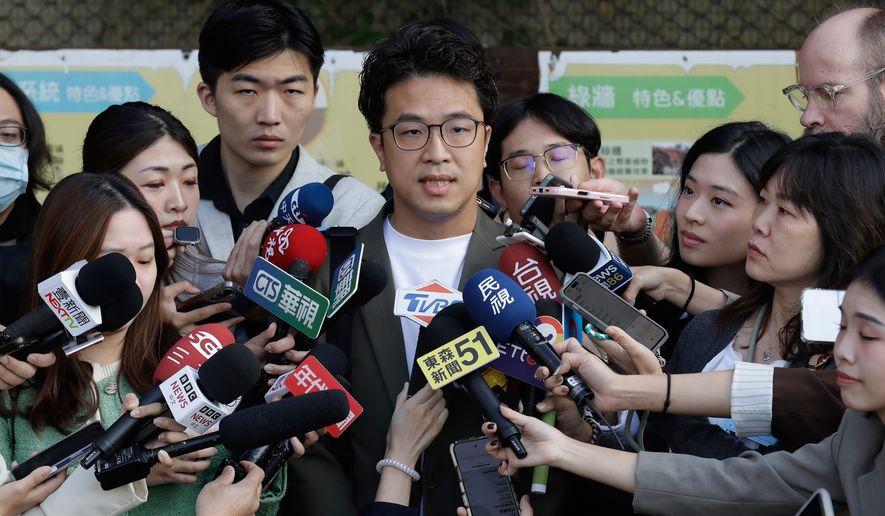

SEOUL, South Korea – Taiwan’s ruling party, which takes a firm anti-China stance, saw a key figure lose the mayoral race for the island’s capital Saturday, but otherwise improved its position in city and county elections.
Speaking at an election-night rally in Taipei, Democratic Progressive Party Mayoral Candidate Shen Pao-yang – better known as “Puma” Shen, and noted for his anti-Beijing activities — said he had called incumbent Mayor Chiang Wan-an of the main opposition Kuomintang Party to concede.
According to a then-incomplete vote count by the Central Election Commission, Mr. Shen had been trailing Mr. Chiang by 8 percentage points.
People were interested in these podcasts
While media-darling Mr. Shen, some of whose supporters wept during his concession, failed to capture Taipei, the DPP made advances elsewhere across Taiwan.
The democratically governed island plays a central role in both geoeconomics — it is a central node in the global supply chain for advanced semiconductors and geopolitics — it is claimed by Communist-ruled China, which has not ruled out taking it by force.
At the time of writing late Saturday evening, the DPP had won nine seats, the KMT 10, and an independent one.
Counts are incomplete in two municipalities. According to FocusTaiwan, a broadcaster and website, recounts may be required.
President Lai Ching-te and his DPP promote a Taiwanese national identity and take a harder line against China than the KMT. Led by Cheng Li-wun, who met Chinese President Xi Jinping in Beijing in April, the KMT takes a softer, more pro-engagement posture.
The island’s politics are currently a mish-mash of power and counterpower, checks and balances.
Even if the KMT takes the win, overall, Saturday’s results are a far better showing for the DPP than was the case in the last local elections.
In 2022, the DPP won only five seats in total, while the KMT took 14, and independents three.
The DPP, which has won the last three national plebiscites consecutively, retains the presidency and the executive until the next general election in 2028.
However, Mr. Lai is constrained in the Legislative Yuan, where the KMT occupies the largest bloc of seats.
Mr. Shen, who was granted a proportional representation seat by the DPP, was an election neophyte when he entered the race for Taipei.
Odds were stacked against him. The capital is considered a KMT fortress, and some believe the DPP used Mr. Shen as a “sacrificial lamb” in the uphill battle.
However, his innovative campaign, buoyed by his own upbeat persona, generated major noise island-wide, leading many to believe he had a real chance.
Prior to entering politics, Mr. Shen was an academic, but was better known for founding two nonprofit organizations.
Kuma Academy teaches Taiwanese civilians how to survive a physical disaster — such as an invasion.
Doublethink Lab focuses on informing the public on cognitive warfare — a key Chinese gray-zone tactic.
Beijing officials, who have called Mr. Lai a “dangerous separatist” and a “war instigator,” have dubbed Mr. Shen a “traitor.”
China has blacklisted him, and Mainland police are investigating him on charges of secession, despite him being a Taiwanese citizen.
Overall, the election campaign had taken place in the shadow of Chinese might.
“Regardless of which party or candidate wins … the real victor in these local elections is Taiwan’s democratic growth an institutional resilience,” opined Taiwan News in an editorial. “Despite extensive malign Chinese influence operations and intimidation from Beijing, the ability to hold fiercely contested, highly transparent local elections is powerful proof of democratic maturity.”
According to newswires in Taiwan, the Ministry of National Defense reported about 33 sorties by Chinese warplanes toward the island between Friday and Saturday.
With 2026 drawing to an end, this year’s local elections had added security spice.
2027 is the year U.S. military and intelligence officials claim China’s armed forces have been ordered to be fully invasion-capable.
Ever since then-House Speaker Nancy Pelosi infuriated Beijing by visiting Taipei in 2022, Chinese forces have been probing ever closer to the island, more frequently, and with more forces, often crossing the median line in the Taiwan Strait.
Meanwhile, a $14 billion American arms package for Taiwan, approved by Congress in January, has been put on hold by President Trump, who, in May, called it “a bargaining chip” in negotiations with China.
That language alarmed many in Taipei and Washington.
Mr. Trump has held two high-profile summits with Mr. Xi this year: a state visit to Beijing in May and the Asia Pacific Economic Cooperation Summit in Shenzhen in November.
He is expected to meet him yet again in Miami at December’s G20 Leaders Summit.
After that last meeting is over, there are hopes that Mr. Trump will finally greenlight the U.S. arms shipments.
Contact the author


Please read our comment policy before commenting.