


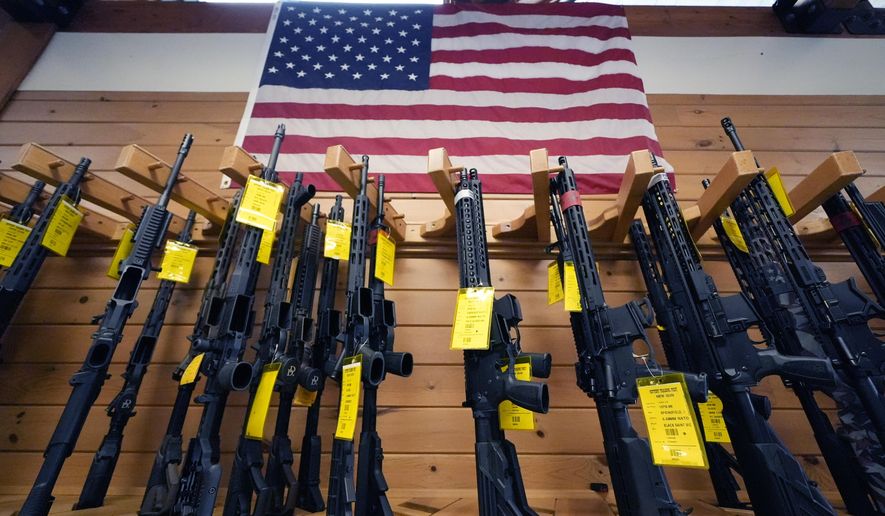

The AR-15 has become the most iconic gun sold in America today. It’s considered easy to use, it’s customizable and to many, it just looks and feels like what they think a semiautomatic weapon should be.
Which has also made it the No. 1 target for gun control activists, who call it the “weapon of choice for mass shooters” and who have worked feverishly get it banned.
The Supreme Court this week will take up a pair of cases testing whether those bans are constitutional, looking at laws in Connecticut and Cook County, in Illinois.
People were interested in these podcasts
The issue for the justices will be whether possession of AR-15s and similar semiautomatic rifles is consistent with the nation’s tradition of firearms ownership — the standard the Supreme Court laid out in 2022.
To gun ban advocates, the answer is a resounding no.
Cook County told the justices in its briefs that AR-15s are “offensive weapons of war,” putting them beyond the Second Amendment’s protections for guns used in self-defense, and “unusually dangerous,” putting them in the realm of other weapons such as Bowie knives, which were regulated in the 1800s.
“The Constitution does not prevent states and localities from enacting laws they deem necessary to protect special risks to human life,” Cook County said.
Second Amendment advocates, including the current Justice Department, countered that the lethality gun control advocates decry is the very reason why someone would buy an AR-15 for self-defense.
And the gun’s sheer prevalence means they aren’t the kinds of “unusual arms” such as Bowie knives and sword canes that drew bans in the founding era and up through the 19th century.
“In short, AR-15 rifles are in common use among law-abiding citizens for lawful purposes. The challenged bans are therefore invalid,” U.S. Solicitor General D. John Sauer told the court in his own brief.
The case marks the biggest gun issue to come to the court since the Bruen decision in 2022, where the justices cut through years of conflicting decisions, invalidated strict concealed-carry laws in the states and laid out the history and traditions test for constitutionality.
In the years since, the court has grappled with laws restricting who may obtain a gun and where they can be carried. But the AR-15 cases are the first ones to grapple with which weapons can be blocked.
Several of the court’s members have already expressed skepticism of broad bans like the ones in Connecticut and Cook County.
Justices Clarence Thomas, Samuel A. Alito Jr. and Neil M. Gorsuch all last year tried in vain to get the court to hear an earlier case on a Maryland law banning AR-15 ownership. And Justice Brett M. Kavanaugh, though he didn’t vote to hear the Maryland case, said the day would soon come.
Now it has.
The court in its landmark 2008 opinion in the Heller case ruled that handguns are protected by the Second Amendment’s right to bear arms, given their prevalence and use in self-defense.
Justice Kavanaugh, while declining to hear the Maryland case, said he didn’t see much difference constitutionally between handguns and AR-15s.
“Law-abiding citizens use both AR–15s and handguns for a variety of lawful purposes, including self-defense in the home,” he said.
If anything, he said, handguns might be a tougher call when it comes to the Second Amendment.
“For their part, criminals use both AR–15s and handguns, as well as a variety of other lawful weapons and products, in unlawful ways that threaten public safety. But handguns can be more easily carried and concealed than rifles, and handguns — not rifles — are used in the vast majority of murders and other violent crimes that individuals commit with guns in America,” he wrote.
Gun control groups, while acknowledging handguns’ prevalence, say AR-15s are more lethal, and therefore further outside the Constitution’s ambit.
Everytown for Gun Safety, a New York-based nonprofit, calls the AR-15-style gun ‘the weapon of choice for mass shooters,” pointing to its use in some of the most horrific mass shootings in recent years.
That included the shooter at the elementary school in Uvalde, Texas, in 2022; the 2018 massacre at Marjorie Stoneman Douglas High School in Parkland, Florida; and the 2018 attack on the Tree of Life Synagogue in Pittsburgh.
It also included the shooter at Sandy Hook Elementary in Newtown, Connecticut, which has one of the laws being challenged before the justices on Wednesday. In less than five minutes, using an AR-15 and 154 rounds, the shooter killed 20 first graders and 20 school staff.
Then there was the man who perched in a casino hotel room and rained fire down on a music festival in Las Vegas in 2017, slaying 58 and injuring hundreds more. The final police report found 18 rifles and one handgun at the scene, including 13 AR-15s.
Most had 100-round magazines and all had bump stocks, which are accessories that can speed the rate of fire to mimic a machine gun.
Gun control advocates point to those sorts of add-ons as a reason to ban AR-15s, saying they are too attractive — and too useful — for those who want to deal in mass death.
Second Amendment advocates counter that the overall death toll from AR-15s is actually pretty small, compared to the universe of guns.
John R. Lott Jr., head of the Crime Prevention Research Center, studied mass shootings from 1998 through 2025 and concluded that in a majority of them, only a handgun was used.
He projected that there are 10 AR-15s or AK-47s, another popular rifle platform, in circulation for every 100 people — about a 10-fold increase over the last two decades.
By contrast, rifles account for less than 4% of murders committed with guns during that time, and the rate has remained relatively steady. It stood at 3.7% of gun murders in 2025.
Mr. Lott’s data shows that it is lower than the period from 1994 to 2004, when a federal “assault weapons ban” was in place.
Contact the author


Please read our comment policy before commenting.