


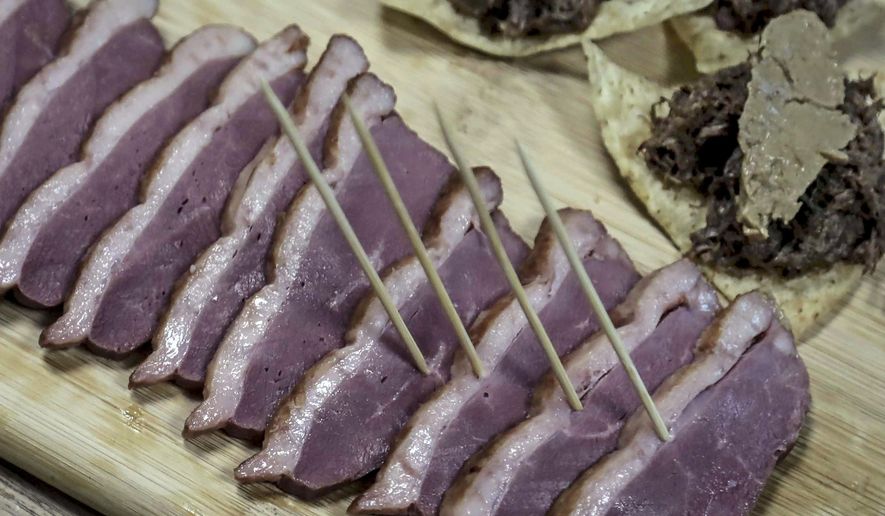

District residents strongly supported a ban on foie gras during Tuesday’s election, meaning the days are numbered for the duck and goose liver delicacy on D.C. menus — that is, as long as the city can enforce it.
Roughly 73% of voters backed Initiative 86, which calls for banning the sale of fattened bird liver products that come from force-feeding the avian animals.
The initiative’s passage was a banner day for Pro-Animal DC, the activist group that got the measure on the ballot.
People were interested in these podcasts
“We just won a major battle in the fight against force-feeding, and the foie gras industry is freaking out,” the group said on social media late Tuesday. “Ducks and geese will no longer be force-fed to supply this gross form of animal torture to Washington DC. We just won in the nation’s capital. This is a huge deal.”
The advocates said the District is the third-largest consumer of foie gras nationwide, striking a major blow to the luxury food item that comes from French cuisine.
Voters in Denver also approved a ban on foie gras Tuesday, joining California and New York, as well as Pittsburgh and Portland, Oregon.
The measure says restaurants that violate the ban will be fined anywhere from $1,000 to $5,000, and eateries that repeatedly violate the restriction could have their business license suspended or revoked.
The District’s Department of Energy and Environment is tasked with leading the crackdown when the ban kicks in July 1.
The city’s culinary industry has already rallied to oppose the new initiative.
The Restaurant Association of Metropolitan Washington said in a statement that it’s “concerned about the foie gras ban and the precedent it sets for government dictating what restaurants can serve and diners can choose.”
The organization said these are not simple yes-or-no questions to be listed on a ballot and should instead be hashed out in public hearings held by the D.C. Council.
Burt Hutchins, head chef of Butterworth’s in the heart of Capitol Hill and a vocal critic of the city’s anti-foie gras movement, said Tuesday’s vote was “largely symbolic.”
He said the city still has to foot the more than $300,000 bill to make the initiative enforceable, and he said there are bigger budget needs on lawmakers’ minds than creating the “foie gras police.”
Mr. Hutchins also said the activists misunderstand the basic biology of ducks, which has powered their arguments calling the practice animal cruelty.
He said ducks overfeed every winter in the same manner they are force-fed to make foie gras, and their esophaguses have few nerve endings that make the process more natural for them. Mr. Hutchins said he believes the I-86 advocates have more ambitious motives than merely banning the luxury food item.
“The campaign is being funded by out-of-state vegans who very explicitly have said, on multiple occasions, that this was just low-hanging fruit, so it was like their best chance to get a win of any kind on the path to banning meat altogether,” he said.
The chef was serving a multi-course foie gras meal prior to Tuesday’s vote in order to raise money for the coming legal fight. Ongoing litigation has prevented New York from enforcing its own foie gras ban that was passed in 2019.
When asked if he will continue serving foie gras after the measure takes effect next summer, Mr. Hutchins responded that he will be serving the dish “forever.”

Please read our comment policy before commenting.