


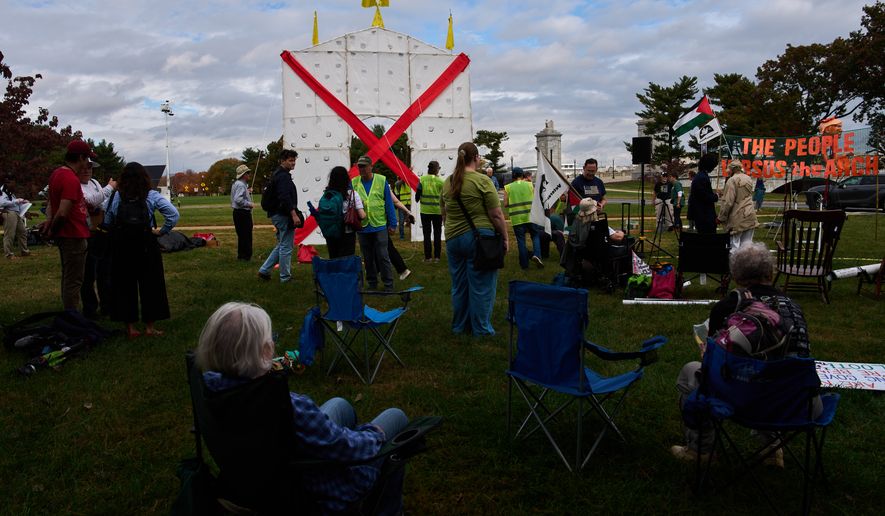

The National Capital Planning Commission gave its final approval late Thursday to President Trump’s vision of a triumphal arch at the foot of Memorial Bridge, and Interior Secretary Doug Burgum released a document defending the size and location, as the project cleared its bureaucratic hurdles.
Mr. Burgum said the arch will serve as a symbolic gateway between Arlington National Cemetery on one side and the monumental core of Washington on the other.
“Situated within the historic ceremonial corridor linking the Lincoln Memorial, Arlington Memorial Bridge, and Arlington National Cemetery, the arch is intended to provide visitors with an additional perspective from which to appreciate the nation’s history, its monumental landscape, and the ideals that continue to guide its future,” the secretary wrote.
People were interested in these podcasts
Opponents of Mr. Trump’s plan will now look to the courts to try to stop him. Lawsuits have already been filed by Virginia and the District of Columbia governments, and by angry citizens.
The local governments sought a restraining order earlier this week.
U.S. District Judge Tanya Chutkan, an Obama pick who’s been a frequent legal roadblock for Mr. Trump, is overseeing the cases.
The Justice Department notified Judge Chutkan on Thursday of both the planning commission and Mr. Burgum’s actions, fulfilling a demand the judge had made that she be notified within one hour of the final decisions.
She also demanded notice within 30 minutes of any preparation or construction work at Memorial Circle, where the arch is to be built.
Mr. Trump envisions a 250-foot-high structure on the circle, which is part of the National Park Service’s George Washington Memorial Parkway.
Mr. Burgum defended the height, saying Thursday that a smaller arch would actually do more to impair the views of the cemetery on one side and the Lincoln Memorial, at the end of Memorial Bridge, on the other side.
“The big arch will have a large enough central opening to “retain views through the structure,” the secretary said.
He also said the location in Memorial Circle is crucial to the design, saying the point of the arch is to showcase the important role of the nation’s military in “achieving and sustaining the freedoms and liberty we enjoy today.”
The arch is one of a number of projects Mr. Trump is overseeing on public lands as he tries to leave his physical mark on the capital city.
Earlier this week, he showcased work on his ballroom project at the White House, and he has vowed to plow ahead with a redesign of the golf course at East Potomac Park on the National Mall.
Both of those other projects have sparked major legal confrontations.
The Supreme Court has allowed construction of the ballroom while lower courts ponder the legal issues involved in that project.
The golf course is not yet at that stage of litigation.
Mr. Burgum, in his decision Thursday, said he’d considered objections such as worries that the arch could detract from the solemnity of the cemetery.
He said they evaluated views from a number of locations within the cemetery and found that while the arch may be visible from some locations, it couldn’t be seen from the hallowed ground of the Tomb of the Unknown Soldier.
Mr. Burgum also said they plan to use noise-reduction techniques to prevent the construction from disturbing operations at the cemetery.
“The department anticipates that the undertaking will maintain Arlington National Cemetery’s ability to convey its status and significance as a solemn resting place for those who have served our nation,” Mr. Burgum said.
Contact the author

Please read our comment policy before commenting.