


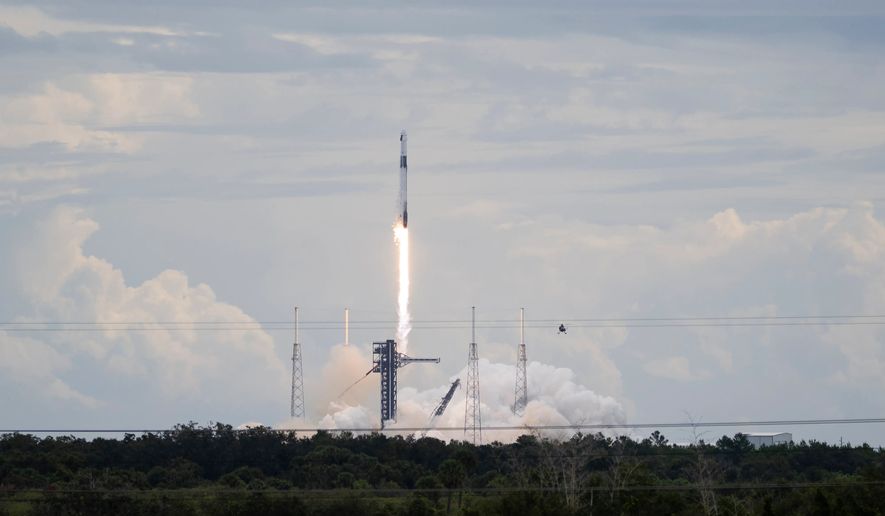

Four crew members aboard NASA’s SpaceX Crew-13 mission launched at 11:10 A.M. EDT Thursday, Oct. 1, from Space Launch Complex 40 at Cape Canaveral Space Force Station in Florida, beginning a science expedition to the International Space Station, NASA announced.
A SpaceX Falcon 9 rocket sent a Dragon spacecraft into orbit carrying NASA astronauts Jessica Watkins and Luke Delaney, Canadian Space Agency astronaut Joshua Kutryk and Roscosmos cosmonaut Sergey Teteryatnikov, according to the agency.
The spacecraft is scheduled to dock autonomously with the forward port of the station’s Harmony module at about 7 P.M. EDT, NASA said. The agency said that would be the fastest launch-to-docking by a U.S. spacecraft in the station’s history.
People were interested in these podcasts
“Crew-13 is another demonstration of America’s unmatched capability in human spaceflight and the strength of our commercial partnerships,” NASA Administrator Jared Isaacman said in a statement. He said the crew will carry forward important work aboard the station while helping build the experience and capabilities needed for ambitious missions to the Moon and beyond.
Dr. Lori Glaze, associate administrator of NASA’s Human Spaceflight Mission Directorate, said the steady cadence of commercial crew launches demonstrates the station’s essential role in sustaining a presence in Earth’s orbit and sharpening tools for the Moon and Mars. “Each space station mission adds to our blueprint for exploration,” she said.
During the roughly 7-hour, 50-minute flight, SpaceX will monitor automatic spacecraft maneuvers from its mission control center in Hawthorne, California, while NASA monitors station operations from Johnson Space Center in Houston, the agency said. NASA’s live arrival coverage begins at 5:20 P.M. EDT. After docking, the crew will change out of their spacesuits and prepare cargo for offload before opening the hatch around 8:45 P.M. EDT.
The newcomers will join the Expedition 75 crew, which includes NASA astronaut Anil Menon and Roscosmos cosmonauts Pyotr Dubrov and Anna Kikina. After a brief handover, the Crew-12 mission will return to Earth, NASA said. That crew consists of NASA astronauts Jessica Meir and Jack Hathaway, European Space Agency astronaut Sophie Adenot and Roscosmos cosmonaut Andrey Fedyaev.
According to NASA, the Crew-13 members will use microgravity to produce human stem cell-derived tissues for improved personalized medicine, disease modeling and pharmaceutical testing for conditions such as heart disease and Parkinson’s. They also will explore crop production with a new, mostly autonomous plant growth system and test how plants grow outside dedicated facilities. The crew will continue human-health studies examining factors linked to blood-flow abnormalities in microgravity and test a new inflight diagnostic device to monitor astronaut health.
Crew-13 is part of NASA’s Low Earth Orbit Program, which partners with private companies to provide reliable access to space, support research and development aboard the station and enable future missions beyond low Earth orbit, the agency said.
This article was constructed with the assistance of artificial intelligence and published by a member of The Washington Times' AI News Desk team. The contents of this report are based solely on The Washington Times' original reporting, wire services, and/or other sources cited within the report. For more information, please read our AI policy or contact Steve Fink, Director of Artificial Intelligence, at sfink@washingtontimes.com
The Washington Times AI Ethics Newsroom Committee can be reached at aispotlight@washingtontimes.com.

Please read our comment policy before commenting.