


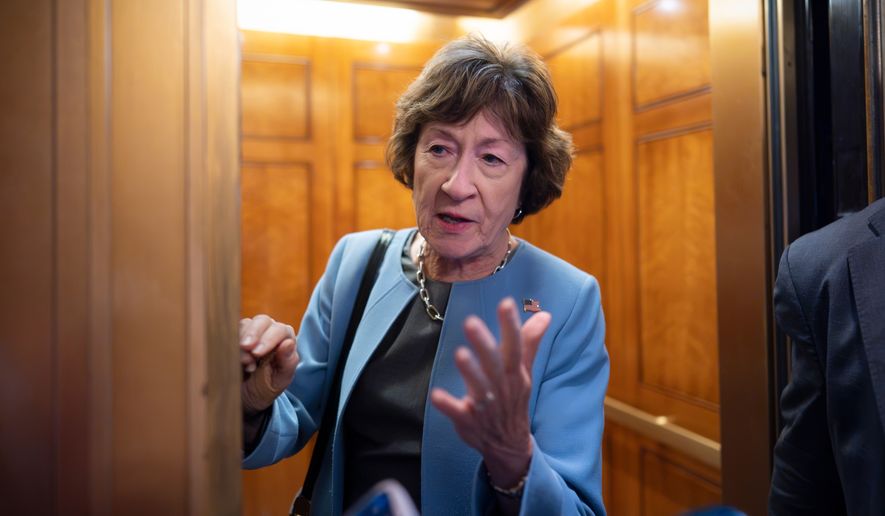

AUBURN, Maine — Sen. Susan Collins is in the toughest reelection battle of her career despite steering massive sums of federal funding to Maine communities and businesses.
The five-term Republican holds the gavel on the Appropriations Committee, arguably the most powerful panel in Congress because it controls the government’s purse strings.
But her success in bringing money home to Maine is falling flat with voters struggling to pay the rent or buy groceries. It’s putting her quest for a sixth Senate term in serious jeopardy.
People were interested in these podcasts
“If she was doing any good, we’d be better off living than we are now,” said Joshua Ruest, 35, a pipe fitter and father of two who lives in Auburn.
Ms. Collins, 73, has historically over-performed when the outlook was dire. Every public poll showed her losing in 2020, but Ms. Collins beat Democrat Sara Gideon by 9 points, exceeding President Trump’s support in all of the state’s 16 counties.
Auburn’s residents are a mix of those disenchanted with Ms. Collins and others who appreciate the money and federal contracts she steered to the state.
“Her track record shows it,” said Tony, a Collins supporter who lives outside of Auburn and did not want to be fully identified. Tony works for a heating and air conditioning company that stays in business by servicing the homes of the employees at Bath Iron Works.
The shipyard is one of the state’s largest employers and has survived in no small part thanks to Ms. Collins, who steered to it roughly $10 million in Navy business, most recently its newest Arleigh Burke-class destroyer.
“She’s worked to save those defense contracts,” Tony said.
Ms. Collins, 73, should arguably be in a strong position because she can tally how her seniority and powerful perch in the Senate pays off for voters.
Her campaign boasts that Ms. Collins brought home $1.5 billion in federal funding to the state for 672 projects over the past five years alone.
But seniority and federal funding are a harder sell this year.
Inflation, gasoline prices, deeply unpopular wars in the Middle East and increasing frustration with the Trump administration have left voters disenchanted with the status quo and with Ms. Collins, who has served in the Senate since 1997.
She is now at risk of becoming the first Senate appropriations chair to lose reelection since Democratic Sen. Warren Magnuson in 1980.
Her opponent, Democrat Troy Jackson, 58, is running about even with her in the polls, boosted by a campaign centered on affordability and a message that the GOP has left the working class behind.
Ms. Collins hasn’t lowered costs, despite holding the appropriations gavel, Mr. Jackson said during a campaign swing through the state with Sen. Bernard Sanders.
“People are working harder than ever just to keep their heads above water,” Mr. Jackson, an ex-logger and state representative, told a crowd in Lewiston on Sunday. “I understand what they are going through.”
In September 2025, Ms. Collins stood with local leaders outside the community center in Auburn to celebrate the facility’s grand reopening. The center was rebuilt and expanded with $3 million in federal funding secured by Ms. Collins.
A little more than a year later, some of Auburn’s residents aren’t giving her much credit for helping to pay for the new center, which is five times the size of the original building and includes a new gymnasium, athletic field, playground and community garden.
“Nothing is being done for the cost of living. It’s really getting bad,” said Aravy Murphy, a mother of three who lives a block away from the center.
Some voters also shrug off the $2.5 million in federal funding Ms. Collins secured for the Auburn Public Safety building and aging Auburn Central Fire Station renovations.
And they don’t seem to care about the $5 million in federal funding for safety improvements on State Road 4, a major highway that runs through the city.
It’s all about the cost of living.
“Fire stations and roads don’t pay my bills,” Mr. Ruest, the pipe fitter, said.
During a recent debate, Ms. Collins blamed “failed policies” crafted during Mr. Jackson’s decades in the state legislature, where he served as Senate president from 2018 until 2024.
Ms. Collins said she is working to lower energy costs and prescription drug prices. She helped pass legislation that capped insulin at $35 a month for Medicare recipients and shepherded other policies to lower costs.
“Senator Collins is delivering practical help through heating assistance, investments in rural healthcare, and federal funding that reduces the burden on local taxpayers. Those investments help communities pay for essential services without asking property taxpayers to shoulder the cost,” a campaign spokesperson said Monday.
Mr. Jackson blamed Ms. Collins for not being willing to stand up to Donald Trump and his signature tax cut bill, which tightened eligibility for food stamps and Medicaid. Mr. Trump’s decision to go to war in Iran and impose steep tariffs also caused high prices, he said.
Mr. Jackson is leading among the state’s younger voters. Polls show Ms. Collins ahead of Mr. Jackson among Maine’s older voters, who make up 59% of the state’s electorate and are more likely to turn out on Election Day.
Tammy West, an Auburn resident who turns 60 next month, said she will cast her vote for Ms. Collins because she trusts her more than Mr. Jackson.
“She’s always done good for the state of Maine,” Ms. West said. “Always.”
Contact the author


Please read our comment policy before commenting.